
Introduction
The vast majority of maktabs in the world have no dedicated administrator. There is no person whose job description includes “manage the maktab.” Instead, there is the imam who teaches and also collects fees and also manages parent communication and also registers students for exams and also handles complaints — all in the hours around five daily prayers, Jumu’ah preparation, and their own family responsibilities.
Or there is a volunteer — a community member who gives up two evenings a week to handle the administrative work that keeps the institution running. They do this out of deep commitment, and they do it well, until they move away or change jobs or have a baby or simply run out of capacity.
This guide is for both of them. It shows how to design a maktab’s administrative processes so that they require the minimum possible human intervention — through automation, self-service, and intelligent system design — so that an imam with too much on their plate, or a volunteer with limited hours, can keep an institution running smoothly.
The Admin Burden Problem in Maktabs
The administrative burden in a manually-managed maktab of 80 students falls out at approximately 11–12 hours per week — as documented in The Real Cost of Managing Your Maktab on Paper in 2026. For a paid administrator, this is a meaningful job. For an imam already working 60+ hours per week, or a volunteer giving up two evenings, it is unsustainable.
The consequences of admin overload in maktabs are predictable and consistent across institutions:
- Fee collection becomes inconsistent — the imam does not have time to chase individually, so arrears accumulate
- Attendance recording becomes patchy — sessions get missed when there is no time to update the register
- Parent communication becomes reactive — no regular updates go out proactively; the imam only contacts parents when there is a problem
- Hifz tracking falls behind — the paper register gets updated weekly instead of daily, and accuracy suffers
- Exam registration becomes a crisis — suddenly it is two weeks before the deadline and three months of attendance records need to be reconstructed
The solution is not to find more volunteer hours — community capacity is limited. The solution is to reduce the administrative burden itself through intelligent system design. Done well, the same 80-student maktab can be managed in 2–3 hours per week instead of 11–12.
The Four Administrative Pillars to Systematise
Maktab administration breaks down into four core pillars, each of which can be systematised to dramatically reduce the human time required:
| Pillar | Current Time (Manual) | Systematised Time | Weekly Saving |
| Enrolment and student records | 2 hrs/week average | 15 min/week | 1 hr 45 min |
| Attendance recording and follow-up | 3 hrs/week | 30 min/week | 2 hrs 30 min |
| Fee collection and reminders | 2.5 hrs/week | 20 min/week | 2 hrs 10 min |
| Parent communication | 2 hrs/week | 30 min/week | 1 hr 30 min |
| Total | 9.5 hrs/week | 1 hr 35 min/week | ~8 hrs/week |
Source: Ilmify maktab administrator time research, 2026
Eight hours per week returned to the imam or volunteer. That is the equivalent of finding a full-time administrator for eight hours a week at no cost — through systematisation alone.
Pillar 1 — Enrolment: Make It Self-Service
The problem: Every new student requires the administrator to collect information from the family, record it, and set up the student’s profile. For a maktab that enrols 20 new students in September, this is 3–5 hours of data entry plus the time managing incomplete forms and follow-up calls for missing information.
The systematised solution: Online enrolment forms
A digital enrolment form — linked from the maktab’s WhatsApp message or shared with new families — allows parents to submit all required information themselves: student name and date of birth, guardian contacts, medical notes, fee category preference. The data goes directly into the management system without any data entry by the administrator.
What the administrator still needs to do: Review each completed enrolment (5 minutes per student), approve and activate the student profile, and send the welcome communication. For 20 new students, this is approximately 2 hours — down from 3–5 hours.
Additional self-service elements:
- Address update requests: A simple form linked from the parent portal allows guardians to submit address and contact changes directly, without needing to reach the imam or administrator personally
- Medical update notifications: Parents can be given a process to notify the institution of medical changes through the parent portal
- Re-enrolment: Returning students at the start of a new academic year can confirm re-enrolment through the portal rather than requiring individual outreach
One setup — ongoing benefit: The enrolment form is configured once and used year after year. The initial 1–2 hours of setup saves 2–4 hours annually for every intake cycle.
Pillar 2 — Attendance: Reduce to Two Minutes Per Session
The problem: Attendance recording in a paper-based maktab takes 15–25 minutes per session — marking the register, noting absences, following up with families of absent students via WhatsApp, and then reconciling the register for any exam eligibility purposes.
The systematised solution: Mobile attendance marking with automated follow-up
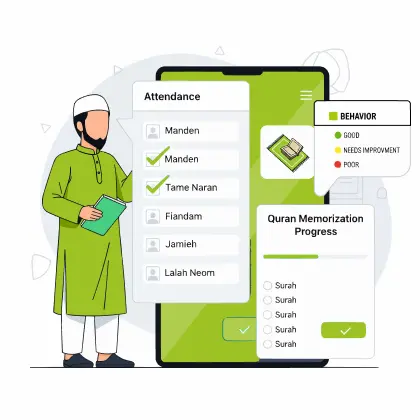
With a management system on the teacher’s phone, marking attendance for a class of 25 students takes approximately 90 seconds — a single tap per student (present/absent). The system automatically sends an absence notification to the absent student’s guardian, records the attendance against the student’s profile, and updates the running attendance percentage.
What the administrator needs to do: Nothing for routine absences — the automated notification handles parent communication. Only follow up for students who have been absent for three or more consecutive sessions (flagged automatically by the system).
The attendance follow-up rule: Automate routine absence notifications. Personally follow up only on extended absences (3+ sessions). This reduces attendance-related communication from a daily task (messaging absent parents individually) to a weekly task (reviewing extended absence flags).
Exam eligibility: Because attendance is recorded digitally from the first session, the end-of-year exam eligibility calculation is automatic. No manual calculation, no reconstruction from partial records.
| Attendance Task | Manual Time | Digital Time |
| Marking attendance (25 students) | 8 min/session | 90 sec/session |
| Sending absence notifications | 5 min per absence | Automatic |
| Weekly attendance review | 30 min | 5 min (review flags only) |
| Exam eligibility calculation | 3 hrs/exam cycle | Automatic |
| Monthly attendance report | 45 min | 5 min (auto-generated) |
Pillar 3 — Fee Collection: Automate Everything Possible
The problem: Fee collection in a manually-managed maktab consumes 2–3 hours per week — generating invoices, chasing non-payers, recording cash receipts, reconciling accounts. Much of this is reactive time: responding to “did you receive our payment?” messages and chasing families who are weeks behind.
The systematised solution: Automated invoicing, reminders, and online payment
The fee management automation sequence that eliminates most administrative time:
- Automated monthly invoicing: The system generates and sends invoices on a fixed date each month — no manual generation required.
- Automated reminder sequence: Reminders at day -5, day 0, day +5, and day +12 go out automatically based on payment status. No manual chasing for the majority of families.
- Online payment recording: UPI payments received in the institution’s bank account are recorded in the system by the designated payment recorder (5 minutes per day) rather than requiring cross-referencing with a separate register.
- Automated receipts: On payment recording, the system sends an automated receipt to the parent — no manual receipt generation.
What the administrator needs to do: On a weekly basis, review the outstanding balance dashboard (5 minutes) and make personal contact with any family that has been sent four automated reminders without payment (approximately 2–3 families per month in a typical institution).
The result: Fee-related administration reduces from 2.5 hours per week to approximately 20 minutes per week — the time to record payments and make personal contact with persistent non-payers.
Pillar 4 — Parent Communication: Set It Up Once, Run Automatically
The problem: Parent communication consumes enormous administrative time in manually-managed maktabs — primarily because it is reactive and manual. Every announcement requires the administrator to compose a message, decide who to send it to, and send it. Every parent query requires a personal response.
The systematised solution: Automated event-driven notifications plus a self-service parent portal
Automated notifications (set up once, trigger automatically):
- Attendance: parent notified automatically when child is absent
- Fee: invoice sent automatically; reminders sent automatically
- Hifz milestone: parent notified automatically when child completes a juz
- Session cancellation: single administrator message triggers all parent notifications
- Ramadan schedule: send once to all parents simultaneously
Self-service parent portal (eliminates reactive queries):
Parents who can check their child’s attendance, fee status, and Hifz progress themselves no longer need to ask the imam. The three most common parent enquiries — “How is my child doing?”, “Has our fee been received?”, “What session is this week?” — are answered by the portal without administrator involvement.
What the administrator needs to do: Send one institutional message per major event (Ramadan schedule, Eid holiday, exam date). Respond to parents with specific queries that the portal cannot answer. Approximately 30 minutes per week.
The Minimum Viable Admin Week
With all four pillars systematised, the minimum viable administrative week for an 80-student maktab runs approximately as follows:
| Task | Time | Frequency | Weekly Total |
| Review attendance flags (extended absences) | 5 min | 2×/week | 10 min |
| Record UPI/cash payments received | 5 min | Daily | 35 min |
| Review outstanding fee dashboard; personal contact for persistent non-payers | 10 min | 1×/week | 10 min |
| Review Hifz progress flags (students not advancing) | 5 min | 1×/week | 5 min |
| Respond to parent queries via portal | 10 min | Daily | 70 min |
| Update any new enrolments or profile changes | 10 min | As needed | ~15 min |
| Total weekly admin time | ~2 hrs 25 min |
Compare this to the 9.5 hours per week in a manual system. The same institution, the same students, the same teacher — 7+ hours per week returned.
For an imam already stretched across all their mosque responsibilities, 2.5 hours per week of maktab administration is manageable. 9.5 hours is not.
Distributing Admin Across Multiple People (Role Sharing)
Even 2.5 hours per week can be distributed across multiple volunteers if needed. A management system with role-based access makes this straightforward.
Suggested role distribution for a volunteer-managed maktab:
| Role | Who Holds It | Time Required | System Access |
| Head teacher / imam | Imam | 45 min/week | Full access |
| Fee manager | Mosque treasurer or trusted volunteer | 45 min/week | Fee module only |
| Enrolment coordinator | PTA volunteer | 30 min/week | Enrolment and student records |
| Teacher (attendance + Hifz) | Each class teacher | 15 min/session | Own class only |
With this distribution, no individual role exceeds one hour per week. The imam is freed from fee chasing, enrolment form processing, and attendance recording — their role is oversight, pastoral care, and teaching.
Role-based access is essential for this model. A volunteer who handles fees should not have access to the full student record. A teacher who records attendance for their class should not have access to another teacher’s class. A management system with granular role permissions makes this distribution safe and practical.
Protecting Institutional Knowledge from Individual Departure
The most underappreciated benefit of systematisation is resilience to volunteer turnover. When institutional knowledge lives in a system rather than a person, individual departures cease to be crises.
What happens in a non-systematised maktab when the imam or key volunteer leaves:
- Student records may be in a personal notebook or personal phone
- Fee records are in a cash book held by the departing person
- Parent contacts are in a personal WhatsApp or phone
- Hifz records are in a paper register that may or may not be handed over
- The next person starts essentially from scratch
What happens in a systematised maktab when the same departure occurs:
- The next person logs into the management system
- All student records are there, complete and current
- All fee history is there
- All Hifz progress records are there
- All parent communication history is there
- Handover is a 30-minute briefing rather than a multi-week reconstruction
This resilience compounds over time. An institution that systematises its records from the beginning builds an institutional memory that survives individual turnover indefinitely — and becomes more valuable every year.
What Technology Cannot Replace
It would be dishonest to end this guide without acknowledging what automation and management systems cannot do.
Technology cannot replace the pastoral relationship between a teacher and a student. The conversation after class with a student who is struggling. The phone call to a family going through difficulty. The instinct to spend an extra five minutes with a child who seems withdrawn. The judgment call about when to be firm and when to be gentle. The dua for every student at the end of a session.
Technology cannot replace the imam’s role as a spiritual anchor for the community. Parents bring their children to the maktab not only because of the curriculum but because of the teacher — the one who loves the Quran and whose love is contagious.
The goal of administrative systematisation is not to make the maktab feel like a business. It is to free the people who carry the institution — the imam, the volunteer, the teacher — from the administrative burden that drains time from the human dimensions of their role. Every hour saved on fee chasing is an hour available for the conversation that changes a child’s relationship with their Deen.
That is what the systems are for.
Conclusion
Running a maktab without a dedicated administrator is not easy — but with the right systems, it is entirely achievable. The four pillars of enrolment, attendance, fee collection, and parent communication, when properly systematised, can be managed in under 2.5 hours per week rather than the 9–12 hours that manual management requires. The remaining time belongs to the imam, the teacher, and the community they serve.
The investment in setting up these systems is modest — typically a few hours in the first week plus a reasonable software cost. The return is hundreds of hours per year freed from administrative burden, an institution that survives volunteer turnover without losing its records, and a maktab that can focus on what it was built for: Islamic education.
👉 Set Up Ilmify for Your Maktab in One Session — Free Setup Support →
Related Articles
You might also find these helpful:
- 📚 10 Signs Your Maktab Has Outgrown WhatsApp and Spreadsheets
- 💰 The Real Cost of Managing Your Maktab on Paper in 2026
- 📚 How to Run a Maktab Fee Collection System That Actually Works
- 📚 Moving from WhatsApp to a Real School Management System
- 📚 How to Track Hifz Progress Digitally: A Step-by-Step Guide
- ⚙️ Best Madrasa Management Software in 2026: The Complete Comparison Guide
- ⚙️ Maktab Management Software for India in 2026
- 📚 How to Start an Islamic School in India: The Complete 2026 Guide





 Arabic
  English
  Malay
Malay  Urdu
Urdu