
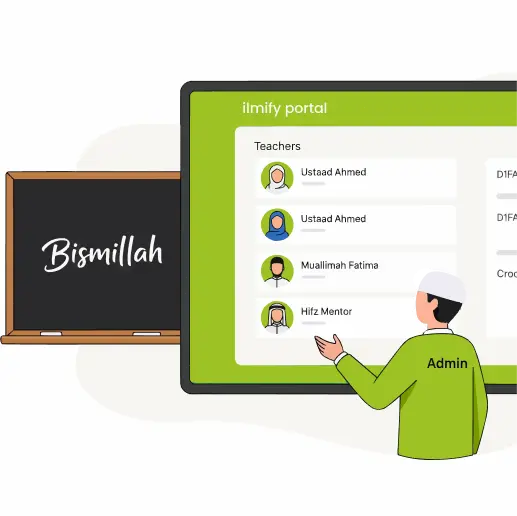
Introduction
“Digital transformation” is a phrase that has been applied to everything from large corporations to corner shops, and the overuse has drained it of meaning. So let’s be specific.
For an Islamic school — a maktab, a madrasa, a Hifz programme, a Darul Uloom — digital transformation means one concrete thing: moving from systems that rely on individual memory, paper, and informal communication to systems that hold institutional knowledge securely, make it accessible to the right people at the right time, and allow the institution to operate at scale without burning out the people who run it.
It does not mean sophisticated AI. It does not mean an app for every possible function. It does not mean spending money on technology for its own sake. It means replacing the notebook, the WhatsApp group, and the fee spreadsheet with purpose-built tools that make the notebook, the WhatsApp group, and the fee spreadsheet unnecessary.
This guide explains what that transformation looks like in practice — the stages, the decisions, the tools, and the cultural change required to make it stick.
Why Islamic Schools Have Been Slow to Digitise
The Islamic education sector globally has been significantly slower to adopt digital management tools than mainstream education. This is not because Islamic educators are resistant to technology — many are highly technically capable in other domains. It is because of a specific combination of factors:
No purpose-built tools existed. The mainstream school management software market — SIMS, Arbor, iSAMS — was built for schools following national curricula. It has no concept of Hifz tracking, Sabak, Dhor, Tarbiyah assessment, or Salah monitoring. Generic tools require such extensive workarounds to serve Islamic education that they become more trouble than they are worth.
The institutions are small and resource-constrained. Enterprise school management systems cost thousands of pounds per year and require dedicated IT staff to implement. Community maktabs have neither the budget nor the personnel.
The governance is volunteer-led. When no one is paid to handle administration, there is no natural home for the administrative function that digital tools support. Tools require someone to champion them, configure them, and ensure they are used — and in a volunteer-run institution, this person is often absent.
The community is relationship-oriented. Islamic education has always been transmitted through personal relationships — teacher to student, parent to school, community to institution. There is a cultural wariness of replacing these relationships with screens and systems. This wariness is not irrational; it becomes problematic only when it is used to resist tools that strengthen rather than replace those relationships.
The result: most Islamic schools are managing 21st-century institutions with 20th-century tools — or with no tools at all.
The Three Stages of Digital Transformation in Islamic Education
Digital transformation for an Islamic school does not happen in a single leap. It happens in three stages, each building on the last. Understanding where your institution currently sits — and what the next stage looks like — makes the path forward clear.
Stage 1: Digitising the Basics
Where most institutions start from: Paper registers, WhatsApp, personal Excel files.
What Stage 1 looks like: Moving core records into a digital system with appropriate access control.
What Changes in Stage 1
Student records move from paper enrolment forms and teacher notebooks into a centrally held, searchable, access-controlled database. Every student’s name, contact details, and current Hifz or Nazirah position is findable in seconds by any authorised staff member.
Attendance moves from paper registers to app-based recording. Teachers mark attendance on their phones during or immediately after each session. Absent-student notifications go to parents automatically — no administrator involvement.
Hifz progress moves from teacher notebooks and memory to per-student digital records. Sabak, Sabaq Para, and Dhor are tracked per session, per student, with quality ratings. The record persists when teachers change.
Fee payments move from manual bank reconciliation and personal spreadsheets to a fee management module. Payments are recorded in one click; outstanding balances are flagged automatically.
What Stage 1 Produces
- A complete, current, searchable student database
- Attendance records that generate automatically, with parent notifications
- Hifz records that survive teacher turnover
- Fee records that can be reported to trustees in minutes
What Stage 1 Does Not Yet Produce
At Stage 1, the data exists and is secure — but it is not yet connected. The attendance module and the Hifz module and the fee module each hold their own data, but you cannot yet see a holistic picture of each student.
How Long Stage 1 Takes
For a maktab of 60 students with reasonable existing records: 2–4 weeks from decision to full live operation.
Stage 2: Connected Data — From Records to Reporting
Where Stage 2 begins: Core records are in the system; teachers are recording consistently.
What Stage 2 looks like: The data in the system is connected across modules and generates meaningful reports automatically.
What Changes in Stage 2
Parent reporting becomes automatic. Instead of producing termly reports manually — a 15–20 hour task — the system compiles the term’s Hifz data, attendance record, and Tarbiyah assessment into a formatted report. The teacher adds qualitative comments; the quantitative compilation happens automatically.
The parent portal becomes active. Parents log in to see their child’s progress — Hifz position, recent session quality, attendance record, fee balance — without calling the teacher or administrator. This dramatically reduces the volume of routine parent queries.
Tarbiyah assessment is structured and recorded. Tarbiyah observations — previously unrecorded or held in teacher notebooks — are captured in a consistent framework, stored per student, and appear in end-of-term reports alongside Hifz and academic data.
The principal gains a whole-institution view. Instead of asking individual teachers for updates, the principal can see: which teachers have recorded their sessions, which students are falling behind their Sabak pace, which classes have attendance concerns, and which students’ Dhor cycles are overdue — from a single dashboard.
What Stage 2 Produces
- Termly reports generated from existing data, requiring only teacher commentary
- Parent portal engagement — parents informed without administrator effort
- Holistic student picture — Hifz, attendance, Tarbiyah, and fees in one profile
- Institutional oversight — the principal seeing all students, not just hearing about individual concerns
What Stage 2 Does Not Yet Produce
At Stage 2, the institution is reactive — it sees what is happening and reports on it. It is not yet using data proactively to anticipate problems before they become serious.
Stage 3: Proactive Management — From Reporting to Insight
Where Stage 3 begins: Connected data with consistent reporting.
What Stage 3 looks like: Using historical data to make better decisions, anticipate problems, and improve outcomes.
What Changes in Stage 3
Predictive flagging. The system identifies students who are at risk of falling significantly behind — based on their Sabak pace, their Dhor cycle completion, their attendance trend — before the end of term, while there is still time to intervene. The principal receives a weekly “at-risk students” report and can act immediately.
Teacher performance insight. Aggregate data across teachers’ classes shows whether Hifz quality ratings differ systematically between teachers — which might indicate a difference in teaching approach worth investigating or sharing.
Term-on-term comparison. How does this term’s average Sabak pace compare to last term’s? Has attendance improved or declined? Which Juz completions have accelerated, and which have slowed? This longitudinal data informs curriculum and programme decisions.
Community-level insight. Across multiple branches or affiliated institutions, the administrator sees performance patterns at scale — which locations are excelling and which need support.
Financial forecasting. Fee data over multiple terms enables basic cash flow forecasting — anticipating seasonal dips (Ramadan, school holidays) and planning accordingly.
What Stage 3 Requires
Reaching Stage 3 requires at least two or three terms of consistent data in the system — enough historical data to identify trends rather than noise. It also requires a principal or administrator who is willing to act on what the data shows, not just review it.
Most Islamic schools are at Stage 1 or early Stage 2. Stage 3 is the destination — but the journey there is straightforward if Stage 1 is implemented well and Stage 2 builds naturally on it.
What Digital Transformation Does Not Mean
Clarity about what digital transformation is requires equal clarity about what it is not.
It does not replace the teacher-student relationship. The Hifz teacher who listens attentively to a student’s recitation, who notices that a student is distracted today and finds a quiet moment to ask if they are okay, who makes dua for their students by name — this is irreplaceable. Digital tools track and report on what happens in that relationship; they do not substitute for it.
It does not replace the parent-school relationship. An automated WhatsApp notification that a student was absent is not the same as a phone call from a teacher who knows the child and the family. Digital tools handle routine communication; exceptional situations still require human conversation.
It does not mean screens in the classroom. Digital transformation in an Islamic school is about management infrastructure — student records, progress tracking, fee management, parent communication — not about changing how teaching happens in the classroom. The classroom should remain what it has always been: a place of human transmission of knowledge and character.
It does not require a large budget. A purpose-built Islamic school management platform costs a fraction of what a mainstream enterprise system costs, and the return on investment — in time saved, compliance achieved, and parent trust built — is rapid.
It does not require technical expertise to implement. The right system is designed to be set up by a non-technical administrator in a few hours, not deployed by an IT team over months.
The Cultural Change That Makes Technology Stick
Technology is easy. Culture is hard. Every failed technology implementation in an Islamic school has been, at root, a culture failure — not a technology failure.
The culture requirements for digital transformation to succeed:
Leadership commitment. If the principal or committee chair is not visibly committed to using the system — if they continue to track Hifz in their notebook and let teachers “use the app if they want to” — the system will not be used. The leader must model the behaviour they require.
Non-optional adoption. “We encourage teachers to use the app” produces 40% adoption. “Session recording in Ilmify is required for all teachers from [date]” produces 95% adoption. The difference is clarity and enforcement. This is not bureaucratic — it is the minimum necessary to maintain institutional records.
Recognition of the behaviour change. Teachers who adopt new systems well should be recognised — in a team meeting, in a message from the principal, in the annual recognition event. Behaviour that is recognised is behaviour that is sustained.
Parent onboarding. If parents are not using the parent portal, the parent-facing half of the system is wasted. Parent onboarding — a clear explanation of what the app shows, how to log in, and what to expect — should be part of the new enrolment process and the beginning-of-term communication for existing families.
Patience with the initial discomfort. Any new system takes 4–6 weeks before it feels natural. The first term with a new management system is harder than the first term without one — because you are learning the system while running the programme. The second term is dramatically easier. The first term must be survived, not used as evidence that the system does not work.
The Islamic Case for Embracing Technology
There is sometimes an implicit assumption in Islamic educational circles that technology is incompatible with the traditional model of Islamic knowledge transmission — that digitising records is somehow a departure from the human-centred, relationship-based tradition of Islamic education.
This assumption is worth examining directly. The Islamic tradition has always embraced the tools of its time in service of knowledge. The printing press transformed the transmission of Islamic texts. Audio recording preserved Quran recitations. Video enabled online Hifz teaching across continents. Each technology was initially met with some resistance; each was eventually embraced as a tool in service of the tradition, not a threat to it.
A management system that ensures a student’s Hifz progress is not lost when their teacher changes — that serves the tradition. A parent portal that enables a mother who cannot attend school to stay informed about her child’s Quran journey — that serves the tradition. A Tarbiyah tracking module that makes character development visible and accountable in an institution — that serves the tradition.
The Islamic concept of Ihsan — excellence in all that one does — applies to the management of Islamic educational institutions as much as it applies to the quality of Quran recitation. A maktab that operates with excellent administrative infrastructure is a maktab that respects the students it serves, the parents who trust it, and the community that depends on it.
Technology in service of Islamic education is not a compromise with modernity. It is Ihsan in institutional management.
Ilmify as a Digital Transformation Partner
Ilmify was built from within the Islamic education community — by people who understand what a Sabak is, why Dhor tracking matters, what Tarbiyah means in practice, and why a UK maktab needs GDPR-compliant data storage and Urdu-language parent communication.
Stage 1 support: Ilmify’s onboarding process guides new institutions through the complete Stage 1 setup — student database, attendance, Hifz tracking, fee management — in a few hours, with team support throughout.
Stage 2 capabilities: Ilmify’s reporting engine, parent portal, Tarbiyah assessment module, and Salah tracking module are all Stage 2 features — available from day one, activated progressively as the institution builds its data foundation.
Stage 3 vision: Ilmify’s institutional dashboard and cross-class reporting tools give administrators the insight layer that characterises Stage 3 management — seeing patterns, identifying at-risk students, comparing performance across terms.
What Ilmify does not do: Ilmify does not replace the teacher. It does not replace the principal’s judgement. It does not replace the community relationships that sustain an Islamic educational institution. It provides the infrastructure that allows those human elements to focus on what only humans can do.
Cross-silo link: For how digital infrastructure supports Hifz programme quality: The Complete Guide to Hifz Tracking for Islamic Schools →
Cross-silo link: For how digital infrastructure enables holistic Islamic education assessment: Beyond Grades: Measuring Holistic Development in Islamic Schools →
💡 Your institution is ready for digital transformation — the tools are ready tooIlmify is the only Islamic school management platform built for maktabs, madrasas, and Hifz programmes from the ground up.Start your institution’s digital transformation with Ilmify →
Conclusion
Digital transformation for an Islamic school is not a luxury, a compromise, or a distraction from the institution’s educational mission. It is the infrastructure that makes the mission sustainable at scale — that ensures Hifz progress survives teacher turnover, that parents are genuinely informed partners in their child’s development, that the institution can demonstrate compliance with its legal obligations, and that the people running it are not consumed by administrative tasks that technology could handle better.
The three-stage journey — from paper to connected data to proactive management — is achievable for any institution that starts with the right tools and the right commitment. Ilmify is the platform designed for exactly that journey.
Begin your Islamic school’s digital transformation with Ilmify →
Related articles in this series:




 Arabic
  English
  Malay
Malay  Urdu
Urdu