

Sign 1 — You Cannot Instantly Tell Any Parent Their Child’s Hifz Position
Picture this: a parent messages you after a session — “Assalamu alaikum, how is my son doing? Where is he in his Hifz?” You know roughly which juz he is in, but you cannot recall the exact surah and ayah without looking at the paper register. Which is at the madrasa. And tonight is Thursday, so the next session is Saturday.
This situation is common in paper-based Hifz schools and highlights a deeper problem.
Parents gradually disengage when they cannot access timely and accurate updates.
Consequently, student motivation declines over time.
Because Hifz is a long-term commitment requiring daily reinforcement, parental involvement remains essential.
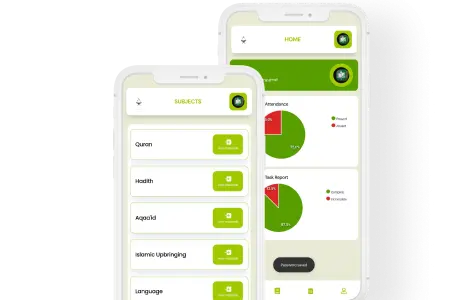
A proper maktab management system gives any parent, at any time, a clear view of exactly where their child is: current Sabak position, juz completed, most recent Dhor review, attendance rate, and upcoming milestones. The parent does not have to ask — they already know. The teacher does not have to guess — the system records it.
You have outgrown WhatsApp when: You cannot answer a parent’s Hifz progress question in less than two minutes without physically accessing the paper register.
Sign 2 — Your Teacher Is Irreplaceable Because All the Records Are In Their Head
This sign is one of the most serious, and one of the most overlooked. In many maktabs, a single teacher holds the entire operational memory of the institution — who is enrolled, where each student is in Quran, who has paid fees, which students have special circumstances, which families are struggling.
When that teacher is absent for a day, the substitute is lost. When that teacher leaves — for any reason — months or years of institutional knowledge walks out with them. The maktab is left trying to reconstruct records from partial paperwork and memory.
This is not the teacher’s fault. It is a structural problem: institutions that have not systematised their records are dependent on individual memory, and individual memory is fragile.
A management system makes the institution’s knowledge institutional — stored in a system that every authorised staff member can access, not in one person’s head or one paper register.
You have outgrown WhatsApp when: You could not continue operating normally if your main teacher was absent for two weeks without notice.
Sign 3 — Parents Are Asking Questions You Cannot Answer Without Checking Three Places
“Has my daughter’s fee been received?” — check the fee register.
“Is my son’s attendance okay this term?” — check the attendance notebook.
“When is the next board exam?” — check the email from the board.
“How many juz has my child completed?” — check the Hifz register.
As a result, each question has its answer stored in a different place. For a volunteer administrator managing a maktab after their own full working day, tracking down answers across multiple systems creates delays, errors, and frustration.
A maktab management system consolidates all of this into one place. One dashboard with the answer to every question a parent, teacher, or trustee might ask — accessible from a phone, in seconds.
You have outgrown WhatsApp when: Answering a routine parent question requires checking more than one document or notebook.
Sign 4 — Fee Collection Is a Monthly Chase
Maktab fee collection is one of the most consistent pain points administrators describe. The cycle is familiar: fees are due on the first of the month. By the 10th, roughly half have been paid — in cash, handed to the teacher, recorded in a notebook. By the 20th, you are messaging parents individually to chase the outstanding amount. By the 30th, you have given up on two or three families and moved on. Next month, the cycle repeats, and the families who missed last month still have not paid.
The issue is not unwillingness to pay — most parents do.
Instead, the real problem is friction: no invoice, no reminders, no easy payment method, and no clear record of past payments.
A management system sends automated fee reminders before the due date, generates proper receipts when payment is received, maintains a running outstanding balance visible to the administrator, and enables online payment through UPI (India), bank transfer (UK), or equivalent local methods.
You have outgrown WhatsApp when: You are personally chasing more than 20% of families for monthly fees, or you cannot produce a clear statement of who owes what from this term.
| Metric | Paper-Based | Digital System |
| Time spent on fee reminders | 2–3 hrs/month | Automated |
| Outstanding fee visibility | Manual calculation | Real-time dashboard |
| Payment methods accepted | Cash only | Cash + UPI/bank transfer |
| Receipt generation | Manual or none | Automatic |
| Year-end financial summary | Manual | Generated in minutes |
Source: Ilmify maktab administrator survey, 2026
Sign 5 — Board Exam Registration Season Means Three Weeks of Chaos
For maktabs affiliated with Deeniyat, Samastha, Markazi Taleemi Board, BEFAQ, or any Islamic board, the annual exam registration cycle is a significant administrative burden. Collecting and verifying student details, checking eligibility criteria, completing board forms (often by hand or in specific formats), chasing missing information, submitting before the deadline, and following up on confirmations — all of this falls on the same administrator who is also running the daily maktab.
The chaos is entirely a product of data being fragmented. If student information, attendance records, curriculum progress, and fee status all live in different places, assembling a complete exam registration takes hours per student. For a maktab with 60 exam-eligible students, this can be a full week’s work.
A management system with board exam support already holds all relevant data and generates exam registrations automatically. It pulls verified student details from records and checks eligibility using attendance and progress data.
You have outgrown WhatsApp when: Your exam registration cycle causes your administrator or imam to lose significant sleep in the two weeks before the board deadline.
Sign 6 — You Have More Than One WhatsApp Group and You Are Still Losing Messages
The WhatsApp group proliferation is one of the clearest signs of a maktab that has outgrown informal communication tools. It typically follows this pattern:
First there is the main parent group. A separate group is created for Hifz parents. Another group is used for teachers. The management committee uses its own group. Additionally, a separate group handles Ramadan schedule updates.
A broadcast list is created for fee reminders.
In addition, administrators often maintain personal chats with parents who do not check group messages.
Each group has a different subset of information. Messages get lost in the noise. Important announcements are buried under fifty replies of “JazakAllahu khayran.” A parent claims they never saw the fee reminder that was in the group last Tuesday.
WhatsApp was designed for personal messaging. It was not designed to be a school communication system. The moment you have more than one group — or more than 30 people in a group — it stops working effectively as a structured communication tool.
A parent portal with targeted, automated notifications (this parent receives their child’s attendance alert; that parent receives a fee reminder; all parents receive the Ramadan schedule change) replaces the group chaos with structured, trackable communication.
You have outgrown WhatsApp when: You have more than two WhatsApp groups for school communication, or parents routinely claim they missed important information that was shared on WhatsApp.
Sign 7 — Your Attendance Register Has Gaps
Pull out your maktab attendance register from three months ago and look at it honestly. How many days have incomplete entries? How many students have rows that stop mid-term and never resume? How many times did a substitute teacher mark attendance differently from the regular teacher, creating confusion in the record?
Gaps in attendance records matter for several reasons. Board exam eligibility often depends on a minimum attendance threshold — a student with missing attendance records may be wrongly excluded from an exam, or may incorrectly pass the eligibility check. Fee waivers and scholarships may be contingent on attendance. And for pastoral purposes, a student whose attendance has quietly dropped from five sessions a week to two without anyone noticing is a student who is slipping away from the institution.
A digital attendance system, accessible from the teacher’s phone, takes under two minutes to complete for a class of 30 students. It creates a clean, gapless, permanent record. Automated alerts flag students whose attendance drops below a threshold. Board exam eligibility is calculated automatically from the attendance data.
You have outgrown WhatsApp when: You cannot produce a clean, complete attendance record for any student for the current academic year.
Sign 8 — You Cannot Produce a Progress Report Without Several Hours of Manual Work
Twice a year — or in some institutions once a year — comes the moment of dread: writing individual progress reports for every student. For a class of 40, this means 40 separate documents, each requiring the teacher to: find the student’s Hifz position in the register, calculate progress since the last report, recall behavioural and character observations from memory, and write it all up in a format parents can understand.
Most teachers spend an entire evening completing these reports.
The quality often varies — some reports are detailed, while others remain brief or inaccurate because teachers rely on memory instead of recorded data.
A management system generates progress reports automatically from the daily tracking data. The teacher reviews and optionally adds a personal note. The system produces a formatted report showing Hifz position, progress since the last report, attendance, and tarbiyah observations. Total time: fifteen minutes for the entire class.
You have outgrown WhatsApp when: Progress report season is dreaded rather than simply scheduled.
Sign 9 — A New Volunteer Administrator Has to Be Trained for Weeks Before They Can Help
Maktabs run on volunteer labour — and volunteer turnover is a permanent feature of Islamic institution management. The mosque committee changes. The dedicated sister who managed enrolment for three years moves away. The retired uncle who handled fee collection passes away.
Each transition is painful because knowledge lives in people, not systems. Training a new volunteer means walking them through paper registers, explaining the filing system, sharing context that was never written down, and hoping they absorb enough before the old volunteer is gone.
A management system makes this transition orderly. The new volunteer logs in, sees the student records, the attendance history, the fee status, and the Hifz progress — all organised, all accessible, all self-explanatory. Training takes hours, not weeks.
You have outgrown WhatsApp when: The departure of a single administrator creates a knowledge crisis for the institution.
Sign 10 — You Worry About What Happens to the Records If Something Goes Wrong
This sign is rarely spoken aloud, but it is present in almost every paper-based maktab: the quiet anxiety about physical records. What happens if the notebook is lost? What if the Excel file on the teacher’s laptop is deleted? What if there is a fire, a flood, or a theft at the mosque?
The student records of a maktab — years of attendance, Hifz progress, fee payment history, family contact information — represent a significant institutional asset. For many families, these records are important documents: proof of their child’s Islamic education, progress certifications, exam results.
Paper records can be lost or damaged easily, and Excel files on personal laptops carry similar risks.
In contrast, cloud-based systems protect data through backups and secure storage.
You have outgrown WhatsApp when: You have ever thought “what would we do if we lost all our records?”
What the Right Maktab Management System Solves
Each of the ten signs above maps directly to a feature of a purpose-built maktab management system. The table below summarises the mapping.
| Sign | Root Problem | Solution Feature |
| 1. Cannot answer Hifz progress questions | No accessible Hifz records | Three-stream Hifz tracking with parent portal |
| 2. Irreplaceable teacher | Knowledge in one person | Centralised records accessible to all authorised staff |
| 3. Answers in multiple places | Fragmented data | Single dashboard for all student information |
| 4. Monthly fee chase | No automated reminders or online payment | Fee management with automated reminders and UPI/online payment |
| 5. Board exam chaos | Fragmented data for eligibility checking | Board exam management with automated eligibility check |
| 6. WhatsApp group proliferation | No structured communication system | Parent portal with targeted automated notifications |
| 7. Attendance gaps | Paper register fragility | Mobile attendance marking, automated alerts |
| 8. Manual progress reports | No aggregated tracking data | Automated progress report generation |
| 9. Volunteer transition crisis | Knowledge in people not systems | Systemised records with role-based access |
| 10. Data loss anxiety | Physical record fragility | Cloud-based storage with backup |
Source: Ilmify maktab operations research, 2026
Conclusion
WhatsApp and spreadsheets did not fail your maktab — they served it well when the institution was smaller and simpler. But institutions grow, and tools that worked for 30 students and one teacher create real operational problems at 80 students and three teachers. The ten signs in this guide are not catastrophes — they are the accumulated friction of a system trying to do more than it was designed to do.
The transition to a purpose-built maktab management system is not as difficult or as expensive as most administrators assume. The institutions that have made the transition describe one consistent experience: they wish they had done it sooner.
👉 See How Ilmify Solves Every One of These 10 Problems — Book a Free Demo →
Related Articles
You might also find these helpful:
- 📚 Moving from WhatsApp to a Real School Management System: A Step-by-Step Guide
- 💰 The Real Cost of Managing Your Maktab on Paper in 2026
- ⚙️ Best Madrasa Management Software in 2026: The Complete Comparison Guide
- ✅ How to Choose Islamic School Management Software: The Complete Buyer’s Guide
- 📚 How to Track Hifz Progress Digitally: A Step-by-Step Guide
- 📚 How to Run a Maktab Fee Collection System That Actually Works
- 📚 How to Manage a Maktab Without a Dedicated Administrator
- ⚙️ Maktab Management Software for India in 2026




 Arabic
  English
  Malay
Malay  Urdu
Urdu