Introduction
India has an estimated 10 to 20 million children attending madrasas and maktabs. Uttar Pradesh alone has over 14,500 state-recognised and unregistered madrasas. Kerala has more than 10,000 Samastha-affiliated madrasas serving over a million students. Idara-e-Deeniyat’s network reaches 1.6 million students across 25 countries. And virtually all of these institutions — despite their enormous combined scale — are managed with paper registers, WhatsApp groups, and cash envelopes.
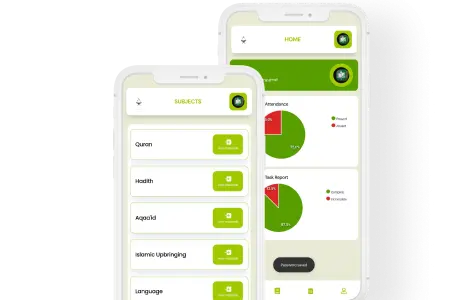
This guide is for the administrators, imams, and mosque committees who are ready to change that. It explains what maktab management software for India needs to do differently from generic school tools, which boards and curricula need to be supported, and what to look for when evaluating platforms in 2026.
Why Generic Indian School Software Does Not Work for Maktabs
India has a thriving school management software market. Platforms like Fedena, MyClassboard, and EduKool are widely used across private schools. However, these systems are not designed for maktabs, which creates major operational challenges.
Academic Calendar Mismatch
First, most Indian school software assumes a fixed academic year based on CBSE or state boards.
In contrast, maktabs follow the Islamic calendar, including Ramadan schedules and Eid holidays.
As a result, systems that cannot adapt to Hijri-based scheduling create confusion and administrative inefficiencies.
Subject Structure Differences
Next, generic platforms are designed for subjects like Mathematics, Science, and English.
However, maktabs focus on Quran, Tajweed, Hadith, Fiqh, Arabic, and Urdu.
Because of this, administrators are forced to rely on workarounds, which reduces accuracy and usability.
Progress Tracking Limitations
In regular schools, progress is measured using marks and grades.
On the other hand, maktabs track progress through Hifz milestones such as Sabak, Sabak Para, and Dhor.
Therefore, traditional grading systems fail to represent real student progress.
Language Support Issues
Another key limitation is language support. Most platforms are designed for English or Hindi.
Meanwhile, maktabs operate in Urdu, Malayalam, Tamil, and Arabic.
Without proper Urdu Nastaliq and regional language support, usability becomes a serious issue.
Fee Model Misalignment
Finally, school software assumes fixed monthly fees.
In contrast, maktabs rely on donations, Zakat, and flexible fee structures.
As a result, generic systems cannot support real-world financial workflows.
Final Takeaway
In summary, generic school software does not align with maktab operations.
Therefore, purpose-built solutions are essential for efficiency and accuracy.
Quran and Hifz Progress Tracking for Indian Maktabs
India’s maktab students follow a structured Quran learning journey. However, most software systems fail to support this properly.
The Quran Learning Path
Typically, students progress through the following stages:
- Qa’idah — learning Arabic basics
- Nazra — reading the Quran fluently
- Hifz — memorisation using structured revision
- Tajweed — applying recitation rules
- Aamuktha — completion (common in South India)
The Three-Stream Hifz System
At the core of Hifz is a three-part daily system:
- Sabak — new memorisation
- Sabak Para — recent revision
- Dhor / Manzil — long-term revision
Therefore, students are always balancing new learning and revision simultaneously.
Why Manual Tracking Fails
Managing this manually is extremely difficult. For example, a teacher handling 30 students must track:
- 30 Sabak positions
- 30 Sabak Para cycles
- 30 Dhor schedules
As a result, paper systems often lead to errors, missed revisions, and inefficiency.
How Software Solves This
Modern software simplifies this process. It can:
- Automatically track all three streams
- Highlight daily revision tasks
- Update progress instantly
- Provide parent visibility
Consequently, what once took hours can be reduced to minutes.
Board Affiliation Management: Deeniyat, Samastha, MTB, and More
Board exam season is one of the most stressful periods in any affiliated maktab’s year. For institutions affiliated with Deeniyat, Samastha, MTB, or Jamiat DTB, the exam registration process involves:
- Verifying that each student has completed the required curriculum portions for their level
- Confirming minimum attendance thresholds
- Collecting and verifying student biographical data
- Submitting registration forms to the board (often in specific formats)
- Tracking fee payments to the board
- Recording results after the exam cycle
Without software support, this process typically runs on a combination of Excel spreadsheets, physical form-filling, and WhatsApp coordination with the board’s district representative. Errors — wrong student details, missed registrations, lost fee records — are common.
Software that integrates board affiliation management can automate most of this: pulling verified student data from the existing records, checking eligibility criteria against attendance and curriculum progress, generating the registration submissions, and recording results back into the student’s record.
| Board Management Feature | Benefit for Indian Maktabs |
| Board affiliation field in student profile | Immediate visibility of which board each student is registered with |
| Exam eligibility automated checking | Flag students who do not meet attendance or curriculum thresholds |
| Registration form generation | Eliminate manual data entry into board submission forms |
| Result recording and progress tracking | Board results become part of the student’s permanent record |
| Multi-board support (Deeniyat, Samastha, MTB, DTB) | One platform for maktabs affiliated with different boards |
Language Support: Urdu, Malayalam, Arabic, and More
Language is not a minor detail for Indian maktabs — it is the fundamental context of how teachers and administrators work.
North India (UP, Bihar, MP, Rajasthan, Delhi, Maharashtra Muslim communities): Urdu is the primary language of instruction and administration. Any software expecting teachers to work in English or Hindi will create resistance. Urdu interface must use Nastaliq script — the script in which Urdu teachers and administrators are literate. Naskh rendering (the Arabic-style script used in some transliterations) is not the same and is not adequate.
South India — Kerala: Malayalam is the medium of instruction for Samastha and most Kerala board-affiliated madrasas. The Samastha curriculum includes Arabi-Malayalam hybrid texts (Arabic written in Malayalam script) — a unique feature of Kerala Islamic education that no generic software has ever attempted to support.
South India — Karnataka, Tamil Nadu, Andhra Pradesh, Telangana: A mix of Kannada, Tamil, and Telugu alongside Urdu depending on community origin. Hyderabad’s Muslim community is primarily Urdu-speaking; coastal Karnataka’s Beary community uses Tulu; Tamil-speaking communities in TN use Tamil.
Arabic across all regions: Quran text and Arabic subject matter require proper Arabic rendering throughout the platform — not a transliteration fallback.
| Language | Regions | Script Required |
| Urdu | North India, Deccan, all diaspora | Nastaliq (right-to-left) |
| Malayalam | Kerala, Lakshadweep | Malayalam script (left-to-right) |
| Arabic | All regions (Quran/Islamic subjects) | Arabic (right-to-left) |
| Tamil | Tamil Nadu, Sri Lanka-linked | Tamil script (left-to-right) |
| Kannada | Karnataka (partial) | Kannada script (left-to-right) |
| English | Urban, diaspora-facing | Standard |
Source: Ilmify India maktab research, 2026
Fee Collection for Indian Maktabs
Most Indian maktabs collect fees in one of three ways: monthly cash collection at the mosque, annual fee payment at the start of the academic cycle, or a voluntary donation model with no fixed fee at all. Very few have the infrastructure for online payment collection — but this is changing rapidly as UPI and mobile payment penetration reaches even rural Muslim communities.
What Indian maktab fee management needs to support:
- Cash fee recording with receipt generation (still the dominant payment method)
- UPI payment tracking (Google Pay, PhonePe, Paytm — increasingly standard)
- Fee waiver management with Zakat eligibility tracking
- Donation receipt generation for charitable giving
- Reporting for mosque committee or trust management
- Outstanding fee tracking without aggressive dunning — many Indian maktabs are deeply relationship-based and aggressive reminder systems create community friction
| Fee Feature | Indian Maktab Context |
| Cash fee recording | Most common payment method; must work without internet |
| UPI payment support | Growing adoption, especially in urban and peri-urban maktabs |
| Zakat-funded fee waiver | Many maktabs offer free or subsidised places for eligible families |
| Donation receipt | Essential for mosque committee accountability and Gift Aid equivalents |
| Outstanding fee reporting | Trustees need visibility; reminder approach must be culturally appropriate |
Parent Communication in the Indian Context
WhatsApp has 500 million users in India. For Indian Muslim families, it is not just a messaging app — it is the primary channel for school communication, community notices, and local news. Any parent portal that relies on email notifications is making the wrong assumption about how Indian maktab parents communicate.
Effective parent communication for Indian maktabs means: WhatsApp-native push notifications for attendance (child absent today), Hifz progress milestones (child has completed Juz 5), fee reminders (this month’s fee is due), and exam results. These notifications should be automatic — not requiring an administrator to compose and send each message manually.
The parent portal itself should be accessible from a basic Android smartphone — which is the primary device for most Indian parents — and should work adequately even on 3G connections.
How Ilmify Serves Indian Maktabs
Ilmify was designed with Indian maktabs as the primary use case. The platform directly addresses each of the seven requirements listed earlier in this guide:
- Three-stream Hifz tracking — Sabak, Sabak Para, and Dhor/Manzil tracked separately, with automated revision scheduling and parent visibility
- Board exam management — Support for Deeniyat, Samastha, Markazi Taleemi Board, Jamiat DTB, and regional boards; eligibility checking, registration workflow, result recording
- Urdu Nastaliq interface — Full RTL Urdu interface in proper Nastaliq script for North Indian maktabs
- Malayalam support — Interface and reporting in Malayalam for Kerala institutions
- Hijri calendar — Full Islamic calendar integration with Ramadan scheduling and board cycle management
- Charitable fee management — Cash recording, UPI tracking, Zakat waiver management, donation receipts, committee reporting
- WhatsApp-native notifications — Automated parent notifications through WhatsApp for all key events
Ilmify is the only platform in the Indian Islamic school management market that directly addresses all seven requirements. Generic Indian school software addresses none of them. Western Islamic school platforms (Muntazim, IBEAMS) address one or two.
Feature Comparison Table
This table compares Ilmify against the most common alternatives used by Indian maktabs: generic Indian school software (Fedena/MyClassboard type), Muntazim, and IBEAMS.
| Feature | Ilmify | Generic Indian School Software | Muntazim | IBEAMS |
| Sabak/Sabak Para/Dhor tracking | ✅ | ❌ | ❌ | ❌ |
| Nazra level tracking | ✅ | ❌ | ❌ | ⚠️ Basic |
| Aamuktha (South India) support | ✅ | ❌ | ❌ | ❌ |
| Deeniyat board exam management | ✅ | ❌ | ❌ | ❌ |
| Samastha board exam management | ✅ | ❌ | ❌ | ❌ |
| MTB / Jamiat DTB support | ✅ | ❌ | ❌ | ❌ |
| Urdu Nastaliq interface | ✅ | ❌ | ❌ | ❌ |
| Malayalam interface | ✅ | ⚠️ Limited | ❌ | ❌ |
| Hijri calendar | ✅ | ❌ | ❌ | ⚠️ Limited |
| Tarbiyah assessment | ✅ | ❌ | ❌ | ❌ |
| Zakat fee waiver tracking | ✅ | ❌ | ❌ | ⚠️ Limited |
| WhatsApp-native notifications | ✅ | ⚠️ Some | ❌ | ❌ |
| UPI payment support | ✅ | ✅ | ❌ | ❌ |
| Offline mode | ✅ | ⚠️ Some | ❌ | ❌ |
| Student management | ✅ | ✅ | ✅ | ✅ |
| Attendance tracking | ✅ | ✅ | ✅ | ✅ |
| Standard fee collection | ✅ | ✅ | ✅ | ✅ |
Source: Platform documentation; Ilmify research, April 2026
Conclusion
India’s maktab sector is enormous — tens of millions of children, tens of thousands of institutions — and almost entirely undigitised. The reason is not lack of will or lack of technology. It is lack of the right technology: software that understands Sabak and Dhor, that speaks Urdu in Nastaliq, that knows what a Deeniyat exam registration looks like, and that works when the internet goes down.
Ilmify was built for exactly this gap. If you run a maktab in Lucknow, a Hifz school in Hyderabad, a Samastha madrasa in Kerala, or a Deeniyat maktab in any of India’s thousands of mosques — this is the platform that was built for you.
👉 See Ilmify for Indian Maktabs — Book a Free Demo →
Related Articles
You might also find these helpful:
- ⚙️ Best Madrasa Management Software in 2026: The Complete Comparison Guide
- ✅ How to Choose Islamic School Management Software: The Complete Buyer’s Guide
- 📚 How to Track Hifz Progress Digitally: A Step-by-Step Guide for Islamic Schools
- 📚 Maktab Boards in India: The Complete Guide to Every Major Network
- 📚 What Is Idara-e-Deeniyat? India’s Largest Mosque-Based Maktab Network
- 📚 What Is Samastha Kerala? The Sunni Vidyabhyasa Board Explained
- 📚 The 10 Biggest Challenges Running a Maktab in India (And How to Solve Each One)
- 📚 Moving from WhatsApp to a Real School Management System: A Step-by-Step Guide