

Introduction
The online Islamic school sector grew enormously during and after the 2020 pandemic — and has not retreated. Institutions like IOM Bangladesh, Your Madrasah (UK), Markaz Online Madrasa (India), and dozens of smaller providers demonstrated that Quran and Islamic education could be delivered effectively online, reaching students who could not access local maktabs: diaspora communities in non-Muslim countries, rural areas with no nearby maktab, adults who missed their Islamic education, and students whose local options were inadequate.
What grew less quickly was the management infrastructure for these online institutions. Many online Islamic schools are still managed through the same informal tools as physical maktabs: WhatsApp groups, spreadsheets, and verbal tracking of student progress. The specific challenges of online Islamic education — virtual attendance, remote Hifz monitoring, online fee collection, student identity verification, and managing students across multiple time zones — require management approaches that physical maktab tools were not designed to handle.
This guide addresses online Islamic school management specifically: what makes it different from physical maktab management, what systems are needed, and how to run a digital Islamic school that operates with the same professional standards as its best physical counterparts.
The Online Islamic School Landscape in 2026
Online Islamic education in 2026 falls into several distinct categories, each with different management needs:
| Type | Description | Scale | Management Challenge |
| Online Hifz programme | One-on-one Hifz sessions via video call | 1 teacher: 10–30 students | Individual progress tracking; remote Hifz monitoring |
| Online weekend maktab | Group sessions for diaspora children | 1–5 teachers: 30–200 students | Virtual attendance; group Quran assessment |
| Online Alim/Alimah course | Structured Islamic studies curriculum | 5–20 teachers: 100–1000 students | Multi-subject tracking; assignment management |
| Hybrid institution | Physical and online students in same institution | Variable | Two-track management; consistent experience for all |
| Large-scale online madrasa | IOM Bangladesh model; thousands of students | 50+ teachers: 1000–50,000 students | Industrial-scale management infrastructure |
The fastest-growing segment in 2026:
The fastest-growing segment is the hybrid institution — a physical maktab that has added online classes for students who cannot attend in person (illness, distance, work commitments, diaspora family members). These institutions face the challenge of providing an equivalent experience to both in-person and online students through a single management system.
How Online Management Differs from Physical Maktab Management
The core functions of maktab management — student records, attendance, Hifz tracking, fee collection, parent communication — are the same online as in person. But the operational context creates specific differences that any management approach must address.
| Function | Physical Maktab | Online Maktab | Key Difference |
| Attendance | Teacher marks present in room | Teacher marks attendance per video session | Cannot observe physical presence; must define “attended” clearly |
| Hifz recording | Teacher hears student in person | Teacher hears student via audio/video | Latency and audio quality affect assessment reliability |
| Student identity | Teacher recognises students visually | Regular identity verification needed | Risk of student substitution in assessments |
| Fee collection | Cash or local transfer | International payment methods needed | Multiple currencies; payment processor selection |
| Parent communication | Possible at physical collection | Entirely digital; time zones complicate real-time contact | Must be asynchronous-capable |
| Safeguarding | Visual monitoring; two-adult rule | One-to-one online creates specific risks | Policies must address online-specific scenarios |
Virtual Attendance: The Foundation of Online Accountability
Attendance in an online context requires a clear definition before it can be tracked. “Attended” in a virtual setting could mean: joined the video call, joined for the minimum required duration, had their microphone on during Quran recitation, submitted the required practice recordings, or some combination of these.
Defining virtual attendance for your institution:
Before setting up any tracking system, define your institution’s attendance criteria in writing:
- Minimum session duration required to count as “attended” (e.g., present for at least 75% of scheduled session length)
- Whether technical issues (dropped connection, audio problems) count as attended or absent
- Whether submission of a practice recording counts as partial attendance for asynchronous learners
- How Ramadan and other Islamic calendar events affect attendance calculations
Virtual attendance recording methods:
| Method | How It Works | Best For |
| Manual marking during session | Teacher marks each student as they join | Small groups (under 20) |
| Video platform automated reports | Zoom/Google Meet attendance exports | Medium groups with consistent platform |
| Student self-check-in | Student marks themselves present; spot-checked | Large-scale with honour system |
| Practice recording submission | Presence = submission of required practice | Asynchronous Hifz programmes |
| Management system integration | Platform records presence automatically | Best for scale |
Why attendance recording matters online:
For board exam eligibility, for fee disputes (student claims sessions were attended, institution says otherwise), for safeguarding records (documentation that the student participated), and for quality assurance (identifying students who are disengaging before they disappear). Online attendance records are, if anything, more important than physical records — because the institution cannot rely on the physical observation of “I can see the student is here” as a backup.
Online Hifz Monitoring: Tracking Progress Without Physical Presence
Hifz monitoring online presents specific challenges. The traditional Hifz assessment — student recites face-to-face with teacher, teacher corrects Makharij in real time — works imperfectly over video due to audio latency, background noise, and the inability to observe physical recitation posture.
Adapting the three-stream model for online Hifz:
The Sabak/Sabak Para/Dhor structure remains the right framework for online Hifz — the educational principles are the same. The delivery adaptations are:
Sabak (new memorisation): Student records a video of their new Sabak recitation and submits before the session. The teacher reviews the recording between sessions and provides feedback during the live session. This approach gives the teacher a higher-quality audio record (no live latency) and allows the student to submit at their optimal time of day for memorisation (often Fajr, which may not align with session scheduling).
Sabak Para: Covered in the live session — the student recites recent portions to the teacher over video. Teachers should develop clear assessment protocols for what constitutes an acceptable online Sabak Para pass (e.g., no more than 3 hesitations in 10 lines, Tajweed rules correctly applied).
Dhor/Manzil: Can be handled through a combination of live session recitation (sampling sections) and practice recording submissions. For large Dhor portions, sampling is inevitable — the teacher cannot listen to 4 juz live every week. A clear sampling protocol (e.g., teacher selects 2 pages from the Dhor section to test live each week, random selection) maintains accountability without being unsustainable.
Recording as a teaching tool:
Online Hifz recordings have an advantage over in-person assessment: they can be archived. A student’s Sabak recording from six months ago can be compared to their current recording to demonstrate progress in Tajweed quality — a tangible, shareable evidence of development that parents value.
Student Identity and Verification in Online Settings
Online Islamic schools face a genuine identity verification challenge that physical maktabs do not. When a student submits a Hifz recording or sits an online examination, the institution needs confidence that the person completing the work is the enrolled student.
Common online identity risks in Islamic education:
- A parent completing recordings on behalf of a child (particularly in Hifz where stakes feel high)
- A sibling substituting for an enrolled student in live sessions
- Students sharing login credentials
Proportionate verification approaches:
| Verification Level | Method | Best For |
| Low (informal programmes) | Teacher recognises student by face over consistent video sessions | Small groups with stable enrolment |
| Medium (board-affiliated programmes) | Student shows face on camera for all assessments; periodic live identity check | Most online maktabs |
| High (examination-linked programmes) | Identity document check at enrolment; random spot check requests during sessions | Formal examination preparation |
The trust-based approach: For most online Islamic schools serving known community members, proportionate trust combined with teacher recognition is sufficient. Document your identity verification approach in your policies — if a concern arises, you need to demonstrate that you had a reasonable process.
Fee Collection for Online Islamic Schools
Online Islamic schools serve students from multiple countries, which creates payment complexity that physical maktabs do not face.
International payment methods for online Islamic schools:
| Payment Method | Best Markets | Notes |
| PayPal | UK, USA, Canada, Australia | Widely available; high fees (3–5%) |
| Stripe | UK, USA, Europe, global | Professional; lower fees than PayPal |
| Bank transfer / IBAN | UK, EU | Low cost; manual reconciliation needed |
| bKash / Nagad | Bangladesh | Essential for Bangladeshi students |
| UPI / RazorPay | India | Essential for Indian students |
| GCash | Philippines | For Filipino Muslim community |
| Local bank transfer | Country-specific | Set up local accounts where needed |
Subscription billing: Online Islamic schools are well-suited to subscription billing — a monthly recurring charge that parents authorise once. Stripe and PayPal both offer subscription billing that reduces the monthly collection burden to zero once set up. This is significantly more efficient than monthly manual invoicing for an international student base.
Currency considerations: Decide whether to invoice in one currency (GBP/USD) or to price locally. Local pricing (₹X for India, ৳X for Bangladesh) improves accessibility but creates currency management complexity. For most small online schools, a single invoicing currency (GBP or USD) with transparent exchange rates is simpler.
Parent Communication Across Time Zones
Online Islamic schools serve students across multiple time zones, which means synchronous parent communication (phone calls, real-time WhatsApp messages) only works reliably if the time zone difference is managed.
Asynchronous-first communication approach:
The most reliable approach for international online schools is asynchronous-first: use written communications (parent portal messages, email, WhatsApp text) as the primary channel, with live calls by appointment for complex conversations. This approach works across all time zones and creates a written record.
What the parent portal must handle for an online school:
- Student virtual attendance record (visible to parents as it is recorded)
- Hifz/Quran progress updates (updated after each session)
- Recording submissions (can parents see/hear their child’s recordings?)
- Fee statements and payment history
- Session schedule and time zone representation
- Teacher notes and feedback from each session
A parent in Sydney and a parent in Birmingham receiving the same session update simultaneously — automatically generated from the session record, delivered via WhatsApp at a time appropriate to each location — is the standard that professional online schools achieve.
Scheduling Across Time Zones
Scheduling is one of the most operationally complex aspects of online Islamic schools with international students. A session at 6pm UK time is 11pm in Pakistan, 2am in Malaysia, and 9am on the East Coast of Australia.
Time zone scheduling strategies:
| Strategy | Description | Best For |
| Single time zone | All sessions in one fixed time zone; students choose based on availability | Small, geographically concentrated schools |
| Regional scheduling | Morning sessions for Asia-Pacific; evening sessions for UK/US | Schools serving specific regions |
| Recorded sessions | All sessions recorded; students watch asynchronously | Large-scale or highly distributed schools |
| Asynchronous Hifz | Students submit recordings; teacher reviews and responds | Flexible Hifz programmes |
| Student-choice booking | Students book one-to-one sessions within teacher availability windows | Premium one-to-one programmes |
The Islamic calendar in an international context:
Ramadan begins at different times across the world — Saudi Arabia typically announces Ramadan a day earlier than South Asian countries. For an online school with students across multiple countries, managing the Ramadan schedule requires explicit communication about which Ramadan announcement the institution follows, and ensuring all students understand the schedule adjustment.
The Online Tarbiyah Challenge
Tarbiyah — Islamic character formation — is inherently relational. It develops through consistent human interaction: the teacher observing the student in the school environment, noting how they treat peers, how they handle correction, how they engage with the Quran. In an online context, these observations are significantly more limited.
What online teachers can observe for Tarbiyah:
Despite the limitations, online teachers do have meaningful Tarbiyah observation opportunities:
- How the student presents themselves for sessions (attentive/distracted, appropriate posture and dress for Quran recitation)
- How they respond to correction (graciously/defensively)
- Whether they recite Bismillah before beginning
- Communication style in messages and emails
- Whether they submit recordings consistently or make excuses
- How they treat the teacher in written communication (Assalamu Alaikum, respectful tone)
Tarbiyah in the online progress report:
Even with limited observation, the online Tarbiyah section of a progress report can meaningfully note: consistent session presence (a form of commitment and reliability), engagement quality during live sessions, and communication style. These are genuine character indicators even in an online context.
Technology Stack for a Professional Online Islamic School
A professional online Islamic school in 2026 uses four categories of technology:
| Category | Tool Examples | Purpose |
| Video conferencing | Zoom, Google Meet, Microsoft Teams | Live sessions with students |
| Learning management | Purpose-built Islamic LMS or Ilmify | Student records, progress tracking, assignments |
| Payment processing | Stripe, PayPal, Razorpay, bKash | International fee collection |
| Communication | WhatsApp, email, parent portal | Parent and student communication |
The integration challenge: These four categories need to work together — student records link to payment history; attendance links to the LMS; parent notifications link to progress records. Disconnected tools (separate Zoom, separate spreadsheet, separate payment system, separate WhatsApp) recreate the same fragmentation problem that physical maktabs face, just in digital form.
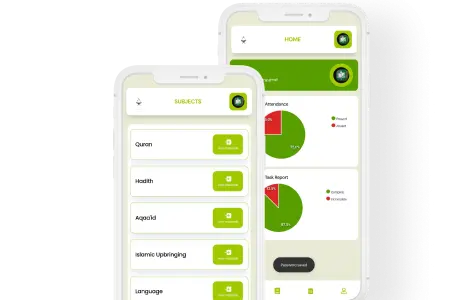
The ideal is a management system that integrates or replaces as many of these functions as possible. Ilmify’s platform covers student management, progress tracking, fee management, and parent communication — reducing the need for separate disconnected tools.
Management Systems for Online Islamic Education
The key difference between a management system designed for physical institutions and one that works for online Islamic education is in how attendance is defined and how progress recording accommodates asynchronous workflows.
What an online-capable management system must do:
- Allow attendance to be marked per virtual session (not just physical classes)
- Support asynchronous Hifz recording submission and teacher feedback workflows
- Handle international payment methods and multi-currency fee management
- Provide time-zone-aware scheduling and communication
- Generate progress reports from asynchronous tracking data (not just session notes)
- Support parent portal access for internationally distributed families
Ilmify supports both physical and online Islamic school management within the same platform — allowing hybrid institutions to manage in-person and online students through a single system with consistent tracking and reporting for both.
Conclusion
Online Islamic education is here to stay — and the institutions that run it professionally, with proper student management systems and clear processes for virtual attendance, online Hifz monitoring, and international fee collection, will serve their students better and sustain their operations longer than those that continue managing complex online operations through WhatsApp and spreadsheets.
The technology infrastructure for a professional online Islamic school is accessible and affordable in 2026. The main requirement is the decision to implement it properly — before the operational fragmentation of informal tools creates the kind of institutional crisis that is so much harder to resolve than to prevent.
👉 See How Ilmify Supports Both Physical and Online Islamic School Management →
Related Articles
You might also find these helpful:
- 📚 How to Track Hifz Progress Digitally: A Step-by-Step Guide
- 📚 Sabak, Sabak Para, and Dhor: The Three Stages of Hifz Revision Explained
- 📚 Moving from WhatsApp to a Real School Management System
- 💰 The Real Cost of Managing Your Maktab on Paper in 2026
- ⚙️ Best Madrasa Management Software in 2026: The Complete Comparison Guide
- 📚 Ramadan Scheduling for Islamic Schools and Maktabs
- 📚 How to Generate a Quran Progress Report That Parents Actually Find Useful
- 📚 How to Manage a Maktab Without a Dedicated Administrator




 Arabic
  English
  Malay
Malay  Urdu
Urdu