
Introduction
A Hifz progress report does something a grade card cannot: it tells a parent not just how their child is performing, but where they are in a lifelong spiritual journey. Done well, a Hifz report is one of the most meaningful documents a school can produce. Done poorly — or not produced at all — it leaves parents guessing and teachers under pressure to answer the same questions over and over.
This guide covers exactly what a Hifz progress report should contain, how to structure it for different audiences, how often to produce it, and how to automate the process so it is not an administrative burden on teaching staff.
Why Hifz Reports Matter — and Why Most Schools Don’t Produce Them Well
For parents: A Hifz report is evidence that the institution takes their child’s progress seriously. It confirms that someone is watching, recording, and thinking about their child’s development — not just running them through a programme and hoping for the best.
For the institution: Regular reporting builds trust. A parent who receives a clear, detailed Hifz report every term is not the parent who calls the teacher every week asking for updates. Good reporting reduces ad hoc communication burden and positions the institution as professional and accountable.
For teachers: Generating a report forces a teacher to look at all the data together — Sabak progress, Sabaq Para quality, Dhor cycle status — and form a considered view of where each student actually is. This is valuable professional reflection, not just administrative box-ticking.
For students: A student who knows their progress is being recorded, reported, and shared with parents has an additional layer of accountability. The knowledge that a report will be generated motivates consistent effort.
Despite all of this, most Islamic schools produce either no formal Hifz reports, or produce reports that are limited to a single figure (“completed 8 Juz”) that tells parents very little about the quality or sustainability of the progress.
The Five Elements Every Hifz Report Must Include
Regardless of the format — paper, digital, automated — a complete Hifz progress report must contain these five elements:
1. Current Position (Where the Student Is)
The most basic piece of information. Always express this in terms that a non-specialist parent can understand:
Poor: “Student is at page 316”
Good: “Your child is currently memorising Surah Al-Kahf (Juz 15), page 298 of the Mushaf. They have completed 14 complete Ajza in total.”
2. Progress Rate (How Fast They Are Moving)
How many pages or Ajza were completed in this reporting period? Is this on track, ahead, or behind the expected pace for the curriculum?
Poor: “Good progress”
Good: “In this term (12 weeks), your child completed 1 full Juz (approximately 20 pages). Our expected pace for their level is 1–1.5 Juz per term. They are progressing at the lower end of the expected range.”
3. Revision Health (Sabaq Para and Dhor Quality)
This is the section most reports skip — and the most important section for long-term Hifz quality. A student who is moving forward quickly but whose Dhor is weak is building on unstable foundations.
Poor: No mention of revision
Good: “Sabaq Para quality this term: Good — your child recites their recent Ajza fluently with minor corrections. Dhor cycle status: The last full cycle was completed in November. Juz 3 and Juz 6 have not been revised in the last 6 weeks and will need attention in the coming term.”
4. Attendance
Hifz progress is directly linked to attendance. A student who missed 20% of sessions in a term cannot be expected to make full progress — and parents need to understand this relationship.
Good format: “Attendance this term: 34 sessions attended out of 40 scheduled (85%). 6 sessions were missed: 4 due to illness (notified in advance), 2 unnotified absences.”
5. Teacher Assessment and Next Term Targets
A qualitative teacher observation — written in plain language, not jargon — and a clear target for the next term.
Good format: “Teacher’s observation: [Child] shows strong dedication to their Sabak preparation and consistently arrives with their new lesson well prepared. The main area for development is Dhor consistency — please encourage revision of earlier Ajza at home this term. Target for next term: Complete Juz 15 and begin Juz 16; complete one full Dhor cycle of Juz 1–14 by the end of term.”
Three Levels of Hifz Reporting
Not all reports serve the same purpose or require the same detail. A well-organised institution produces three types of Hifz report:
Level 1: After-Session Update (Daily/Weekly)
Audience: Parent
Format: Push notification or in-app update
Content: Today’s Sabak (what was covered, quality rating), brief Sabaq Para note, any teacher comment
Length: 3–5 lines
How produced: Automatically from the teacher’s session entry
Frequency: After every lesson
This is the real-time layer. It keeps parents informed without requiring any additional work from the teacher beyond their normal record-keeping.
Level 2: Monthly Summary Report
Audience: Parent
Format: In-app report card or PDF
Content: Monthly progress summary covering all five elements above
Length: One page
How produced: Generated automatically from the month’s session data
Frequency: Once per month, or at the start of each new Juz
Level 3: End-of-Term Comprehensive Report
Audience: Parent (and institution’s academic records)
Format: Formal PDF or printed report
Content: Full term summary, quality trends, attendance, teacher assessment, next term targets
Length: 1–2 pages
How produced: Generated from term data with teacher commentary added
Frequency: End of each academic term
The End-of-Term Hifz Report: A Template
Below is a template for an end-of-term Hifz report. Adapt this to your institution’s format and branding.
[Institution Name]
Hifz Progress Report — [Term Name] [Year]
Student Name: [Name]
Teacher: [Teacher Name]
Report Date: [Date]
Term Duration: [Start Date] – [End Date]
Current Position
Your child is currently memorising: [Surah Name, Ayah range] — Juz [number]
Total Hifz completed: [X] Ajza ([X]% of the full Quran)
Progress This Term
Pages memorised this term: [X] pages ([X] Ajza)
Expected pace: [X] Ajza per term
Progress assessment: ☐ Ahead of target ☐ On target ☐ Below target
Attendance
Sessions attended: [X] out of [X] scheduled ([X]%)
Absences: [X] (notified) / [X] (unnotified)
Revision Health
Sabaq Para quality (last 4 weeks): ☐ Excellent ☐ Good ☐ Acceptable ☐ Needs Attention
Dhor cycle status: ☐ On track ☐ 1 cycle overdue ☐ Multiple cycles overdue
Sections needing Dhor attention: [List specific Ajza if applicable]
Teacher’s Assessment
[3–5 sentences of honest, specific, constructive teacher observation — written in plain English]
Targets for Next Term
Sabak target: Complete [Juz X] and advance to [Juz Y]
Revision target: Complete [X] full Dhor cycles of Juz [range]
Home revision recommendation: [Specific guidance]
Teacher Signature: _______________
Date: _______________
The Weekly Progress Update: What to Include
A weekly update does not need to replicate the end-of-term report. It should be short enough to read in 60 seconds and specific enough to be actionable.
Recommended weekly update format:
This week’s Hifz update for [Child Name]Sabak covered: [Surah, Ayah range] — [X] pages ([Quality: Excellent/Good/Needs revision])Sabaq Para: [Quality this week]Dhor: [Sections revised this week] — [Quality]Attendance: [X/X sessions attended]Note from [Teacher]: [One sentence — either encouragement or specific home revision guidance]Next lesson: [Date]
This format takes a teacher 2 minutes to generate if the data has been entered in real time during sessions. With an automated system, it takes 0 minutes — the report generates itself from the session data.
Milestone Reports: Celebrating Juz Completions
Completing a Juz of Quran is a meaningful achievement — not just administratively, but spiritually and emotionally for the student and their family. A milestone report acknowledges this properly.
What a Juz completion milestone report should include:
- Formal congratulations to the student and family
- The date of completion and the Juz number
- The quality assessment from the formal Juz test
- A brief note on the journey (how long this Juz took, any highlights)
- What comes next (the next Juz target)
- Teacher’s signature
Many institutions mark Juz completions with a small ceremony or a certificate. Ilmify generates a milestone report when a Juz is completed and can produce certificate-ready output for printing.
Common Report Mistakes to Avoid
Only reporting forward progress, not revision health. A report that says “completed 2 Ajza this term” without mentioning Dhor quality is incomplete. The Dhor status is as important as the Sabak progress.
Using jargon without explanation. Many parents are not familiar with terms like Sabaq Para or Dhor. Either explain them briefly in the report, or use plain language equivalents (“recent revision” and “long-term revision”).
Producing reports that are so generic they could apply to any student. If you remove the student’s name from the report and it still makes sense for any student in the class, it is not specific enough to be useful.
Producing reports only at year-end. Annual reports are better than nothing, but they are too infrequent to drive home revision behaviour. By the time a parent reads that Dhor needs work, the term in question is long over.
Producing reports in formats parents cannot access. A PDF emailed to a parent who checks email twice a month is less effective than a push notification delivered to their phone the evening after the lesson.
How to Automate Hifz Reporting with Ilmify
The reason most institutions do not produce good Hifz reports is not that they do not want to — it is that generating them manually takes hours per student per term. Multiplied across 50 or 100 students, manual reporting is a full-time job.
Ilmify eliminates this burden by generating Hifz reports automatically from the session data teachers enter in real time.
After every session: The teacher’s session entry (Sabak, Sabaq Para quality, Dhor notes) automatically generates a parent-facing update delivered by push notification.
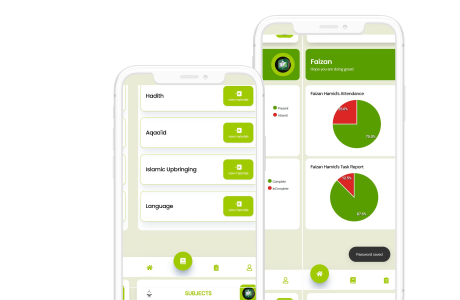
Monthly summary: Ilmify compiles all session data from the month into a formatted monthly summary report, visible in the parent portal without any teacher action needed.
End-of-term report: The term’s data is compiled into a structured report. The teacher adds their qualitative assessment (a few sentences) and the report is complete — no manual calculation of attendance percentages, no manual collation of Sabak pages, no formatting work.
Juz completion milestone: When a teacher marks a Juz assessment as passed, Ilmify generates a milestone notification to the parent and produces a milestone report that can be printed as a certificate.
All reports are private: Each parent sees only their own child’s data. Reports are never shared across the parent group or accidentally visible to others.
Internal link: For parents who want to understand what they should be seeing: Can Parents Track Their Child’s Hifz Progress Online? →
💡 Generate Hifz progress reports in one click — not one afternoonIlmify compiles every session’s data into formatted parent reports automatically, with no extra teacher work.See Ilmify’s Hifz Reporting Features →
Conclusion
A good Hifz progress report is one of the most powerful tools a maktab or Islamic school has for building parent trust, supporting home revision, and demonstrating institutional accountability. It does not need to be long or complex. It needs to be specific, honest, and delivered consistently.
The five elements — current position, progress rate, revision health, attendance, and teacher assessment — give parents the complete picture. The three reporting levels — session update, monthly summary, end-of-term report — ensure the right information reaches parents at the right frequency.
And with the right digital tools, none of this needs to be a burden on teachers. Ilmify automates the data collection and report generation so that teachers can focus on what they do best — teaching — while parents get the visibility they deserve.
See how Ilmify generates Hifz reports automatically →


 at
at