
Introduction
The mosque is the oldest educational institution in Islam. From the earliest Muslim communities, the masjid was not only a place of prayer — it was the classroom, the library, the halaqah, and the centre of Islamic learning. This tradition continues today in mosques worldwide: the majority of Islamic education delivered to Muslim children and adults happens not in dedicated schools, but in mosque-based programmes.
Mosque education software is software designed to manage this reality — not a maktab that happens to use a mosque building, but the full ecosystem of educational activities a mosque runs: the maktab for children, the adult Quran circle, the weekly Islamic studies class, the women’s halaqah, the youth programme, and the Hifz circle for older students. Managing all of these with paper registers, WhatsApp groups, and an imam’s memory is not a system. It is an accident waiting to happen.
This guide covers what mosque education software must do, why mosque-based education management is uniquely challenging, and how to find a platform that serves the full scope of what mosques deliver educationally.
The mosque as an educational institution
Before evaluating software, it helps to understand the scale of what mosque education actually covers.
A typical medium-sized mosque in the UK, North America, or South Africa may run:
| Programme | Students | Frequency | Teacher type |
| Children’s maktab (Quran + Islamic studies) | 40–200 | Daily / weekday evenings | Imam + volunteers |
| Weekend maktab | 30–150 | Saturday/Sunday | Volunteers |
| Hifz circle / halaqah | 5–30 | Daily or weekly | Hafiz teacher |
| Adult Quran class | 10–50 | Weekly | Imam |
| Women’s Islamic studies | 10–40 | Weekly | Female teacher |
| Youth programme | 20–80 | Weekly | Youth coordinator |
| Ramadan intensive | 50–200 | Ramadan period only | Multiple |
Managing all of these programmes — with different teachers, different schedules, different student populations, and different parent communication needs — is a significant administrative challenge. Most mosques manage it badly, or not at all, because no one has time and no system exists to support the effort.
What education programmes mosques run
Maktab (children’s Quran and Islamic studies)
The core educational programme for most mosques. Children attend after school or at weekends to learn Quran recitation (Nazirah), Quran memorisation (Hifz), and basic Islamic studies. This is the programme with the most students, the most teachers, and the most parent communication needs.
Adult Quran and Islamic studies
Many mosques run weekly or bi-weekly Quran circles and Islamic studies classes for adult men and women. These require separate enrolment, separate attendance tracking, and different communication to participants (adults, not parents of children).
Hifz programme
A dedicated Hifz programme for older students or committed younger students working toward full Quran memorisation. This may operate alongside the general maktab or as a separate programme with more intensive scheduling.
Ramadan programmes
During Ramadan, mosques typically run intensified educational programmes — Tarawih for children, Quran completion circles, increased Islamic studies sessions, and sometimes dedicated daily classes that do not exist at other times of year. These have unique scheduling and attendance tracking needs.
Women’s halaqah and niswan education
Women’s Islamic education — Quran classes, Islamic studies, halaqah circles — often operates as a separate programme with female teachers and separate administration. It may share the mosque management system or operate independently.
Youth programmes
Teenage and young adult programmes — often combining Islamic education with community activities — require management tools that handle a different age group with different engagement patterns.
Why mosque education is hard to manage digitally
Fragmentation across programmes
Each programme in a mosque may be managed by a different person — the imam manages the maktab, the Hifz teacher manages the Hifz circle, a volunteer manages the adult class. Without a shared system, data is scattered across multiple people’s phones and notebooks.
Shared physical space creates scheduling complexity
The mosque’s prayer hall is used five times a day. The classrooms are used for maktab in the evenings and weekend classes on Saturday mornings. The women’s section runs a class on Tuesday evenings. Managing these overlapping schedules without a system means conflicts, double-bookings, and disruption.
Part-time and volunteer staffing across all programmes
Not a single programme in the list above is likely to have full-time, dedicated teaching staff. Everyone is part-time, volunteer, or primarily responsible for something else. High turnover is the norm. Software must survive teacher changes without losing data.
Multiple student populations with different communication needs
Children’s maktab parents need Hifz progress updates and absence notifications. Adult Quran class participants communicate directly. Women’s halaqah members have their own communication channel. Youth programme participants may be communicated with directly or via parents depending on age. A single mosque education management system must handle all of these communication contexts.
Ramadan schedule disruption
Ramadan changes everything. The maktab schedule changes. New programmes start. Existing classes restructure. The management system must accommodate a complete schedule rebuild for the Ramadan period, then revert to the normal schedule afterward.
What mosque education software must cover
| Requirement | Priority | Why |
| Multiple programme management (maktab, Hifz, adult, women’s) | Essential | Mosques run multiple programmes simultaneously |
| Hifz tracking (Sabak/Sabaq Para/Dhor) | Essential | Core of children’s and Hifz programmes |
| Separate student populations per programme | Essential | Children and adults are managed differently |
| Shared space scheduling with conflict detection | High | Prevents timetabling conflicts across programmes |
| Volunteer teacher management | High | All mosque programmes rely on volunteers |
| Automated parent notifications | High | No admin time to contact parents manually |
| Adult participant communication (direct, not via parents) | High | Adult programmes communicate differently |
| Multilingual communication | High | Most mosque communities are multilingual |
| Ramadan schedule management | High | Complete schedule change during Ramadan |
| Committee reporting | High | Mosque committee needs institution-wide data |
| Cash and donation fee recording | Medium | Mosque maktabs collect cash or donations |
| Offline functionality | Medium | Mosque Wi-Fi is often unreliable |
| Mobile-first interface | Essential | No dedicated computers in mosque classrooms |
Managing multiple programmes in one mosque
The most distinctive feature required of mosque education software — compared to software for a standalone maktab or madrasa — is the ability to manage multiple independent educational programmes within a single institution.
In Ilmify, each programme is managed as a separate entity within the mosque’s account:
Children’s maktab: Students are enrolled, classes are assigned, teachers log Hifz and attendance, parents receive notifications.
Hifz circle: A separate programme with its own teacher, its own students, and its own three-stream Hifz tracking (which may be more intensive than the general maktab’s tracking).
Adult Quran class: A separate programme where participants are the primary communication recipients (not their parents), attendance is tracked, and progress is recorded differently.
Women’s halaqah: A separate programme with female teacher access and its own communication stream.
Each programme is visible to the administrator from a single dashboard. The mosque committee sees institution-wide metrics across all programmes. Individual programme teachers see only their own programme.
The imam’s role in educational administration
In most mosque-based educational systems, the imam bears disproportionate administrative responsibility. They teach, lead prayers, respond to community needs, manage volunteer teachers, communicate with parents, and report to the mosque committee — all as part of a single, typically full-time but non-administrative role.
Mosque education software that requires significant administrative input from the imam is software that will not be used. The system must be designed to reduce the imam’s administrative burden, not add to it.
Functions that must be automated:
- Absence notifications to parents (triggered by teacher attendance marking — no imam action required)
- Weekly Hifz progress to parents (generated automatically from teacher entries)
- Monthly committee report (generated automatically from accumulated data)
Functions the imam should be able to do quickly:
- View today’s attendance across all programmes (one screen, one minute)
- See which students have not had Hifz logged this week (one tap)
- Send a general announcement to all parents (one message, all languages)
Functions that should not require the imam at all:
- Individual teacher attendance marking (teachers do this themselves)
- Parent responses to notifications (parents and teachers interact directly where appropriate)
- Fee payment recording for individual students (delegated to fee administrator)
Feature comparison: mosque education management tools
| Feature | Paper + WhatsApp | Generic school app | Ilmify |
| Multiple programme management | ✗ | ✗ | ✓ |
| Hifz tracking (3-stream) | ✗ | ✗ | ✓ |
| Adult participant management | ✗ | ✗ | ✓ |
| Shared space scheduling | ✗ | △ | ✓ |
| Ramadan schedule management | ✗ | ✗ | ✓ |
| Volunteer teacher management | △ | ✗ | ✓ |
| Automated parent notifications | ✗ | ✓ | ✓ |
| Adult direct communication | △ (WhatsApp) | ✗ | ✓ |
| Multilingual communication | ✗ | ✗ | ✓ |
| Committee reporting dashboard | ✗ | △ | ✓ |
| Cash fee recording | ✓ (paper) | ✗ | ✓ |
| Offline mode | ✓ | ✗ | ✓ |
| Mobile-first | △ | △ | ✓ |
| Tarbiyah assessment | ✗ | ✗ | ✓ |
| Salah monitoring | ✗ | ✗ | ✓ |
Reporting to the mosque committee
Mosque committees govern the mosque’s operations including its educational programmes. They typically meet monthly and want to know how the education function is performing. Without a management system, the imam or maktab coordinator must manually compile attendance figures, enrolment numbers, and fee collection data before each committee meeting — a task that takes hours and is often done badly or not at all.
With Ilmify, the committee report is available on demand. A single button generates:
Enrolment summary: Total students enrolled across all programmes, broken down by programme and age group.
Attendance summary: Average attendance rate across all programmes, with classes or programmes performing below threshold highlighted.
Hifz progress summary: How many Juz were completed across the institution this month; how many students are on track for their year-end target.
Fee collection summary: Total collected, outstanding balances, and concessions granted.
Teacher attendance: Which teachers were present for all sessions; which had absences or substitutions.
This report takes seconds to generate and is available to committee members through read-only access to the dashboard — they do not need to wait for the imam to compile it manually.
How Ilmify serves mosque education programmes
Ilmify is used by mosque-based educational institutions across more than 40 countries. The majority of its user base are mosque-based maktabs and Islamic education programmes, not standalone schools.
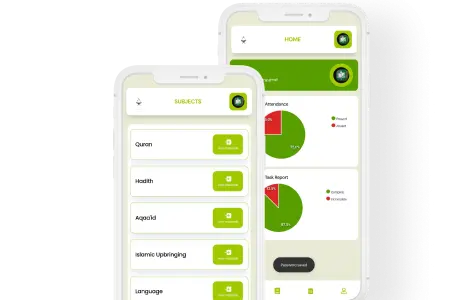
Multi-programme management: Ilmify allows a single mosque account to manage multiple distinct educational programmes — maktab, Hifz circle, adult Quran class, women’s halaqah — each with its own student list, teachers, schedule, and communication.
No dedicated computer required: The entire platform — teacher app, admin dashboard, parent portal — runs on smartphones. The imam manages the institution from their phone.
Offline attendance and Hifz logging: Mosque classrooms with unreliable Wi-Fi are fully supported. Data syncs when connectivity is restored.
Automated communication: Absence notifications, Hifz progress updates, and termly reports are generated and sent automatically. The imam does not need to manually contact parents.
Multilingual parent communication: English, Arabic, Urdu, Tamil, and Malayalam — covering the parent communities of most mosques in the UK, North America, South Africa, South Asia, and Southeast Asia.
Ramadan scheduling: A separate Ramadan schedule can be configured and activated at the start of Ramadan, reverting to the normal schedule at Eid.
Committee dashboard: Monthly institutional reports are available on demand for committee members with read-only access.
Conclusion
Mosque education software must do more than manage a single maktab class. It must support the full scope of educational activity that mosques deliver — multiple programmes, multiple student populations, shared spaces, volunteer teachers, and the unique scheduling demands of Ramadan — from a mobile-first platform that an imam can operate from their phone without IT support.
Ilmify is built for exactly this context. From a 30-student weekend maktab to a multi-programme mosque education department with 300 students across five different learning programmes, the platform scales to the mosque’s educational mission.
Start managing your mosque’s education programmes with Ilmify → Try Ilmify free