
Introduction
Every educational institution tracks attendance. But in a madrasa, maktab, or Islamic school, the meaning of “attendance” is broader than simply recording whether a student showed up. A madrasa attendance management system must track daily class attendance — the foundation — but also Quran lesson attendance, Salah attendance (for institutions that monitor prayer), and in boarding institutions, attendance at night-time revision sessions.
Most generic school management platforms can handle the first type. None of them, by default, handle the others. This gap matters because a student who is physically present in the classroom but is absent from Hifz lessons or not attending congregational Salah is not achieving what an Islamic institution exists to deliver. Attendance data that only records physical presence gives administrators a partial, misleading picture of student engagement.
This guide explains what a complete madrasa attendance management system looks like, how it differs from standard school attendance software, and how to transition from paper registers to real-time digital tracking that actually reflects what happens in an Islamic institution.
Why attendance matters differently in an Islamic institution
In a mainstream school, attendance is primarily a safeguarding and compliance metric. Is the child in school? Is their absence authorised? This is important — but it is a single dimension.
In a madrasa or maktab, attendance is an Islamic educational quality indicator across multiple dimensions simultaneously.
Class attendance shows whether the student is receiving instruction. But a maktab student who attends class but is absent during individual recitation time (when Sabak is assessed) may be physically present but educationally disengaged.
Hifz lesson attendance is distinct from class attendance in institutions with multiple simultaneous programmes. A student may attend general Islamic studies while being absent from the Hifz session.
Salah attendance is tracked by many Islamic institutions as a core indicator of character formation. A student who completes their Hifz but has inconsistent Fard prayer attendance has a different educational profile to one whose Salah practice is strong.
Boarding attendance in residential madrasas includes night-time Tahajjud, early morning Fajr congregational prayer, and post-Isha revision sessions — all of which need to be tracked separately from daytime class attendance.
An attendance management system that only captures “present / absent” for daily class misses three of these four dimensions entirely.
The three types of attendance a madrasa must track
| Attendance type | What it records | Who needs to see it | Frequency |
| Class / session attendance | Whether the student attended today’s maktab session | Admin, teacher, parent | Daily |
| Quran / Hifz session attendance | Whether the student attended individual recitation / Hifz lesson | Hifz teacher, admin | Daily |
| Salah attendance | Whether the student performed Fard, Sunnah, and Nawafil prayers | Tarbiyah coordinator, admin, parent | Daily (5 prayers) |
| Boarding / residential attendance | Whether the student attended Fajr, Isha, Tahajjud, and revision sessions | Warden, admin | Daily (multiple) |
Not every institution needs all four. A weekend maktab with no boarding students needs class and Salah attendance. A full-time hifz residential madrasa needs all four. A software system should accommodate whichever combination is relevant without requiring workarounds.
The problem with paper attendance registers
Paper registers are universal in Islamic institutions — and they are also the source of some of the most persistent administrative problems.
Data is not searchable. Finding how many times a specific student was absent last month, or which students have three or more consecutive absences, requires manually reviewing multiple registers. This takes hours and is done rarely — which means absence patterns go undetected.
No automatic parent notification. A teacher notes an absence in the register. That information does not reach the parent unless someone manually contacts them. Many maktabs rely on students to report their own absences to parents — an obvious gap.
Multiple registers are not integrated. The class attendance register, the Hifz lesson register, and the Salah attendance sheet are separate documents. There is no way to see a student’s full attendance picture in one place.
Registers are not backed up. A physical register that is lost, damaged, or destroyed takes years of attendance data with it. This is not hypothetical — it happens regularly.
Reporting is manual and slow. Generating a monthly attendance report for a parent evening, a board review, or a regulatory inspection requires manually totalling register entries. In a maktab with 80 students, this is a half-day task.
Patterns are invisible. A student who is consistently absent on the same day of the week — suggesting a specific, potentially concerning pattern — will not be identified without deliberate, time-consuming analysis of the physical register.
What a madrasa attendance management system must do
A purpose-built attendance system for Islamic institutions should meet these requirements.
| Requirement | Why it matters |
| Mark attendance by session type (class, Hifz, Salah) | Different sessions need separate records |
| Mobile-first teacher interface | Teachers mark attendance on a smartphone, not a desktop |
| Real-time parent notification on absence | Parents are informed immediately, not the next day |
| Consecutive absence alerts | Automatic flag when a student has 3+ consecutive absences |
| Student attendance history | Full history accessible in seconds, not hours |
| Attendance reports for parents | Monthly or termly reports generated automatically |
| Attendance reports for administrators | Class-level and institution-level summaries |
| Integration with Hifz tracking | Absence from Hifz sessions linked to Hifz progress record |
| Offline recording | Attendance can be marked without internet connectivity |
| Export for inspection / compliance | Attendance data exportable for regulatory purposes |
Attendance feature comparison: what systems offer
| Feature | Paper register | Generic school app | Ilmify |
| Class attendance | ✓ | ✓ | ✓ |
| Hifz / Quran session attendance | ✗ | ✗ | ✓ |
| Salah attendance | ✗ | ✗ | ✓ |
| Boarding / residential attendance | ✗ | ✗ | ✓ |
| Real-time parent notification | ✗ | ✓ | ✓ |
| Consecutive absence alerts | ✗ | △ | ✓ |
| Mobile-first marking interface | ✗ | △ | ✓ |
| Offline recording | ✓ | ✗ | ✓ |
| Integrated with Hifz record | ✗ | ✗ | ✓ |
| Attendance reports for parents | ✗ (manual) | △ | ✓ |
| Attendance reports for admin | ✗ (manual) | ✓ | ✓ |
| Searchable attendance history | ✗ | ✓ | ✓ |
| Data export for inspection | ✗ | ✓ | ✓ |
Salah attendance: the dimension generic systems miss entirely
Salah monitoring is one of the most distinctively Islamic attendance functions — and it is entirely absent from generic school management software.
Many madrasas, boarding Islamic schools, and maktabs track whether students are performing the five daily Fard prayers, and whether they are performing additional Sunnah and Nawafil prayers. This is not about controlling students — it is about forming habits of worship that are central to the Islamic educational mission.
Effective Salah attendance tracking requires:
Granularity by prayer time. Fard, Sunnah, and Nawafil are tracked separately. Whether Fard was performed at the masjid or at home is also recorded by many institutions.
Pattern analysis. A student who consistently misses Asr but attends all other prayers has a different profile to one who misses prayers randomly. Pattern analysis helps Tarbiyah coordinators have targeted, constructive conversations with students.
Parent visibility. Salah attendance is reported to parents alongside Hifz progress and class attendance. It is one of the most important metrics parents want to see — and one that generic parent communication apps cannot provide.
Integration with Tarbiyah records. Salah consistency is a core Tarbiyah indicator. It should feed into the overall character development record, not sit in a separate system.
Ilmify’s Salah monitoring module tracks Fard, Sunnah, and Nawafil attendance across all five daily prayers, generates trend reports for students and parents, and integrates directly with the Tarbiyah assessment record.
Parent notification: closing the communication loop
The attendance management system is only as useful as the communication it enables. A record that an absent student’s parents never know about is a system that failed at its most basic function.
Same-day absence notifications — sent to parents the day the absence occurs — are the standard expectation in 2026. WhatsApp-based maktabs try to replicate this, but informal group messages are easily missed, create privacy issues, and provide no audit trail.
A proper attendance management system sends:
- An immediate notification when a student is marked absent
- A weekly attendance summary (total sessions attended vs total sessions held)
- A termly attendance report for parent review
- A flag when a student’s attendance falls below a threshold (typically 80%)
These notifications should be delivered in the parent’s preferred language — Tamil, Urdu, Malayalam, or English — not just in the language the administrator uses.
Attendance data and safeguarding
For institutions in the UK, Australia, Canada, and other jurisdictions with formal safeguarding obligations, attendance data is a compliance requirement as well as an educational tool.
Unexplained absences must be followed up promptly. A system that automatically flags unexplained absences after 24 hours removes the dependence on individual staff members remembering to make calls.
Attendance records as evidence. In the event of a safeguarding concern, detailed attendance records are frequently requested by authorities. A digital system with timestamped records is far more reliable evidence than a retrospectively reviewed paper register.
Data protection. Attendance records contain personal data and must be stored securely. Digital systems with proper access controls and encryption meet data protection requirements that paper registers simply cannot.
Long-term retention. Student attendance records should be retained for a defined period after a student leaves. Digital systems can enforce retention policies automatically; paper registers are often lost or destroyed.
How to transition from paper to digital attendance
Most maktabs and madrasas that move to digital attendance do so gradually, not all at once. This phased approach reduces disruption and improves adoption.
Phase 1: Class attendance only (weeks 1–4)
Start by moving daily class attendance from paper to digital. Teachers mark attendance on the app at the start of each session. Parents receive same-day absence notifications. Do not change anything else.
Phase 2: Add Quran / Hifz session attendance (weeks 5–8)
Once daily attendance is running smoothly, add Hifz and Nazirah session tracking. Teachers now log Sabak progress alongside attendance in the same interface.
Phase 3: Add Salah monitoring (weeks 9–12)
Introduce Salah attendance tracking. Brief teachers on the Salah monitoring module and how Salah data connects to the Tarbiyah record.
Phase 4: Activate parent reports
Enable monthly attendance reports for parents. These are generated automatically — no additional work for teachers or administrators.
| Phase | What changes | Timeline |
| 1 | Daily class attendance goes digital | Weeks 1–4 |
| 2 | Hifz / Quran session attendance added | Weeks 5–8 |
| 3 | Salah monitoring activated | Weeks 9–12 |
| 4 | Automated parent reports enabled | Week 13 onwards |
Conclusion
A madrasa attendance management system is not the same as a school attendance register moved online. It must track the dimensions of attendance that matter in Islamic education — class presence, Quran session participation, Salah practice, and residential routine — in an integrated system that communicates automatically with parents and generates reports that reflect an Islamic institution’s educational priorities.
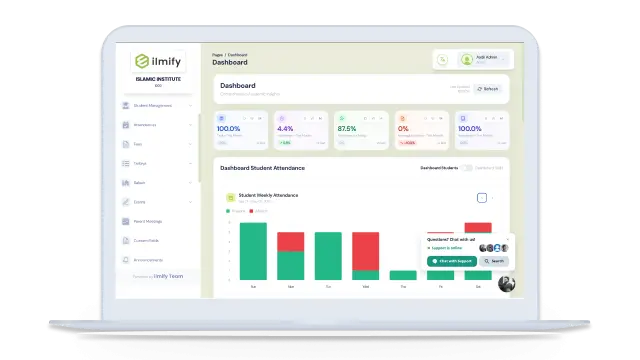
Ilmify’s attendance module covers all of these dimensions, integrates with Hifz tracking and Tarbiyah records, notifies parents in their preferred language, and transitions naturally from paper registers without disruption to teaching.
Move your madrasa attendance management online → Try Ilmify free
Related articles
- Why Salah Monitoring Works in Islamic Schools →
- How Boarding Madrasas Track Daily Prayer →
- Hifz Tracking for Islamic Schools: The Complete Guide →
- How to Digitise Your Madrasa Records in 5 Steps →
- Moving from WhatsApp and Excel to School Management Software →
- Madrasa Student Report Card Templates →
- The Real Cost of Manual Maktab Management →
- Islamic School Data Analytics →





 Arabic
  English
  Malay
Malay  Urdu
Urdu