

Introduction
Parents who send their children to a maktab or madrasa care deeply about Islamic education. They have made an active choice to prioritise Quran learning and Islamic character formation alongside their child’s secular schooling. They want to know whether their child is progressing. They want to be told when something is wrong. They want to feel connected to an institution that is shaping their child’s relationship with Allah and with Islam.
Most maktabs give parents almost none of this. A WhatsApp group message once a month. An occasional call when there is a problem. A termly report card that arrives in paper form, hand-delivered by the child, sometimes lost in a school bag. This is not parent engagement — it is parent neglect dressed up as communication.
A maktab parent portal app changes this. It gives parents real-time visibility into their child’s Hifz progress, attendance, Tarbiyah development, and fee balance — in their own language, on their smartphone, without them having to ask for it. The parent becomes an informed partner in their child’s Islamic education rather than a distant observer who hears nothing unless something goes wrong.
This guide covers what a parent portal must deliver, why the current WhatsApp-based approach fails, and how Ilmify’s parent app changes the parent-institution relationship for maktabs and madrasas.
Why maktab parent communication is broken
The gap between what maktab parents want and what most maktabs deliver is significant. Understanding why helps clarify what the parent portal must fix.
The manual communication problem. Most maktabs communicate with parents only when a teacher or administrator manually sends a message. This means communication happens when someone has time — which is rarely, in a volunteer-run institution. A parent whose child was absent three times this month may not have been contacted at all.
The WhatsApp group problem. WhatsApp groups create several problems: messages are buried by subsequent messages, parents receive irrelevant messages about other students, privacy is violated when all parents can see each other’s responses, and there is no searchable record of what was communicated. A parent who wants to know their child’s Hifz progress from two months ago cannot retrieve it from a WhatsApp group.
The language problem. Most maktab WhatsApp groups communicate in English — the language the administrator is most comfortable with. First-generation parents whose primary language is Urdu, Tamil, Arabic, or Malayalam receive communication in a language they are less comfortable with, reducing both comprehension and engagement.
The one-way communication problem. Most maktab-to-parent communication is one-way: the institution sends, the parent receives. Parents who want to proactively understand their child’s progress have no channel to access it without contacting the teacher or administrator directly — adding to an already stretched team’s workload.
The absence of progress data. Parents of school students receive regular progress reports, grade cards, and parent-teacher meetings. Parents of maktab students often receive nothing about their child’s academic progress in Islamic education for an entire term. A parent who genuinely wants to know how many Juz their child has memorised, or which Tarbiyah goals they are working toward, has no way to find out without asking.
What parents of maktab students actually want to know
When maktab parents are asked directly what they want from the institution’s communication, the answers are consistent across communities and geographies.
| What parents want to know | Current provision | Gap |
| Is my child attending regularly? | Rarely communicated | High |
| What did my child memorise/recite today? | Almost never | Very high |
| Is my child’s Hifz on track? | Once per term at best | High |
| Is my child praying regularly? | Almost never | High |
| What Tarbiyah goals is my child working on? | Almost never | Very high |
| Are there any behavioural or pastoral concerns? | Only when serious | Medium |
| What is our outstanding fee balance? | When reminder sent | Medium |
| What is happening at the maktab next week? | Occasionally | Medium |
| How does my child compare to expectations? | Once per term | High |
The top five items — attendance, daily Hifz/Nazirah progress, Hifz trajectory, Salah monitoring, and Tarbiyah goals — are precisely the items that a purpose-built maktab parent app delivers automatically, without any additional work from teachers or administrators.
The WhatsApp problem: why group messaging is not a parent portal
WhatsApp is the default communication tool for maktabs worldwide — and it fails as a parent communication system in almost every dimension.
| Dimension | WhatsApp group | Parent portal app |
| Individual student data | ✗ All messages visible to all parents | ✓ Each parent sees only their child |
| Hifz progress updates | ✗ Manual, occasional | ✓ Automatic, daily |
| Attendance notifications | ✗ Manual if at all | ✓ Automatic on absence |
| Historical data access | ✗ Buried in message history | ✓ Searchable, always available |
| Parent privacy | ✗ All parents see each other | ✓ Private, individual access |
| Language | ✗ One language (usually English) | ✓ Each parent’s preferred language |
| Data protection compliance | ✗ WhatsApp is not GDPR-compliant for this use | ✓ Purpose-built compliant system |
| Parent response tracking | ✗ No record | ✓ Read receipts and engagement data |
| Professional credibility | ✗ Informal | ✓ Institutional and professional |
| Teacher time required | △ Manual message writing | ✓ Automated — zero extra time |
The most important difference is the last one. A parent portal that sends automatic Hifz progress notifications requires no additional work from teachers — the notification is generated from the Sabak the teacher already logged. WhatsApp requires the teacher or administrator to manually write and send each message.
What a maktab parent portal app must deliver
A parent portal for a maktab or madrasa must provide four types of information, in real time, in the parent’s preferred language.
1. Daily Hifz and Nazirah progress
The single most important information for parents of maktab students. Today’s Sabak — which Surah, which Ayahs, whether the teacher noted strong or weaker performance. For Nazirah students, which portion was recited and the teacher’s fluency assessment. This is not a weekly summary — it is the daily update that tells parents what happened in today’s lesson.
2. Attendance and absence alerts
When a student is marked absent, the parent receives an immediate notification. When attendance falls below a threshold, the parent receives a weekly summary flagging the pattern. Parents should never have to ask “did my child go to maktab this week?”
3. Tarbiyah updates and Salah monitoring
What character development goals is the child working on this term? How consistent is their Salah practice? These are the questions that Islamic education parents care about most — and that are almost never answered by current communication practices. A parent portal that provides weekly Tarbiyah summaries and Salah attendance data changes the parent-institution relationship from transactional to genuinely educational.
4. Fee balance and payment history
Parents can see their current fee balance and payment history without contacting the administrator. This reduces the volume of fee queries and creates transparency that builds trust.
The parent experience: what it looks like in Ilmify
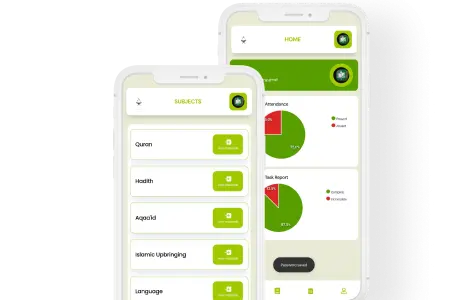
The Ilmify parent app is available on iOS and Android. Parents log in with their phone number — no password required. A one-time code by SMS gives access.
Home screen: The parent sees their child’s name, today’s attendance status, and the most recent Hifz/Nazirah entry. No scrolling required to find the most relevant information.
Hifz tab: A chronological record of every Sabak logged by the teacher, going back to the student’s enrolment. Juz completion milestones are highlighted. The parent can see at a glance how many Juz their child has memorised and how the pace compares to previous months.
Attendance tab: A calendar view of attendance — green for present, red for absent. Weekly attendance rate shown as a percentage. Consecutive absences flagged.
Tarbiyah tab: The student’s current character development goals, the teacher’s most recent Tarbiyah note, and the overall Tarbiyah assessment for the current term.
Salah tab: A seven-day view of Salah attendance — Fajr through Isha — showing which prayers were performed and which were missed or not recorded.
Fees tab: Current balance, last payment, and payment history. Overdue amounts flagged.
Notifications: Parents receive push notifications for absences (immediate), new Hifz entries (daily), and new Tarbiyah reports (weekly or termly). All notifications are in the parent’s preferred language.
Multilingual parent communication: why it matters
Language is the single most underestimated dimension of parent communication in Islamic institutions. Most maktabs communicate in English because that is what the administrator is most comfortable with. But for a significant proportion of maktab parents — particularly first-generation immigrants who are often the most engaged and most committed to their child’s Islamic education — English is a second language.
A parent who receives a Hifz progress notification in Urdu rather than English is:
- More likely to read and understand it
- More likely to discuss it with their child
- More likely to feel respected and included by the institution
- More likely to remain engaged over the long term
Ilmify’s parent portal delivers all notifications, progress reports, and interface text in the parent’s preferred language: English, Arabic, Urdu, Tamil, or Malayalam. The teacher logs Hifz progress in whatever language they work in. The parent receives it in their language. No translation step is required from the teacher or administrator.
The impact on parent engagement is measurable. Institutions that switch from English-only WhatsApp communication to multilingual automated parent portals consistently report higher parent app adoption rates, lower student dropout rates, and more positive parent feedback.
Parent engagement and student retention
The relationship between parent engagement and student retention in maktabs is direct. Students whose parents are actively engaged with their Islamic education — who discuss Hifz progress at home, who know what Tarbiyah goals their child is working on, who receive immediate notification of absences — are significantly less likely to drop out.
This is not surprising. Islamic education competes for children’s time with homework, sports, social activities, and screen time. Parents who are well-informed about their child’s progress and engaged with the institution’s communication are better equipped to prioritise the maktab and support their child’s motivation.
A parent portal app is therefore not just a communication tool — it is a retention tool. Institutions that implement Ilmify consistently report improved student retention rates within the first year of use, attributed primarily to the improvement in parent engagement that the parent portal delivers.
Privacy and data protection for parent-facing apps
A parent portal handles children’s data — which is among the most sensitive categories of personal data. Institutions implementing a parent portal must consider:
Role-based access. Parents see only their own child’s data. Not other children’s attendance. Not other families’ fee balances. Ilmify’s role-based access enforces this at the data level — it is not possible for a parent to view another child’s record.
Consent. Parents should be informed that a digital management system is being used and what data is held about their child. A simple privacy notice, provided at enrolment, covers this requirement.
Data minimisation. The parent portal should show parents the data relevant to their child’s education — not data that is unnecessary. Ilmify limits the parent view to educational and administrative data relevant to the parent relationship.
UK GDPR / data protection compliance. For UK institutions, the parent portal must be compliant with UK GDPR. Ilmify stores UK data in UK/EU-compliant infrastructure with encryption at rest and in transit.
Getting parents onto the app: adoption strategies
The parent portal is only useful if parents use it. Here are the approaches that drive rapid adoption.
SMS invitation at enrolment. When a student is enrolled, the parent receives an SMS with a direct link to set up the parent app. This captures the moment when parents are most engaged — when they have just made the decision to enrol.
First notification creates pull. The first automatic notification the parent receives — typically an absence notification or a Hifz progress update — demonstrates the value of the app immediately. Parents who receive useful information quickly become regular users.
Explicit language choice at setup. During app setup, parents choose their preferred language. This immediately signals that the institution values their language background and removes the English-barrier friction.
Announcement to existing parents. For an institution switching from WhatsApp to a parent portal, a single WhatsApp message announcing the switch — with the invitation link — typically achieves 70–80% parent adoption within two weeks.
Teacher reinforcement. Teachers who mention the app to parents at drop-off (“you can see today’s Sabak in the app”) accelerate adoption significantly.
Conclusion
A maktab parent portal app transforms the parent-institution relationship from one-way, infrequent, and English-only to real-time, automatic, and multilingual. Parents of maktab students deserve to know what their child is learning, whether they are attending, how their Hifz is progressing, and whether their Salah practice is developing — not once a term in a paper report card, but daily, in their own language, on their phone.
Ilmify’s parent app delivers exactly this. It replaces the WhatsApp group, eliminates manual parent communication tasks for teachers and administrators, and builds the kind of parent engagement that keeps students in Islamic education long-term.
Give your maktab parents the visibility they deserve → Try Ilmify free
Related articles
- Madrasa Management App →
- Hifz Progress Report for Parents →
- Can Parents Track Hifz Progress Online? →
- Moving from WhatsApp to School Management Software →
- Madrasa Attendance Management System →
- Parents’ Guide to Tarbiyah Reports →
- Signs Your Maktab Has Outgrown WhatsApp →
- Islamic School Data Analytics →




 Arabic
  English
  Malay
Malay  Urdu
Urdu