Introduction
The phrase “Islamic education app for institutions” covers a wide range of possible tools — from simple attendance registers to comprehensive management platforms covering Hifz tracking, Tarbiyah assessment, fee management, and multilingual parent communication. The range is wide because the institutions that need these apps are diverse: a 25-student Saturday maktab in Manchester, a 500-student residential Darul Uloom in Hyderabad, a Quran centre in Dubai, and an Islamic preschool franchise in Kuala Lumpur all need an “Islamic education app” — but they need different things from it.
This guide is a buyer’s framework. It defines what Islamic institutional education apps must do (the irreducible minimum), how to evaluate platforms against those requirements, which platforms serve which institution types, and how to move from the evaluation decision to a live system within a week. Whether you are managing a small mosque maktab or a multi-branch Islamic education network, the framework applies.
What makes an education app “Islamic” for institutions
Not every education app used by an Islamic institution is an Islamic education app. A generic school management platform used by a madrasa is a generic platform — it does not understand or support Islamic education. An Islamic education app for institutions must:
Understand the Islamic curriculum. Hifz, Nazirah, Qaida, Sabak, Sabaq Para, Dhor — these must be native concepts in the data model, not workarounds built on generic “subject” or “grade” fields.
Reflect Islamic educational values. Tarbiyah — the formation of Islamic character — must be trackable and reportable. Salah practice must be monitorable. The app must be built by people who understand that Islamic education is holistic, not just academic.
Support Islamic institutional structures. Boards like Samastha, Deeniyat, MESBA, and Jamaat — the curriculum frameworks of organised Islamic education — must be accommodatable. The app cannot assume that all Islamic education follows a single model.
Communicate in Islamic community languages. Arabic, Urdu, Tamil, Malayalam — the languages of the communities Islamic institutions serve — must be supported for parent communication, not just for the administrative interface.
Fit Islamic institutional economics. Community maktabs funded by donations and charging £5–£15/month in fees cannot use software priced for well-funded mainstream schools. The pricing model must be designed for community Islamic institutions.
The institutional vs personal distinction
| App type | Who uses it | What it manages | Examples |
| Personal Islamic education app | Individual Muslim | Personal Quran reading, personal learning, personal reminders | Muslim Pro, Quran.com, Tarteel |
| Institutional Islamic education app | School administrators, teachers, parents | Students, classes, Hifz progress, attendance, fees, parent communication | Ilmify, iBeams, eMaktab, Muntazim |
The market for personal Islamic apps is large and well-served. The market for institutional Islamic education apps is smaller but more operationally critical — these are the tools that determine whether a maktab or madrasa runs effectively or not.
Administrators who confuse the two categories — downloading a consumer Islamic app hoping it will manage their institution — waste time and return to paper. The distinction must be clear before any evaluation begins.
Who needs an Islamic education app
| Institution type | App requirement level | Primary functions needed |
| Small mosque maktab (< 50 students) | Essential — basic | Attendance, Hifz tracking, parent notifications |
| Medium maktab (50–150 students) | Essential — standard | Above + fee management, Tarbiyah, parent portal |
| Hifz academy | Essential — deep | Full three-stream Hifz, revision scheduling, Khatm records |
| Full-time Islamic school | Essential — comprehensive | All functions + multi-teacher, academic curriculum, compliance |
| Islamic boarding school | Essential — comprehensive + boarding | All functions + residential management, Salah monitoring, welfare |
| Islamic preschool | Essential — Tarbiyah-first | Tarbiyah reporting, franchise multi-branch, parent engagement |
| Quran centre (GCC/Middle East) | Essential — Arabic-first | Arabic interface, Hifz tracking, Ijazah records |
| Multi-branch maktab network | Essential — network | Central dashboard, branch-level reporting, role-based access |
Every institution type in this list needs an app. The question is not whether to use an Islamic education app but which one fits the specific institution type and context.
The eight functions an Islamic institution app must cover
Function 1: Student management
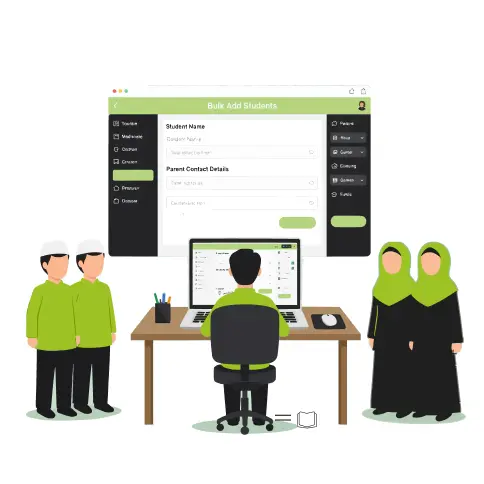
Complete student records — personal data, parent contacts, programme enrolment, starting Hifz position, board affiliation, and communication language preference. Searchable, exportable, and maintained in the cloud.
Function 2: Hifz and Quran progress tracking
Daily Sabak, Sabaq Para, and Dhor tracking for every student in the Hifz programme. Nazirah progress for non-Hifz students. Qaida level tracking for beginners. All three streams independent, daily, per student.
Function 3: Attendance management
Daily attendance marking on smartphone — present, absent, late, excused. Automatic parent notification on absence. Attendance history searchable by student, class, or date range. Salah attendance optional additional layer.
Function 4: Tarbiyah assessment
Islamic character development goals, teacher observations, and termly assessments. Integrated with student record and parent reporting. Not a generic pastoral notes field — a structured Tarbiyah framework.
Function 5: Parent communication
Automated absence notifications, daily Hifz progress updates, weekly summaries, termly reports. Multilingual — parent receives communication in their language. Parent portal app with real-time access to child’s record.
Function 6: Fee management
Student fee recording — cash, UPI, bank transfer. Fee structures, concessions, scholarship tracking. Monthly fee reports for committee oversight. No requirement for a payment gateway — cash recording must work standalone.
Function 7: Teacher and staff management
Teacher accounts with class assignments. Role-based access — teachers see only their classes. Attendance records for teachers. Onboarding new teachers takes under 10 minutes.
Function 8: Institutional reporting
Real-time dashboards for administrators showing today’s attendance, Hifz progress, and fee collection. Monthly reports for mosque committee or board of governors. Data export for regulatory inspection. All generated automatically — no manual compilation.
How to evaluate an Islamic education app
Use this scoring framework to evaluate any platform before committing.
| Criterion | Weight | How to evaluate |
| Native Hifz tracking (Sabak/Sabaq Para/Dhor) | 20% | Log a Sabak in the free trial — is it a native field or a workaround? |
| Multilingual parent communication | 15% | Can you send a parent notification in Urdu or Tamil? |
| Setup time | 15% | Time how long it takes from sign-up to first attendance logged |
| Parent portal quality | 15% | What does the parent see? Is it clear and multilingual? |
| Offline functionality | 10% | Turn off Wi-Fi and try logging attendance — does it work? |
| Fee management | 10% | Can you record a £10 cash payment without a payment gateway? |
| Tarbiyah assessment | 10% | Is there a dedicated Tarbiyah module or just a notes field? |
| Pricing at your institution size | 5% | Is the pricing appropriate for your student count and budget? |
Score each criterion 1–5. A platform scoring under 3 on Hifz tracking or multilingual communication is not suitable for most Islamic institutions regardless of its score on other dimensions.
Platform comparison for 2026
| Platform | Hifz tracking | Multilingual | Parent portal | Offline | Fee management | Tarbiyah | Starting price |
| Ilmify | ★★★★★ | ★★★★★ (5 lang) | ★★★★★ | ★★★★★ | ★★★★★ | ★★★★★ | Free / £19/mo |
| iBeams | ★★★ | ★★ (EN only) | ★★★ | ✗ | ★★★ | ✗ | Contact |
| eMaktab | ★★★ | ★★ (EN only) | ★★★ | ✗ | ★★★ | ✗ | Contact |
| Muntazim | ★★★ | ★★★★ (AR/EN/UR) | ★★★ | ★★ | ★★★ | ★★ | Contact |
| Generic school ERP | ✗ | ★★ | ★★★ | ✗ | ★★★★ | ✗ | £50+/mo |
| WhatsApp + Excel | ✗ | △ | ✗ | ✓ | ✗ | ✗ | £0 |
Overall winner for most institution types: Ilmify. The combination of full three-stream Hifz tracking, five-language parent communication, offline functionality, complete Tarbiyah module, and community-level pricing makes it the strongest overall choice for the majority of Islamic educational institutions globally.
Best for Arabic-first Gulf institutions: Muntazim. For institutions where Arabic is the primary interface language and South Asian language support is not needed, Muntazim’s Arabic-first design is a strong alternative.
Best for very simple UK needs: iBeams or eMaktab. For UK maktabs in English-speaking communities with straightforward attendance and communication needs, iBeams and eMaktab are simpler — though less capable — alternatives.
Institution type matching guide
| Institution type | Recommended app | Key reason |
| Small mosque maktab (< 30 students) | Ilmify Free | No cost, genuine Hifz tracking, offline |
| Medium maktab (30–150 students) | Ilmify Community | Full feature set at £19/month |
| Hifz academy (any size) | Ilmify Community or School | Deepest three-stream Hifz tracking available |
| Full-time Islamic school | Ilmify School | Comprehensive institutional management |
| Islamic boarding school / Darul Uloom | Ilmify School | Only platform with boarding management |
| Islamic preschool / franchise | Ilmify Network | Multi-branch + Tarbiyah-first reporting |
| Quran centre (Gulf) | Ilmify or Muntazim | Hifz + Arabic interface |
| Multi-branch network | Ilmify Network | Central dashboard + branch reporting |
| UK maktab, English-only, simple | iBeams or eMaktab | Simpler; UK-focused community |
| Indian maktab (Tamil Nadu / Kerala) | Ilmify Community | Tamil/Malayalam language support |
| South Asian diaspora maktab (global) | Ilmify Community | Urdu/Tamil/Malayalam + Hifz tracking |
Implementation: from decision to live in one week
Most Islamic institutions that choose Ilmify are fully operational within one week. The typical timeline:
| Day | Action | Time required |
| Day 1 (Monday) | Sign up, choose plan, import student data from CSV or manual entry | 2–3 hours |
| Day 2 (Tuesday) | Set up teacher accounts, assign classes, configure fee structures | 1–2 hours |
| Day 3 (Wednesday) | Teachers download app, 15-minute group walkthrough | 30 minutes |
| Day 4 (Thursday) | First live attendance marking session — teachers use app in class | 0 (during lesson) |
| Day 5 (Friday) | Invite parents to portal via SMS | 30 minutes |
| Weekend | Parents set up parent app, first Hifz notifications received | 0 (automatic) |
| Day 8 (Monday) | Full system live — all teachers using, all parents receiving updates | Ongoing |
Total administrator time invested: approximately 6–8 hours across the first week. Total teacher training time: 15 minutes. Total parent setup time: 5 minutes per family.
Conclusion
An Islamic education app for institutions is not a personal Quran tool — it is the operational infrastructure of a functioning Islamic educational institution. It manages students, tracks Hifz, records attendance, communicates with parents in their language, manages fees, and generates reports that give administrators and committees the data they need to run their institution well.
Ilmify is built specifically for this role — not adapted from a consumer product or repurposed from a generic school platform. If you manage a maktab, madrasa, hifz academy, Islamic school, or any other Islamic educational institution, Ilmify is designed for you.
Find the right plan for your institution and start today → ilmify.app