
Introduction
South India has one of the most distinctive Islamic educational landscapes in the world. Tamil Nadu — and Chennai in particular — is home to thousands of maktabs and madrasas serving Tamil-speaking Muslim communities, operating under a range of local boards and following teaching traditions that differ significantly from the Urdu-medium Deobandi model dominant in North India. Kerala’s Islamic education system is even more structured, with multiple organised streams — Samastha, Deeniyat, Wisdom, and Jamaat-e-Islami affiliated institutions — each with their own curriculum, textbooks, and examination systems.
Finding madrasa software for Tamil Nadu, Chennai, or Kerala that actually fits these institutions is not straightforward. Most Islamic school management platforms are built for North Indian or international contexts. They assume Urdu as the parent communication language, a Deobandi or generic Hifz curriculum, and an administrative structure that does not map onto how South Indian maktabs actually operate.
This guide covers what Islamic institutions in Tamil Nadu, Chennai, and Kerala specifically need from management software — and how to evaluate whether any platform can meet those needs.
Islamic education in Tamil Nadu, Chennai, and Kerala
Tamil Nadu and Chennai
Tamil Nadu has a Muslim population of approximately 4.2 million, concentrated in Chennai, Vellore, Trichy, Madurai, Nagapattinam, and the northern coastal districts. The dominant language of Islamic education is Tamil, with Arabic for Quranic instruction. Most maktabs operate in the evenings after regular school hours, running for one to two hours, five or six days a week.
Chennai’s Muslim communities are distributed across areas including Triplicane, Royapettah, Thousand Lights, Perambur, and Washermenpet, each with a dense network of mosque-based maktabs. The city also has a growing number of full-time Islamic schools and Hifz academies.
The administrative boards governing Tamil Nadu’s maktabs include local Jamaat structures and, increasingly, independent institutional networks. Unlike Kerala, Tamil Nadu does not have a single dominant organised board for maktab education — management is largely decentralised, which creates specific challenges for consistency and record-keeping.
Kerala
Kerala’s 8.9 million Muslims (approximately 26% of the state population) are served by one of India’s most organised Islamic educational systems. The key streams are:
| Stream | Body | Madhab / Tradition | Estimated institutions |
| Samastha SKIMVB | Samastha Kerala Jem-iyyathul Ulama | Shafi’i Sunni | 5,000+ maktabs |
| Samastha SKSVB | Samastha Kerala Sunni Students Federation | Shafi’i Sunni | 2,000+ maktabs |
| Deeniyat | Idara-e-Deeniyat | Deobandi / Hanafi | 800+ maktabs |
| Wisdom | Wisdom Islamic Organisation | Independent Sunni | 600+ maktabs |
| Jamaat-e-Islami | Various JI affiliated bodies | Integrated / reformist | 400+ institutions |
Each stream uses its own textbooks, runs its own examinations, issues its own certificates, and has its own syllabus progression from Level 1 through Level 7 or 8. A software system that cannot accommodate this level structure cannot meaningfully track student academic progress in Kerala.
The specific management challenges South Indian madrasas face
South Indian maktabs and madrasas face a distinct set of operational challenges that differ from institutions in other regions.
Language fragmentation. Teachers and administrators often work in Tamil or Malayalam, Arabic instruction happens in Arabic, and parents may prefer to receive communication in Tamil, Malayalam, or English depending on their background. No single-language system works.
Board-specific curriculum tracking. Kerala institutions, in particular, need to track student progress within specific board syllabi — Samastha Level 3, Deeniyat Level 5, and so on. Generic “grade” tracking does not map onto these level systems.
Evening and weekend scheduling. South Indian maktabs predominantly operate in the late afternoon and evening (4 PM to 7 PM) on weekdays, with Saturday or Sunday classes for revision. Timetabling systems designed for full-day schools do not fit this pattern.
High student-to-teacher ratios. Many Tamil Nadu and Kerala maktabs have one teacher managing 30–60 students, with minimal administrative support. Software must be genuinely simple — not a system that requires a dedicated IT person to maintain.
Fee collection in cash. While digital payments are growing, many South Indian maktabs still collect fees in cash, with manual receipts. A software system that only handles bank transfer or card payment misses how these communities actually operate.
Volunteer teacher workforce. Maktab teachers in Tamil Nadu and Kerala are frequently community volunteers or part-time teachers with varying technical confidence. A system that requires extensive training is effectively unusable.
What Tamil Nadu and Chennai madrasas need in software
Based on the operational context of Tamil Nadu institutions, the following features are non-negotiable for any management software to be genuinely useful.
| Feature | Why it matters for Tamil Nadu |
| Tamil-language parent communication | Most parents in Tamil Nadu maktabs are more comfortable receiving messages in Tamil than English |
| Arabic Quran tracking | Nazirah and Hifz tracking must accommodate Arabic Surah/Juz naming |
| Simple mobile interface | Teachers often use smartphones, not computers, in the classroom |
| Cash fee recording | Many institutions collect fees in cash without a payment gateway |
| Offline functionality | Internet connectivity in classroom settings is not always reliable |
| Evening/weekend timetabling | Class scheduling must accommodate 4–7 PM weekday and Saturday structures |
| Single-teacher class management | One teacher managing a class of 40–60 students must be able to use the system without admin support |
| WhatsApp notification integration | Many South Indian parents are accustomed to WhatsApp updates; transition should be gradual |
Chennai-specific considerations
Chennai’s larger Islamic institutions — full-time schools, Hifz academies, and multi-branch maktab networks — have additional requirements including multi-branch management from a single dashboard, role-based access for multiple administrators and teachers, and more sophisticated reporting for institutional governance. Chennai institutions are generally more open to digital tools than rural Tamil Nadu maktabs, and often have better infrastructure and technical capacity.
What Kerala madrasas need — the Samastha, Deeniyat, and Wisdom streams
Kerala’s organised board system creates specific software requirements that no generic school management platform can meet without significant customisation.
| Requirement | Samastha | Deeniyat | Wisdom |
| Board-specific level tracking (Level 1–7/8) | ✓ Essential | ✓ Essential | ✓ Essential |
| Board exam registration management | ✓ Essential | ✓ Essential | ✓ Essential |
| Textbook/syllabus alignment per level | ✓ Essential | ✓ Essential | ✓ Essential |
| Malayalam parent communication | ✓ Primary language | △ Secondary | ✓ Primary language |
| Arabic Quran progress tracking | ✓ Integrated | ✓ Integrated | ✓ Integrated |
| Certification records | ✓ Required | ✓ Required | ✓ Required |
A management system for a Kerala maktab must be able to record which board the institution is affiliated to, which level each student is in within that board’s progression, what the assessment milestones are for that level, and when the student sat the board examination. Without these fields, the system is not tracking what the institution actually does — it is just a glorified attendance register.
Feature comparison: what South Indian institutions require
| Feature | Generic school ERP | North India-focused madrasa software | Ilmify |
| Tamil language support | ✗ | ✗ | ✓ |
| Malayalam language support | ✗ | ✗ | ✓ |
| Board-level tracking (Samastha, Deeniyat) | ✗ | ✗ | ✓ |
| Evening / weekend timetabling | △ | ✓ | ✓ |
| Cash fee recording | ✗ | △ | ✓ |
| Offline mode | ✗ | ✗ | ✓ |
| Mobile-first teacher interface | △ | △ | ✓ |
| Single-teacher class management | ✗ | △ | ✓ |
| Hifz / Nazirah / Qaida tracking | ✗ | ✓ | ✓ |
| Parent communication in Tamil / Malayalam | ✗ | ✗ | ✓ |
| Multi-branch management (Chennai networks) | △ | ✗ | ✓ |
| Affordable for community maktabs | ✗ | △ | ✓ |
Language requirements for Tamil Nadu and Kerala
Language is the single biggest implementation barrier for South Indian Islamic institutions using management software. The requirements are more complex than simply “we need Tamil” or “we need Malayalam.”
What language complexity looks like in practice:
- The teacher conducts class in Tamil (Tamil Nadu) or Malayalam (Kerala)
- Quranic instruction uses Arabic terminology — Surah names, Juz numbers, tajweed terms
- The administrator records data in English (most comfortable for digital records)
- Parents receive messages in Tamil or Malayalam
- Board examination documents are in Tamil / Malayalam with Arabic sections
A system that only offers an English interface requires the administrator to translate everything mentally between the language they use to interact with parents and teachers, and the language the software uses. Over time this friction drives abandonment.
Ilmify’s multilingual support — English, Tamil, Malayalam, Arabic, and Urdu — means that each role in the institution (admin, teacher, parent, student) interacts with the system in the language most natural to them.
Fee management in the South Indian maktab context
Fee structures in Tamil Nadu and Kerala maktabs reflect community economics that differ from mainstream school fee management.
| Fee characteristic | Tamil Nadu / Kerala maktab | Generic school ERP assumption |
| Payment method | Cash, with manual receipt | Bank transfer or card |
| Fee level | ₹100–₹500/month | Hundreds of pounds/dollars |
| Collection pattern | Monthly, often irregular | Termly, with direct debit |
| Scholarship / concession | Common — many students pay nothing | Exception |
| Community donation offset | Fees often partially subsidised | Not applicable |
| Receipt format | Paper receipt, sometimes handwritten | Digital invoice |
Management software must handle cash recording, manual receipts, flexible concession structures, and the reality that some students are fee-waived by community agreement. A system that only generates digital invoices and tracks bank transfers is not usable for most South Indian maktabs.
How Ilmify serves Tamil Nadu, Chennai, and Kerala institutions
Ilmify is one of the few Islamic school management platforms built with South Indian institutions explicitly in scope.
Tamil and Malayalam interface and communication. Parent messages, notifications, and progress reports can be sent in Tamil and Malayalam. Teachers and administrators who are more comfortable in these languages are not forced to work in English.
Board-level tracking for Kerala streams. Ilmify accommodates the level structures of Samastha, Deeniyat, Wisdom, and other Kerala boards — tracking which level each student is in, when they are due for board examinations, and what their progression looks like within the board’s framework.
Cash fee management. Fee collection in cash is recorded directly in the system. Manual receipts can be generated. Concession structures and fee waivers are handled natively.
Offline functionality. The system works without consistent internet connectivity — critical for maktabs that operate in areas where classroom Wi-Fi is not reliable.
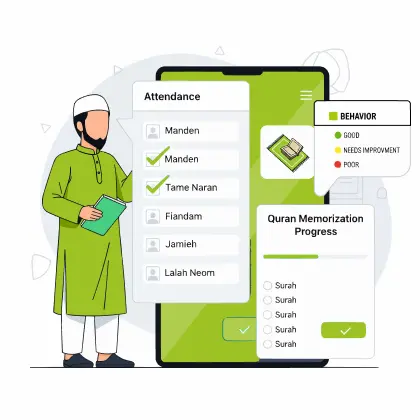
Mobile-first design. Teachers can log Sabak progress, attendance, and Tarbiyah notes from a smartphone. There is no requirement for a computer in the classroom.
Setup in hours. A maktab administrator in Chennai or Thiruvananthapuram can have the system running with their student list, teacher assignments, and fee structure in a single afternoon.
Conclusion
South Indian Islamic institutions — whether a Chennai Hifz academy, a rural Tamil Nadu maktab, or a Kerala madrasa affiliated to Samastha — face a combination of linguistic, curricular, and operational requirements that most management software cannot meet. The gap is not a feature gap that can be patched with customisation. It requires a system built with South Indian Islamic education in context.
Ilmify supports Tamil and Malayalam communication, board-level tracking for Kerala streams, cash fee management, offline operation, and mobile-first teacher interfaces — designed from the ground up for how South Indian maktabs and madrasas actually operate.
Start managing your Tamil Nadu, Chennai, or Kerala institution digitally → Try Ilmify free
Related articles
The 10 Biggest Challenges Running a Maktab in India →
Madrasa Management Software for India: The Complete Guide →
Kerala Islamic Education Boards: Samastha, Wisdom, and Deeniyat Explained →
Best Maktab Management Software for India in 2026 →
Hifz Tracking for Islamic Schools: The Complete Guide →
Maktab Fee Collection in India: From Cash to Online Payments →
Samastha Syllabus, Textbooks, and Levels Explained →





 Arabic
  English
  Malay
Malay  Urdu
Urdu