
Introduction
Every year, thousands of Muslim communities across India recognise the same need: the children in their locality have no structured Islamic education. The nearby mosque runs a basic class, but there is no curriculum, no qualified teacher, no systematic Quran progression, and no connection to any of the established Islamic boards. Parents who care about their children’s Islamic learning have no good local option.
Starting a maktab or Islamic school is the answer — and it is more achievable than most communities assume. This guide covers everything you need to know: the legal structure, board affiliation options, curriculum choices, staffing, fee models, and the operational setup that gives a new institution the best chance of long-term success.
Whether you are an imam planning an evening maktab at your mosque, a mosque committee ready to formalise an existing informal class, or a community group wanting to establish a full-time Islamic school, this guide is your starting point.
Deciding What Type of Institution to Start
India’s Islamic education landscape offers several distinct institutional models. The right model for your community depends on the age of your target students, your available resources, your community’s theological tradition, and whether you want to offer Hifz alongside general Islamic education.
| Institution Type | Students | Sessions | Curriculum | Board Affiliation |
| Evening Maktab | 5–16 years | Evenings, 5×/week | Quran, Islamic studies | Deeniyat, MTB, Jamiat DTB, or independent |
| Morning Maktab | 5–14 years | Mornings, before school | Quran, Islamic studies | Samastha (Kerala), Deeniyat, or independent |
| Hifz School | 8–18 years | Full day or extended | Quran memorisation + Islamic studies | Deeniyat Hifz, Wifaqul Makatib, or independent |
| Integrated Madrasa | 6–18 years | Full day | Islamic + CBSE/State Board curriculum | State Madrasa Board + NIOS/CBSE |
| Darul Uloom | 15+ years | Full day, residential | Dars-e-Nizami classical curriculum | Darul Uloom-affiliated, Wifaq |
For most new institutions, the evening maktab or morning maktab model is the most practical starting point — lower infrastructure cost, easier to staff, and immediately serves the largest community need.
Legal Structure: How to Register Your Institution
Indian law provides several legal structures for charitable educational institutions. You do not need to register a legal entity to run a small informal maktab — but registration becomes essential once you are collecting fees, employing teachers, or seeking any form of official recognition.
Option 1 — Society Registration (Most Common)
Registration under the Societies Registration Act 1860 (or the relevant state equivalent). This is the most common legal structure for Islamic educational institutions in India.
Requirements:
- Minimum 7 founding members (varies by state)
- Memorandum of Association (stating the society’s objectives)
- Rules and Regulations (governing document)
- Registered address
- Filing fee (typically ₹500–₹2,000 depending on state)
Key features:
- Can open a bank account in the society’s name
- Can receive donations and issue receipts
- Eligible for 12A and 80G tax exemptions (allowing donors to claim tax deductions)
- Annual compliance: maintain accounts, file annual returns with the Registrar of Societies
Option 2 — Trust Registration
Registration under the Indian Trusts Act 1882 (for private trusts) or the relevant state Public Trust Act.
Key features:
- Slightly more formal governance structure than a society
- Trust deed specifies the objectives and governance rules
- Trustees have fiduciary duties
- Often preferred for larger institutions or those expecting significant asset acquisition
Option 3 — Section 8 Company
Registration as a not-for-profit company under the Companies Act 2013. This is more formal and has higher compliance requirements — appropriate for larger, more complex institutions rather than a starting maktab.
For a new maktab or small Islamic school, Society Registration is the recommended starting structure. It is the most widely used, the most familiar to Islamic institutions across India, and the most straightforward to maintain.
| Legal Structure | Setup Cost | Annual Compliance | Best For |
| Society | ₹2,000–₹5,000 | Low (annual returns) | Most maktabs and madrasas |
| Trust | ₹3,000–₹8,000 | Low-medium | Institutions with significant assets |
| Section 8 Company | ₹15,000–₹30,000 | High (MCA filings) | Large, complex institutions |
Source: Ministry of Corporate Affairs and state Registrar guidelines; Ilmify India research, 2026
Obtaining 12A and 80G status:
Once registered, apply to the Income Tax Commissioner for 12A registration (exempts the institution’s income from tax) and 80G registration (allows donors to claim 50% tax deduction on donations). Both require the institution to have been in operation for at least one year. These registrations significantly increase donation willingness from wealthier community members.
Choosing a Board Affiliation
Board affiliation provides your students with a formal certificate at the end of each level — a credential that parents value and that connects your institution to a larger Islamic educational network. It also provides curriculum guidance, teaching support, and examination infrastructure that a new institution would otherwise need to develop independently.
India’s major maktab boards and their characteristics:
Idara-e-Deeniyat (National, HQ Mumbai)
- Scale: 1.6 million students, 25+ countries
- Tradition: Sunni/Deobandi
- Curriculum: 7 courses from Nursery to Muallim (teacher training)
- Infrastructure: Provides books, desks, uniforms, ID cards as a complete package
- Best for: North and South India; any mosque with space for an evening maktab
- Registration: deeniyat.com (national) or deeniyatkerala.com (Kerala)
Samastha Kerala Sunni Vidyabhyasa Board (SKIMVB — Kerala)
- Scale: 1 million+ students, 10,000+ madrasas
- Tradition: Sunni/Barelvi/Shafi’i
- Curriculum: 14 class levels, 140 textbooks, 6 languages
- Best for: Kerala and South Indian institutions with Shafi’i tradition
- Registration: Through Samastha regional offices
Markazi Taleemi Board / MTB (National, JIH)
- Scale: National, ~90 textbooks
- Tradition: Jamaat-e-Islami Hind
- Curriculum: Integrated approach — Islamic + mainstream academic
- Best for: Institutions wanting curriculum integration with mainstream education
- Registration: Jamaat-e-Islami Hind state offices
Jamiat Deeni Talimi Board (National, Deobandi)
- Scale: National (West Bengal, Assam, UP, Maharashtra active)
- Tradition: Deobandi/Jamiat Ulama-i-Hind
- Curriculum: Framework-based; links mosque maktab to district madrasa to Darul Uloom
- Best for: North Indian institutions in Jamiat Ulama network
Independent (No board affiliation)
- No external examination or certification
- Full curriculum flexibility
- Higher parent expectation management challenge (no external credential)
- Suitable for experimental or highly localised models
Recommendation for new institutions: Affiliate with Deeniyat if you are in North India or want a national-reach credential; with Samastha if you are in Kerala; with MTB if your community values integrated education. Independent operation is viable but creates more curriculum development work and offers students less credential recognition.
Selecting Your Curriculum
Your board affiliation largely determines your curriculum. However, there are supplementary curriculum decisions to make regardless of board affiliation:
Quran programme (essential — decide this first):
- Nazra only: Students learn to read the Quran correctly by sight. This is the baseline Quran programme for all maktabs.
- Nazra + Hifz: Students who show capacity and family commitment are moved into full memorisation. This requires a dedicated Hifz teacher and more intensive scheduling.
- Nazra + Tajweed: Students learn Quran recitation with formal Tajweed rules. This can be incorporated into the general programme without the full Hifz infrastructure.
Islamic studies subjects (from your board’s curriculum):
All major boards cover: Aqeedah, Fiqh/Islamic practice, Seerah, Hadith, and Arabic. The depth and sequence vary. Review your chosen board’s syllabus before registering to ensure it matches your community’s theological tradition.
Language of instruction:
- North India: Urdu is standard; supplementary Arabic
- Kerala: Malayalam is standard; Arabic and Arabi-Malayalam
- Karnataka/Bengaluru: Kannada and Urdu depending on community
- Tamil Nadu: Tamil and Arabic
Ensure your teacher hiring plan matches your language of instruction requirements.
Finding and Hiring Qualified Teachers
Teacher quality is the single most important factor in a maktab’s success — more important than curriculum, facilities, or board affiliation. A talented, committed teacher with modest materials will produce better outcomes than a mediocre teacher with excellent infrastructure.
Qualification expectations by subject:
| Subject | Minimum Qualification | Preferred Qualification |
| Quran Nazra / Tajweed | Completed Nazra; basic Tajweed knowledge | Certified Qari; Deeniyat Muallim Diploma |
| Quran Hifz (teacher) | Hafiz-ul-Quran | Hafiz + Deeniyat Muallim Diploma or equivalent |
| Islamic Studies (Aqeedah, Fiqh, Seerah) | Alim degree or equivalent | Alim + teaching experience |
| Arabic language | Arabic proficiency | University degree in Arabic or Islamic studies |
Where to find qualified teachers:
- Local Darul Uloom graduates (Alims looking for teaching positions are common)
- Deeniyat Muallim Course graduates (specifically trained for maktab teaching)
- Samastha Thadreeb trained teachers (Kerala)
- MTB Master Trainer network
- Local mosque imam (for part-time support)
- JIH network for MTB-affiliated institutions
Compensation guidance:
For a new institution, teacher compensation typically follows one of three models:
- Volunteer imam model: The mosque imam teaches as part of their mosque duties. Zero additional cost, but capacity is limited and quality varies.
- Part-time paid teacher: ₹4,000–₹12,000/month (varies significantly by region and qualification). Sustainable for institutions with 40+ students.
- Full-time paid teacher (Hifz school): ₹10,000–₹20,000/month for a qualified Hafiz in most North Indian cities.
Critical first year staffing principle: It is better to start with one excellent teacher for a smaller student group than to recruit multiple mediocre teachers to accommodate a larger group. Teacher quality is harder to recover from than student number shortfalls.
Space and Infrastructure Requirements
Most new maktabs begin in a mosque — using the prayer hall, a side room, or a dedicated madrasa room within the mosque complex. This is the most common and most practical starting arrangement.
Minimum space requirements:
| Facility | Minimum | Preferred |
| Teaching space | 1 room, 15 sq metres | 2 rooms, 25 sq metres each |
| Seating | Floor mats (traditional) or chairs and desks | Dedicated student desks |
| Writing surface | Whiteboards or blackboard | Whiteboard per room |
| Storage | Locked cabinet for registers and books | Separate storage room |
| Toilet access | Shared mosque facilities acceptable | Separate student facilities |
| Wudu facility | Shared mosque facilities | Accessible for students before prayer |
Deeniyat infrastructure package: Institutions affiliating with Idara-e-Deeniyat can receive a complete infrastructure package — books, desks, uniforms, ID cards, bags, and blackboards — which significantly reduces initial setup cost. This package is available through the Deeniyat registration process.
Safety requirements:
Even for informal maktabs, basic child safety requirements apply:
- Teacher should never be alone with a single student in an enclosed space
- All teaching spaces should have visibility (windows or open doors)
- Emergency contact information for all students must be maintained
- A basic first aid kit should be available
- POCSO (Protection of Children from Sexual Offences) awareness is mandatory for anyone working with children in India
Setting Your Fee Structure
Indian maktab fee structures vary enormously — from completely free (Zakat/Waqf funded) to ₹500–₹1,000/month for structured institutions in urban areas. Setting the right fee structure from the beginning prevents the common problem of undercharging to build enrolment, then struggling to raise fees later.
Principles for setting maktab fees:
1. Cover your real costs. Calculate your monthly teacher cost, utility contribution to the mosque, and material costs. Divide by expected student numbers. This is your minimum fee.
2. Offer a Zakat/bursary option. Every Islamic institution should have a formal bursary programme for families who genuinely cannot afford the fee. This maintains access for all students regardless of economic status, which is a fundamental Islamic principle, while maintaining a sustainable fee structure for those who can pay.
3. Collect fees monthly, not annually. Monthly collection is more manageable for families and creates more predictable cash flow for the institution. Annual collection creates large individual payment burdens and higher default risk.
4. Accept UPI payments from day one. Even if your students are in a modest socioeconomic group, UPI (Google Pay, PhonePe, Paytm) penetration in India is near-universal. Offering UPI from the start reduces the cash collection burden significantly.
Sample fee structure for a new evening maktab (North India, 50 students):
| Category | Monthly Fee | Notes |
| Standard fee | ₹250–₹400 | Covers costs with modest surplus |
| Bursary (Zakat-eligible families) | ₹0–₹150 | Assessed by application |
| Hifz programme supplement (if applicable) | +₹150–₹250 | Additional teacher cost |
| Registration fee (once at enrolment) | ₹200–₹500 | Setup costs |
Fees should be reviewed annually. Never increase fees mid-year without adequate notice.
Building Your Management System Before You Open
This section is typically overlooked by new institutions — and it is responsible for more operational problems in the first year than almost any other factor.
Most new maktabs start with informal systems: a notebook for attendance, a WhatsApp group for parents, and a cash box for fees. These systems work for the first month. They begin to break down at 40 students. They become a serious liability at 80 students.
The correct approach is to set up a proper management system before you open — not after the problems become acute.
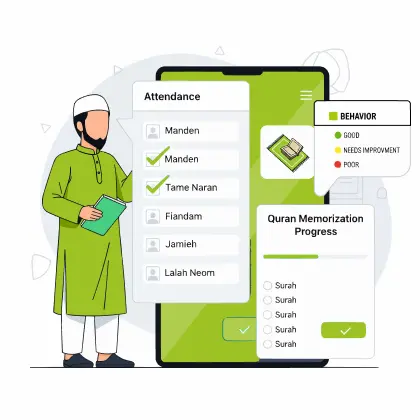
What your management system should do from day one:
- Record all student enrolment information (name, guardian contacts, medical notes, fee category)
- Track daily attendance digitally
- Record Quran progress (Nazra level and, if applicable, Hifz Sabak/Sabak Para/Dhor)
- Generate fee invoices and record payments
- Send parent notifications (attendance, progress, fee reminders)
- Store all records securely (not on a personal phone or personal laptop)
Why doing this from day one matters:
- Institutional records belong to the institution, not to the individual who set them up. If your first administrator leaves, the records stay.
- Starting with good systems is significantly easier than migrating from bad systems later.
- Parent expectations are set from the first interaction. Parents who receive a professional enrolment confirmation and a parent portal from day one have higher confidence in the institution.
- Board exam eligibility depends on attendance records from the first session. If you start tracking attendance on paper and then lose or damage the register, eligibility assessments become impossible.
Ilmify for new Indian maktabs: Ilmify is designed to be set up quickly for a new institution — student profiles, board affiliation, Hifz tracking, and parent notifications can be configured in a single session before the first class. The platform supports all major Indian boards (Deeniyat, Samastha, MTB) and works offline for institutions with unreliable connectivity.
Student Enrolment and Launch
Building your first student cohort:
The most effective channels for initial student enrolment for a new maktab are: mosque announcement (for Jumu’ah), personal outreach by the imam to families with school-age children, word-of-mouth through existing community networks, and a brief notice in the local Muslim community WhatsApp groups.
Do not invest significantly in formal advertising for an initial cohort. Maktab enrolment is driven almost entirely by trust and personal referral. Focus on enrolling 20–30 students for your first cohort and doing the job excellently — the referrals will grow the institution from there.
The enrolment process:
At enrolment, collect the following information from every family:
- Student’s full name and date of birth
- Guardian names, phone numbers, and WhatsApp numbers
- Home address
- Any medical conditions or special needs relevant to the educational setting
- Fee category (standard / bursary application)
- Emergency contact (different from primary guardian)
Provide to each family at enrolment:
- Welcome letter explaining the institution, curriculum, board affiliation, and schedule
- Fee structure and payment methods
- Privacy notice (explaining what data you collect and why — required under India’s Digital Personal Data Protection Act 2023)
- Parent contact details for the institution
The First Year: What to Expect and How to Handle It
The first year of a new Islamic school is a learning process for the institution as much as for the students. Common first-year challenges and how to handle them:
Inconsistent attendance in the first month: Normal. New routines take 4–6 weeks to establish. Maintain consistent communication with parents of absent students, track who is falling away early, and make personal contact rather than group reminders.
Teacher preparation taking longer than expected: Build buffer into your weekly schedule. A teacher who is well-prepared for 60 minutes is more effective than one stretched thin over 90 minutes. Reduce session length if needed in the first term rather than maintaining ambitious timings with poor delivery.
Parents asking for progress updates too early: Set expectations at enrolment about how and when progress will be communicated. A formal progress report at the end of the first term (after 10–12 weeks) is appropriate; individual reports on request in the first month create unsustainable administrative burden.
Fee collection gaps: Some families will miss the first month’s payment. Handle this personally and sympathetically in the first instance — understand whether it is financial difficulty (offer bursary) or administrative oversight (gentle reminder). Do not let gaps accumulate beyond two months.
Board registration delays: Board affiliations often take a full term to formalise — exams for the first cohort will typically be in year two. Communicate this to parents honestly from the start.
Launch Checklist
| Action | Done? |
| Legal and Registration | |
| Society / Trust registered | ☐ |
| Bank account opened in institution’s name | ☐ |
| 12A application submitted (after first year) | ☐ |
| Board affiliation registration submitted | ☐ |
| Staffing | |
| Head teacher confirmed and contracted | ☐ |
| Additional teachers confirmed (if applicable) | ☐ |
| Teacher qualification documents on file | ☐ |
| POCSO awareness confirmed for all staff | ☐ |
| Curriculum and Materials | |
| Board curriculum materials ordered | ☐ |
| Quran programme model decided (Nazra / Hifz / both) | ☐ |
| Deeniyat infrastructure package ordered (if applicable) | ☐ |
| Teaching space prepared and inspected | ☐ |
| Management System | |
| Management platform set up (Ilmify or equivalent) | ☐ |
| Student enrolment forms designed | ☐ |
| Fee structure confirmed | ☐ |
| UPI payment details set up | ☐ |
| Parent notification system tested | ☐ |
| Launch | |
| Initial student cohort enrolled (target: 20–40) | ☐ |
| Parent welcome communication sent | ☐ |
| First session schedule confirmed with all families | ☐ |
| Attendance tracking started from day one | ☐ |
Conclusion
Starting an Islamic school in India is one of the most impactful contributions a Muslim community can make. The institutions that succeed long-term share common characteristics: a clear institutional structure from the beginning, board affiliation that gives students recognised credentials, qualified teachers who are fairly compensated, a sustainable fee model with provision for those who cannot pay, and a management system that keeps institutional knowledge in the institution rather than in any individual’s head.
None of these is beyond the reach of a motivated mosque committee or community group. The resources — boards, curricula, teacher training programmes, and management tools — exist. The gap is usually simply knowing what to do and in what order.
👉 Set Up Ilmify for Your New Maktab Before Your First Session — Takes One Hour →
Related Articles
You might also find these helpful:
- ⚙️ Maktab Management Software for India in 2026
- 📚 Maktab Boards in India: The Complete Guide to Every Major Network
- 📚 What Is Idara-e-Deeniyat? India’s Largest Mosque-Based Maktab Network
- 📚 How to Track Hifz Progress Digitally: A Step-by-Step Guide
- 📚 How to Run a Maktab Fee Collection System That Actually Works
- 📚 The 10 Biggest Challenges Running a Maktab in India
- ✅ How to Choose Islamic School Management Software: The Complete Buyer’s Guide
- ⚙️ Best Madrasa Management Software in 2026: The Complete Comparison Guide





 Arabic
  English
  Malay
Malay  Urdu
Urdu