Introduction
Women’s Islamic education in India has undergone a significant and largely unacknowledged transformation over the past four decades. The classical image — informal, home-based, transmitted by mothers and female relatives, limited to Quran recitation and basic practice — describes a reality that has been substantially changed by the emergence of dedicated women’s Islamic educational institutions across the country.
Today, thousands of Madrasa Banaat (girls’ Islamic schools) operate in India, from small mosque-attached classes for girls to full residential Darul Ulooms producing Alimah graduates. The sector is growing faster than its male equivalent in some regions, driven by a combination of religious conviction, economic incentive, and the growing availability of online pathways that remove historical access barriers.
The Historical Context
Formal Islamic education in classical South Asian history was almost entirely male. The Darul Uloom, the madrasa, the Hafizia — these were institutions for men and boys. Women’s Islamic education was transmitted informally: mothers taught daughters Quran recitation and basic Fiqh; women’s circles at mosques transmitted religious knowledge; elite households maintained female scholarly traditions through private instruction.
The change began incrementally. Darul Uloom Deoband — the institution that shaped nearly everything else in South Asian Islamic education — established a formal female Islamic education programme over the course of the 20th century. Other Darul Ulooms followed. By the 1980s and 1990s, dedicated women’s madrasas — Madrasa Banaat — were being established across North and South India, producing Alimah graduates for the first time in institutional numbers.
The sector has accelerated in the 21st century: digital platforms have enabled women in conservative communities to access Islamic education remotely; Gulf remittances have funded girls’ institutions in communities where they could not previously have been sustained; and the growing demand for qualified female Islamic teachers has created an employment market that incentivises Alimah training as a practical qualification, not only a religious one.
The Madrasa Banaat Model
Madrasa Banaat (مدرسہ بنات) — “schools for daughters” — are dedicated Islamic educational institutions for women and girls. They parallel the male Dars-e-Nizami tradition but are adapted for the female educational context.
Residential vs Non-Residential:
Residential Madrasa Banaat are common in rural and semi-rural areas where girls would otherwise have no access to structured Islamic education — they travel from across a region, board at the institution, and return home during holidays. This model provides access but creates management complexity: boarding, meals, guardian permissions, health management, and child safety all require institutional attention.
Day-model Madrasa Banaat are more common in urban areas where families want Islamic education for daughters but prefer them to live at home. Less logistically complex, but requiring the institution to manage more diverse family contexts and transportation arrangements.
Curriculum structure: The Alimah programme typically covers 6–8 years of study, beginning with Arabic language sciences (Sarf and Nahw) and progressing through Quran with Tafsir, Hadith, Fiqh with specific emphasis on female-relevant rulings, Aqeedah, and Seerah. The final years include the study of Hadith collections in the tradition of the male Dawra-e-Hadith, with the Alimah Sanad issued on completion.
The Alimah Programme
The Alimah certificate is the female equivalent of the Alim degree — the primary credential of a Madrasa Banaat. A 6–8 year programme covering:
- Arabic language: Sarf (morphology) and Nahw (syntax) — the tools for engaging classical texts
- Quran with Tajweed and Tafsir: Systematic study of the Quran’s meaning and interpretation
- Hadith: Study of prophetic traditions, typically through the major Hadith collections in the final years
- Fiqh: Hanafi jurisprudence, with specific emphasis on the rulings most relevant to women’s practice — rules of purity (Tahara), menstruation and its effect on prayer and fasting, marriage law from the woman’s perspective, her rights and obligations within the family
- Aqeedah and Seerah: Islamic theology and the Prophet’s biography
- Usul al-Fiqh: Principles of Islamic jurisprudence
Some Indian Madrasa Banaat have adopted a condensed 6-year female Dars-e-Nizami curriculum — structurally similar to Pakistan’s Wifaq boards’ women’s track — leading to the same Alimah terminal credential as the 8-year programme, with female-specific Fiqh topics given additional time.
West Bengal’s Documented Sector
The West Bengal Board of Madrasah Education’s data provides unusual visibility into the women’s sector. WB’s data shows approximately 42 girls-only Senior Madrasahs in the state’s formal board-affiliated system — a small but documented subset of a much larger ecosystem. This confirms that institutionalised girls’ Islamic education is not a marginal phenomenon but a recognised and growing component of the formal madrasa system, at least in states that collect and publish this data.
MANUU and the Equivalency Question
Maulana Azad National Urdu University (MANUU) in Hyderabad is a central university specifically serving the Urdu-speaking Muslim community. MANUU has developed equivalency programmes for madrasa graduates — both male and female — enabling them to transition into mainstream higher education with their Islamic credentials recognised.
For Alimah graduates specifically, MANUU’s equivalency pathways provide a route from Islamic education to mainstream university admission: a bridge that would otherwise not exist. An Alimah graduate who completes a MANUU equivalency programme can apply for university postgraduate programmes.
MANUU also offers distance education programmes that allow women in conservative communities to access higher education without requiring residential relocation — a significant accommodation for the social constraints that affect women’s educational mobility.
The Employment Pipeline
The Alimah credential creates a genuine employment pipeline within India’s Islamic education sector:
Teaching in Madrasa Banaat: The most common path — Alimah graduates return to institutions like their own, teaching Quran, Hadith, Fiqh, and Arabic to the next generation of female students.
Quran teaching for women and children: In communities where male teachers are not appropriate for female students, Alimah graduates provide Nazra instruction, Tajweed correction, and basic Islamic Studies to neighbourhood women and children.
Online Islamic education: The growth of online Quran teaching — through Zoom, dedicated platforms, and WhatsApp-based instruction — has created significant employment for qualified female Islamic teachers. An Alimah with Tajweed certification can teach students globally from home, without physical mobility constraints. This has been particularly transformative for graduates in rural areas with limited local employment options.
Emerging Iftaa roles: Some major Islamic institutions in India are beginning to establish female Dar al-Iftaa departments — recognising that women seeking Islamic guidance on personal matters may prefer to receive it from a female scholar. This is an emerging but growing role for highly qualified Alimah graduates.
Geographic Distribution
Madrasa Banaat are distributed across India with significant regional variation:
North India (UP, Bihar): The largest concentration in absolute numbers — reflecting the overall North Indian dominance of Indian Islamic education and the strong tradition of Deobandi-aligned Darul Uloom education for which Banaat institutions are the female parallel.
South India (Kerala, Tamil Nadu, Karnataka): Integrated into the broader South Indian Islamic education network. Kerala’s Samastha has a developed Madrasa Banaat track. Tamil Nadu and Karnataka have independent institutions and trust-run networks.
Gujarat: A strong Banaat tradition, reflecting Gujarat’s prosperous Muslim community and its history of investment in Islamic education.
POCSO and Residential Girls’ Madrasas
The Protection of Children from Sexual Offences Act (POCSO, 2012) applies to all institutions serving minors — including residential Madrasa Banaat. For residential girls’ madrasas, POCSO compliance requires:
- Background verification of all staff with access to children
- Mandatory reporting procedures when abuse is suspected or disclosed
- Clear institutional policies on child-adult interactions
- Safe, accessible reporting channels for students and junior staff
POCSO awareness in the Madrasa Banaat sector has been improving but remains uneven across institutions. Residential girls’ madrasas that lack documented POCSO compliance policies are exposed to serious legal and reputational risk — as well as, most importantly, a failure of duty of care to the children in their charge.
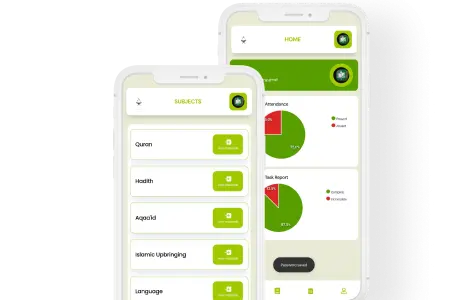
Software for Madrasa Banaat
Residential Madrasa Banaat have specific software requirements beyond general madrasa management:
Guardian management: Every residential female student has a designated wali (guardian) whose permission governs key decisions — overnight stays, holiday travel, medical procedures. Guardian contact details, permission records, and communication logs must be maintained systematically.
Dormitory management: Room assignments, roommate records, dormitory staff assignments, and entry/exit records at term start and end.
Purdah-compliant visitor management: Authorised visitor lists (male relatives permitted as mahram under Islamic rules), visit scheduling, and visit logs — balancing family access with the institution’s Islamic environment.
Health records: For residential students, basic health records and medical contact details are institutional safety requirements, not optional features.
POCSO documentation: Staff background check records, mandatory reporting logs, policy acknowledgements, incident records — specific to institutions serving minor females in residential settings.
Alimah curriculum tracking: The 6-8 year Alimah curriculum needs book-completion tracking (as with the Dars-e-Nizami) rather than conventional subject grades, along with Hifz progress records for students who are completing memorisation alongside their studies.
See how Ilmify supports residential Madrasa Banaat →
Conclusion
India’s Madrasa Banaat sector is one of the fastest-growing and least-documented areas of Islamic education in the country. From small urban day schools offering the Alimah certificate to large residential Darul Ulooms for girls in rural UP and Bihar, these institutions are meeting a genuine and growing demand — for Islamic education that is serious, credentialled, and designed for women — that has historically been unmet.
The management challenges of running a residential girls’ madrasa are substantial and specific: guardian management, POCSO compliance, purdah-compliant visitor protocols, dormitory logistics, health records, and the Alimah curriculum’s classical book-tracking requirements. Standard school management software addresses none of these; generic madrasa software addresses some but misses the residential female-specific requirements.
Ilmify is designed to serve the full range — from small Madrasa Banaat day schools to large residential Darul Uloom Banaat — with the specific features that female Islamic education in India actually requires.
See how Ilmify supports Madrasa Banaat and residential girls’ institutions →
Related articles: