
Introduction
The majority of Islamic education delivered to Muslim children in the West — and in much of South Asia, Southeast Asia, and Africa — happens not in full-time schools, but in weekend maktabs and Sunday Islamic schools: community institutions that operate one, two, or three days per week, typically on weekends, run by mosque committees, volunteer teachers, and part-time administrators.
These institutions are the backbone of Islamic education for millions of children. They are also, operationally, some of the hardest institutions to manage well. Not because they are complex in the way a full-time school is complex — but because they operate with minimal staff, high volunteer turnover, irregular schedules, and no dedicated administrative time. A maktab that meets for two hours on Saturday and two hours on Sunday has the same fundamental management needs as a daily institution — student records, Hifz tracking, attendance, fees, parent communication — but almost no capacity to meet those needs manually.
This guide covers what weekend maktab software must do, why standard school management tools are a poor fit, and how to find a solution that works for the way part-time Islamic institutions actually operate.
The weekend maktab model — what makes it distinct
Weekend maktabs and Sunday Islamic schools vary significantly in structure, but share a set of defining characteristics that separate them from both full-time schools and daily maktabs.
| Characteristic | Weekend / Sunday maktab | Daily maktab | Full-time Islamic school |
| Sessions per week | 1–3 (typically Sat/Sun) | 5–6 (evenings) | 5 (full days) |
| Session length | 1.5–3 hours | 1.5–2 hours | 6–8 hours |
| Teaching staff | Mostly volunteers | Volunteers + some paid | Mostly paid |
| Administrative staff | Part-time or volunteer | Part-time or volunteer | Dedicated admin |
| Fee structure | Low (£5–£20/month) or donation-based | Low to moderate | Moderate to high |
| Student age range | 5–16 | 5–14 | 5–18 |
| Curriculum focus | Quran + basic Islamic studies | Quran + Islamic studies | Full Islamic + secular |
| Governance | Mosque committee | Mosque committee or independent | Board of governors |
The part-time nature of the weekend maktab creates specific management pressures. Teachers arrive, teach, and leave — there is no staffroom, no common planning time, and no administrative support available during the session. Record-keeping happens in the moment or not at all.
Why standard school software does not fit weekend institutions
Generic school management software is built around the assumption of a full-time school day: multiple subjects, a complex timetable, a dedicated admin office, and staff who are present for most of the working week. None of these assumptions hold for a weekend maktab.
Timetabling mismatch. A school management system designed for 30-period weeks cannot simply be configured for a two-session weekend schedule without leaving most of its timetabling module unused and confusing.
Overkill complexity. Volunteer teachers who arrive on Saturday morning to teach for two hours will not use software that requires 15 minutes of training and presents irrelevant modules about GCSE tracking and UCAS applications.
No Islamic curriculum tracking. The absence of Hifz tracking, Nazirah progress, and Tarbiyah assessment is the fundamental gap — weekend maktabs teach Quran, and their software must track Quran progress.
No volunteer teacher model. School management systems assume employed, contracted staff with payroll records. A maktab with 12 volunteer teachers who attend on a rota needs a different staffing model entirely.
Pricing designed for full schools. Software priced at £5–£15 per student per month is fine for a school charging £2,000 per year in fees. It is unaffordable for a weekend maktab charging £10 per month per student.
The five management challenges unique to weekend maktabs
Challenge 1: Irregular attendance — students and teachers
Weekend maktab attendance is notoriously inconsistent. Family events, sports, holidays, and illness all compete with Saturday morning Quran class in a way they do not compete with a full school day. Teacher attendance is equally variable — a volunteer who teaches every week may occasionally be unavailable, requiring last-minute cover.
A management system must handle irregular attendance patterns without generating alarm-level alerts for every missed Saturday.
Challenge 2: No admin present during sessions
Most weekend maktabs have no dedicated administrator present during the teaching session. The most senior teacher present doubles as de facto administrator. Management software must allow a single teacher to run the entire session — taking attendance, logging Hifz, and handling basic communication — without administrative support.
Challenge 3: High volunteer teacher turnover
Volunteer teachers leave for reasons unrelated to the maktab — career changes, moving house, family commitments. When a volunteer teacher leaves mid-year, their class’s Hifz records, attendance history, and student notes must remain accessible. Software that stores data locally on a teacher’s phone — rather than in the cloud — loses all of this when the teacher leaves.
Challenge 4: Parent communication in a low-contact institution
Parents of weekend maktab students have limited opportunity to engage with the institution. There are no school gates to chat at five days a week. There is no daily newsletter. Communication is sporadic and often reactive — parents only contact the maktab when there is a problem. Regular, automated progress communication — “here is what your child did in Hifz class this Saturday” — dramatically improves parent engagement and student retention.
Challenge 5: Fee collection at very low amounts
Weekend maktab fees are often very low — £5–£20 per month — or are donation-based with no fixed amount. Standard invoicing and payment systems are not designed for this model. The software must handle voluntary contributions, irregular payments, and scholarship/fee-waiver situations without requiring a full accounts system.
What weekend maktab software must do
| Requirement | Why it matters for weekend maktabs |
| Simple enough for a volunteer teacher to use in 5 minutes | No training time available on a Saturday morning |
| Works on a smartphone — no desktop required | Teachers use phones, not computers |
| Offline attendance and Hifz logging | Weekend venues often have poor Wi-Fi |
| Saturday / Sunday timetabling (not Mon–Fri) | Default school timetabling is wrong |
| Hifz and Nazirah progress tracking | Core curriculum of most weekend maktabs |
| Automated parent notifications on absence | No admin available to make calls |
| Automated weekly Hifz progress to parents | Replaces WhatsApp updates |
| Volunteer teacher management (no payroll) | Different from employed staff model |
| Low-amount fee recording (£5–£20/month) | Cash and donation-based models |
| Cloud storage — data survives teacher turnover | Critical for institutional continuity |
| Free or very low cost | £19/month or less — not per-student pricing |
Feature comparison: tools used by weekend maktabs
| Feature | WhatsApp group | Paper register | Generic school app | Ilmify |
| Hifz / Nazirah tracking | ✗ | ✗ | ✗ | ✓ |
| Sat/Sun schedule (not Mon–Fri) | ✗ | ✓ | △ | ✓ |
| Works offline | ✓ | ✓ | ✗ | ✓ |
| Attendance on smartphone | △ | ✗ | ✓ | ✓ |
| Auto parent notification on absence | ✗ | ✗ | ✓ | ✓ |
| Weekly Hifz update to parents | ✗ | ✗ | ✗ | ✓ |
| Volunteer teacher model | ✗ | ✓ | ✗ | ✓ |
| Low-amount fee recording | ✗ | ✓ | ✗ | ✓ |
| Cloud data (survives teacher change) | ✗ | ✗ | △ | ✓ |
| Tarbiyah assessment | ✗ | ✗ | ✗ | ✓ |
| Parent portal app | ✗ | ✗ | △ | ✓ |
| Free or low cost | ✓ | ✓ | △ | ✓ |
Scheduling for Saturday and Sunday institutions
Weekend maktab timetabling has requirements that most school management systems do not accommodate without significant workarounds.
Two-day weekend schedule. Many weekend maktabs run on both Saturday and Sunday — sometimes different classes on each day, sometimes the same classes on both days with different content (Saturday for Hifz, Sunday for Islamic studies, for example).
Session-based, not period-based. Rather than 30-period timetables, weekend maktabs have one or two sessions per day — typically a morning session (9 AM–12 PM) and sometimes an afternoon session (2 PM–4 PM). The timetabling system should work at the session level, not the period level.
Ramadan adjustments. During Ramadan, many weekend maktabs change their schedule significantly — shifting to evening sessions, adding Tarawih attendance tracking, or reducing class length. The scheduling system must accommodate this without rebuilding the entire timetable.
Bank holiday and term break management. Weekend maktabs in the UK and other Western countries typically close for bank holidays and school holidays — though not necessarily aligned precisely with the local school term calendar. The system should allow custom closure dates without requiring a school-style term structure.
Volunteer teacher management
Managing volunteer teachers is fundamentally different from managing employed staff. Weekend maktab software must accommodate this reality.
No payroll. Volunteer teachers receive no salary. The software should not require salary records or generate payroll reports that are irrelevant.
Rota-based attendance. In maktabs where multiple volunteers share a teaching rota, the system should track which teacher was present on which Saturday — for accountability and Hifz record continuity.
Class handover continuity. When a volunteer teacher leaves or is temporarily unavailable, their class’s Hifz records, attendance history, and student notes must be immediately accessible to the replacement teacher. Cloud storage with role-based access makes this seamless.
Simple onboarding. A volunteer teacher who joins in September should be able to set up their account and be logging attendance by the following Saturday. Training requirements must be minimal.
Parent communication in a part-time context
Weekend maktab parents are typically engaged but time-poor. They want to know what their child is doing in Islamic class — but they are not at the maktab gate every Saturday to ask the teacher directly.
Automated absence alerts remove the need for the maktab to call or message every absent student’s parent manually. When a student is marked absent, the parent receives a notification automatically.
Weekly Hifz summaries tell parents what their child memorised or recited this Saturday — which Surah, which Ayahs, whether the teacher noted strong or weaker performance. For parents who value their child’s Quran progress highly, this is the single most important communication the maktab can provide.
Termly progress reports give parents a structured view of the semester — attendance rate, Hifz progress, Tarbiyah notes, and Islamic studies assessment. For a weekend maktab, generating these manually for every student is a full day’s work. An automated system generates them in minutes.
Language. Parent communication for weekend maktabs in the UK, North America, and Australia often needs to be multilingual — English for second-generation families, Urdu for first-generation South Asian parents, Tamil or Malayalam for South Indian communities, Arabic for Arab diaspora families. Ilmify’s multilingual parent communication covers all of these.
How Ilmify works for weekend and part-time maktabs
Ilmify’s Community plan is designed with the weekend maktab as the primary use case.
Session-based scheduling — not period-based — works naturally for a Saturday morning and Sunday afternoon institution. The administrator defines sessions, not periods, and teachers mark attendance at the session level.
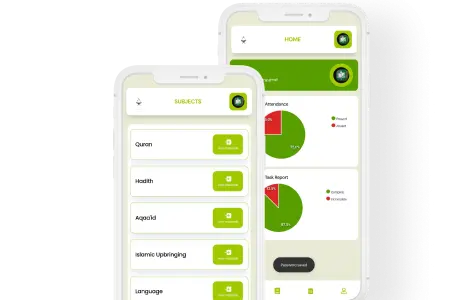
Offline teacher app allows Hifz and attendance logging on a Saturday morning even if the venue’s Wi-Fi is unreliable. Everything syncs when the teacher’s phone reconnects.
Volunteer teacher accounts require no payroll configuration. Teachers receive a login, see only their classes, and log Hifz and attendance — nothing more complex unless they need it.
Automated parent communication sends absence notifications and weekly Hifz summaries without any additional administrative work after initial setup.
Community-level pricing starts at £19/month for up to 150 students — appropriate for a weekend maktab that cannot justify per-student pricing at school rates.
Free plan covers institutions up to 30 students at no cost — sufficient for a small mosque maktab getting started with digital management.
Conclusion
Weekend maktab and Sunday Islamic school software needs to meet a different standard from full-time school management platforms. It must be simple enough for a volunteer teacher to use on a Saturday morning, powerful enough to track Hifz progress and communicate with parents automatically, and affordable enough for a community institution running on donations.
Ilmify is used by weekend maktabs across the UK, North America, South Africa, Australia, and South Asia — institutions that range from 20 students meeting on Sunday mornings to 200 students across Saturday and Sunday sessions. The platform scales to the size and schedule of any part-time Islamic institution.
Start managing your weekend maktab digitally → Try Ilmify free
Related articles
- How to Start a Maktab Step by Step →
- How to Run a Maktab Without an Admin →
- Hifz Tracking for Islamic Schools →
- Moving from WhatsApp to School Management Software →
- Madrasa Attendance Management System →
- Maktab Parent Communication in North America →
- Signs Your Maktab Has Outgrown WhatsApp →
- After School and Weekend Maktabs in America →