

Introduction
The term Islamic LMS is used loosely — sometimes to mean an online Quran teaching platform, sometimes a school administration system, sometimes a parent communication app, and sometimes all three at once. The lack of a clear definition makes it hard for maktabs, madrasas, and Islamic schools to evaluate what they actually need.
This guide gives a precise, practical answer. A learning management system (LMS) in the Islamic education context is software that manages the full cycle of instruction, tracking, and communication for an Islamic educational institution — not just content delivery. An Islamic LMS is an LMS built specifically for the way Islamic institutions teach: through Hifz memorisation, Nazirah recitation, Tarbiyah formation, and Salah practice, delivered by teachers whose students are tracked across these dimensions simultaneously.
Understanding what an Islamic LMS is — and what it is not — helps institutions choose the right tool rather than buying a content platform when they need an operations platform, or buying an operations platform when they need curriculum delivery.
What LMS means — and what Islamic LMS means
Standard LMS definition
A Learning Management System is software designed to create, deliver, track, and report on educational content and learner progress. In mainstream education, LMS platforms like Moodle, Canvas, and Google Classroom allow teachers to upload lessons, assign work, run assessments, and track whether students have completed them.
Islamic LMS definition
An Islamic LMS applies this framework to Islamic education. The learning being managed is not a GCSE History module — it is Quran memorisation, tajweed practice, Islamic studies subjects, and character development. The learner progress being tracked is not essay grades — it is Hifz completion, Sabak retention, Nazirah fluency, and Tarbiyah milestones.
An Islamic LMS is therefore a system that:
- Defines the curriculum of an Islamic institution (Hifz programme, Nazirah programme, Islamic studies syllabus)
- Assigns learning tasks to individual students within that curriculum
- Tracks student progress through Islamic-specific milestones
- Communicates progress to parents and administrators
- Reports on institutional performance across these dimensions
How an Islamic LMS differs from a standard LMS
The differences are not cosmetic. A standard LMS built for secular education cannot function as an Islamic LMS without fundamental changes to its data model.
| Dimension | Standard LMS | Islamic LMS |
| Content unit | Lesson, module, course | Sabak, Juz, Surah, Islamic studies level |
| Assessment type | Quiz, essay, exam score | Hifz retention test, Nazirah recitation check, Tarbiyah evaluation |
| Progress metric | Percentage completion, grade | Juz memorised, Sabaq Para retention, Salah consistency |
| Learning goal | Academic qualification | Quran completion (Khatm), Islamic character formation |
| Teacher role | Subject specialist | Hafiz/Hafiza, Ustadh/Ustadha, Tarbiyah mentor |
| Parent communication | Grade reports, absence alerts | Hifz progress updates, Tarbiyah summaries, Salah monitoring reports |
| Calendar | September–July term | Islamic calendar with Ramadan adjustments |
| Language | Typically monolingual | Multilingual (Arabic for Quran, local language for administration and communication) |
The four functions an Islamic LMS must cover
Function 1: Quran learning management
The core of most Islamic institutions is Quran learning — whether Nazirah (recitation), Hifz (memorisation), or both. An Islamic LMS must manage this through:
- Daily Sabak tracking — recording today’s new memorisation (Hifz) or recitation (Nazirah)
- Sabaq Para / recent revision tracking — monitoring the retention of recently memorised material
- Dhor / long-term revision — scheduling and recording systematic revision of completed Juz
- Milestone recording — Juz completion, Khatm events, teacher certification
- Parent progress reporting — automated or on-demand reports on Quran progress for parents
Function 2: Islamic studies curriculum management
Beyond Quran, most institutions teach Islamic studies subjects — Fiqh, Aqeedah, Seerah, Ahadith, Tarikh, Akhlaq, and Arabic language. An Islamic LMS should allow institutions to define their syllabus for these subjects, assign work, assess students, and report on performance within an Islamic studies framework rather than a generic subject-grade model.
Function 3: Tarbiyah and character development tracking
Islamic education is holistic. Character formation — Tarbiyah — is not an add-on to academic learning; it is central to the educational mission. An Islamic LMS must include a framework for assessing and recording student character development, Islamic behaviour, manners, and personal goal-setting, in a format that is meaningful to teachers and legible to parents.
Function 4: Institutional administration integration
Learning management cannot be separated from institutional administration. Attendance, fees, teacher management, and parent communication must be integrated with the learning management functions — not maintained in parallel systems. An Islamic LMS that only manages curriculum without handling operations is only half a system.
Islamic LMS vs madrasa ERP: what is the difference?
The terms Islamic LMS and madrasa ERP are sometimes used interchangeably. The distinction is useful.
| Aspect | Islamic LMS (narrow) | Madrasa ERP (broad) |
| Primary focus | Curriculum delivery and learning tracking | Full institutional management |
| Includes | Lesson assignment, progress tracking, assessments | LMS functions + administration, finance, HR |
| Does not include | Fee management, staff payroll, institutional governance | (All functions included) |
| Best for | Online Quran teaching platforms, supplementary curriculum tools | Full institutional management for maktabs, madrasas, Islamic schools |
In practice, most Islamic institutions need a system that functions as both — one that manages learning (Hifz tracking, curriculum delivery, assessment) and operations (fees, attendance, parent communication, staff management). Ilmify is designed to cover both functions in a single platform.
Feature comparison: what to look for
When evaluating an Islamic LMS or madrasa management platform, use this framework.
| Feature | Online Quran platform (LMS only) | Madrasa admin system (ERP only) | Purpose-built Islamic LMS/ERP (Ilmify) |
| Hifz / Nazirah tracking | ✓ | △ | ✓ |
| Daily Sabak logging | ✓ | ✗ | ✓ |
| Islamic studies curriculum | ✓ | ✗ | ✓ |
| Tarbiyah assessment | ✗ | ✗ | ✓ |
| Salah monitoring | ✗ | ✗ | ✓ |
| Attendance management | ✗ | ✓ | ✓ |
| Fee management | ✗ | ✓ | ✓ |
| Parent communication | △ | ✓ | ✓ |
| Progress reports | ✓ | △ | ✓ |
| Multilingual support | △ | ✗ | ✓ |
| Teacher management | ✗ | ✓ | ✓ |
| Islamic calendar | △ | ✗ | ✓ |
| Offline functionality | ✗ | ✗ | ✓ |
| Mobile-first design | ✓ | △ | ✓ |
Who needs an Islamic LMS?
Maktabs and weekend Islamic schools
A maktab typically has one or two teachers, 30–100 students, and operates for two to three hours per day. The primary learning management need is tracking Quran progress (Hifz or Nazirah) and communicating it to parents. A full-featured online course platform is overkill. What a maktab needs is a focused Islamic LMS that does Quran tracking, attendance, and parent communication — simply and affordably.
Full-time madrasas and Islamic schools
A full-time madrasa has more complex needs: a multi-subject Islamic studies curriculum, Hifz programme management, staff scheduling, fee administration, and regulatory compliance. The Islamic LMS component (curriculum and learning tracking) must be integrated with the ERP component (operations and administration) in a single system.
Hifz academies
A hifz academy’s entire educational mission is Quran memorisation. Its LMS requirements are deep but narrow: sophisticated Hifz tracking with Sabak, Sabaq Para, and Dhor stages, revision scheduling, retention testing, and milestone certification. A general-purpose LMS is a poor fit. An Islamic LMS with deep Hifz functionality is essential.
Online Quran teaching institutions
Institutions that teach Quran online — via Zoom or dedicated platforms — need an Islamic LMS that handles virtual session management, online assessment of recitation, and parent reporting for remote students. This is the context closest to a “pure LMS” use case in Islamic education.
Islamic school networks and franchise brands
An Islamic preschool or maktab franchise operating across multiple locations needs an Islamic LMS that provides centralised oversight of curriculum delivery, consistent progress reporting, and multi-branch management from a single dashboard.
What Islamic LMS does not mean
Clarity about what an Islamic LMS is requires equal clarity about what it is not.
It is not just a content library. Platforms that provide a library of Islamic lessons, videos, or resources without tracking individual student progress are not LMS platforms — they are content platforms. Ilmify is an LMS; an Islamic YouTube channel is not.
It is not just a parent communication app. Apps that send messages to parents about their child’s school day, without managing the learning or tracking progress, are communication tools, not LMS platforms.
It is not just an online Quran teaching platform. Platforms designed specifically for online, one-to-one Quran tutoring are a specialised subset of Islamic LMS. They typically lack the institutional management functions needed by a maktab or madrasa.
It is not a generic LMS with Islamic content added. A Moodle installation with a Quran course uploaded is not an Islamic LMS in the meaningful sense. The data model — how it tracks progress, what it considers a milestone, how it structures the curriculum — must be built for Islamic education from the ground up.
How Ilmify functions as an Islamic LMS
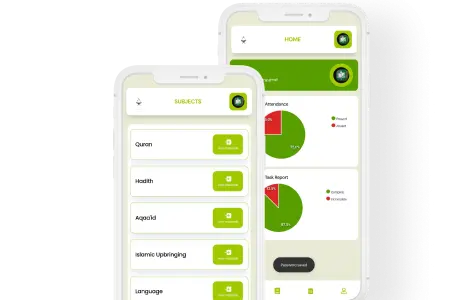
Ilmify integrates Islamic LMS functions with full madrasa ERP capabilities in a single platform.
Learning management: Hifz tracking (Sabak, Sabaq Para, Dhor), Nazirah progress, Qaida level tracking, Islamic studies subject management, and Tarbiyah assessment are all native features — not add-ons.
Curriculum assignment: Teachers assign Sabak, mark recitation quality, and log revision completion directly in the app. Curriculum frameworks can be customised to match the institution’s own syllabus or board requirements.
Progress reporting: Automated progress reports for parents include Hifz milestones, Tarbiyah assessments, and Salah monitoring in a format designed for Islamic education — not repurposed academic report cards.
Operational integration: Attendance, fee management, teacher scheduling, and parent communication are fully integrated with the learning management functions. There are no parallel systems.
Multilingual delivery: Parents receive progress reports in their preferred language. Teachers interact with the system in the language they are most comfortable with.
Conclusion
An Islamic LMS is not a generic learning management system with Islamic content added. It is a system built specifically for the way Islamic institutions teach — tracking Hifz progress, Tarbiyah formation, Salah practice, and Islamic studies curriculum in an integrated platform that also manages the institutional operations that mainstream school software was not designed for.
Ilmify is built to serve exactly this function. Whether you run a small evening maktab, a full-time madrasa, a hifz academy, or an online Quran school, Ilmify’s Islamic LMS and ERP capabilities are designed for your context — not adapted from a mainstream education platform.
Explore Ilmify as your Islamic LMS → Try Ilmify free
Related articles
- Madrasa ERP vs School ERP: Why Generic Systems Fail →
- Best Madrasa Management Software in 2026 →
- How to Choose Islamic School Management Software →
- Hifz Tracking for Islamic Schools: The Complete Guide →
- What Is Tarbiyah? →
- Digital Transformation in Islamic Schools →
- The Real Cost of Manual Maktab Management →
- Islamic School Data Analytics →




 Arabic
  English
  Malay
Malay  Urdu
Urdu