
Introduction
Every maktab wall in the subcontinent has, at some point, displayed his verse. Every Urdu-medium school child has memorised his lines. Yet for many Islamic school leaders today, Allama Iqbal remains a poet on a poster — admired, framed, and largely unexplored.
That is a loss. Because beneath the verse, Iqbal was something far more actionable: a philosopher of education whose central ideas — the elevation of the self, the courage to reason independently, the integration of spiritual and worldly knowledge — speak directly to the challenges Islamic schools face in 2026. The passive learner who memorises without comprehension, the madrasah that fears modernity, the maktab that treats Tarbiyah as an afterthought: Iqbal diagnosed all of these problems nearly a century ago. And he offered answers.
This article explores what Allama Iqbal actually believed about education, why his ideas remain relevant to madrasahs, maktabs, Hifz schools, and Islamic preschools today, and what practical lessons institutional leaders can draw from his life and work.
1. Who Was Allama Iqbal?
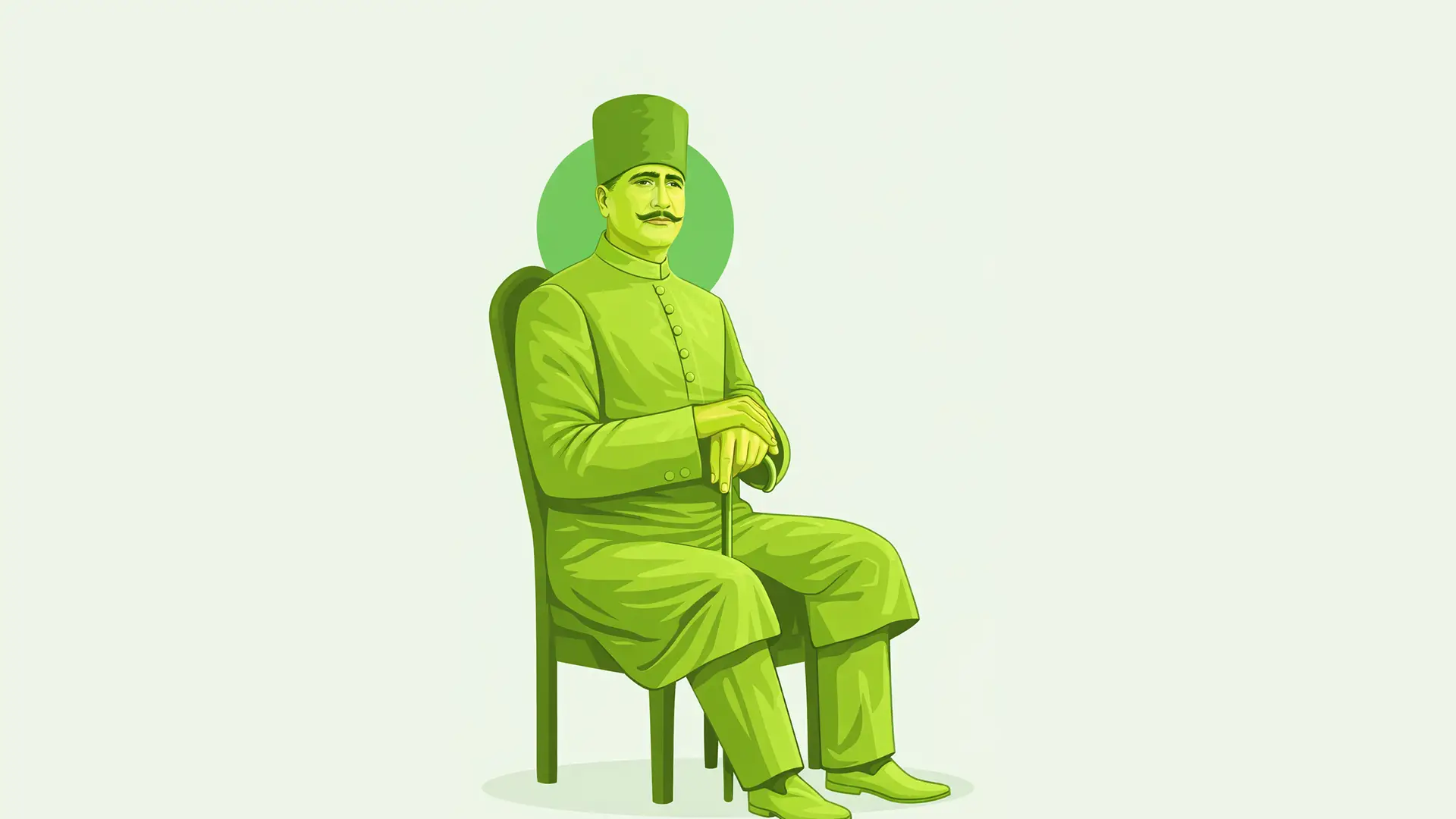
Sir Muhammad Iqbal — known universally by the honorific Allama, meaning “the greatly learned” — was born on 9 November 1877 in Sialkot, Punjab, in British India (present-day Pakistan), and died on 21 April 1938 in Lahore. He is recognised as Pakistan’s national poet, and is described with titles that reflect the breadth of his impact: Shair-e-Mashriq (Poet of the East), Mufakkir-e-Pakistan (Thinker of Pakistan), and Hakeem-ul-Ummat (Sage of the Ummah).
But Iqbal was never only a poet. He was simultaneously a philosopher, a barrister, a political leader, and a theorist of Muslim revival. He studied at Cambridge, earned a doctorate from the University of Munich, and delivered the famous 1930 Allahabad Address that planted the conceptual seed for a separate Muslim homeland. His landmark prose work, The Reconstruction of Religious Thought in Islam (1930), is regarded as one of the most significant works of Islamic intellectual thought in the 20th century.
| Fact | Detail |
| Born | 9 November 1877, Sialkot, Punjab, British India |
| Died | 21 April 1938, Lahore |
| Primary language of poetry | Persian (approx. 7,000 of 12,000 verses) and Urdu |
| Academic credentials | MA Philosophy (Lahore); BA (Trinity College Cambridge); PhD (University of Munich, 1908); Barrister (Lincoln’s Inn) |
| Honorifics | Allama, Shair-e-Mashriq, Hakeem-ul-Ummat, Mufakkir-e-Pakistan |
| Key prose work | The Reconstruction of Religious Thought in Islam (1930) |
| Key poetic works | Asrar-e-Khudi (1915), Rumuz-e-Bekhudi (1917), Bang-e-Dara (1924), Bal-e-Jibril (1935), Javid Nama (1932) |
| British recognition | Knighted in 1922 following publication of Asrar-e-Khudi |
Sources: Wikipedia; Encyclopedia.com; Rekhta.org
2. Iqbal’s Own Educational Journey
To understand Iqbal’s educational philosophy, it helps to trace his own formation. His earliest education began, as was customary in 19th-century Muslim Punjab, in the maktab: he learned Quran recitation and Arabic from Syed Mir Hassan, a scholar of classical languages. This beginning in Islamic foundational learning was formative. Iqbal never disowned it.
Under the mentorship of Mir Hassan, Iqbal proceeded to Scotch Mission College in Sialkot, then Government College Lahore, where he completed his MA in Philosophy in 1899. He subsequently taught Arabic at Oriental College, Lahore, before travelling to England and Germany for advanced study. At Cambridge, he engaged the Western philosophical tradition at its source. In Munich, his doctoral thesis examined The Development of Metaphysics in Persia — a topic that required him to hold Islamic philosophical heritage and European thought in simultaneous conversation.
This biographical arc is itself an educational lesson: Iqbal was a product of both maktab and university, of Syed Mir Hassan and Immanuel Kant. His philosophy of education was not born in abstraction; it emerged from the lived experience of moving between two intellectual worlds without losing his Islamic identity in either.
3. The Core of Iqbal’s Philosophy: Khudi
Everything in Iqbal’s educational vision flows from a single concept: Khudi, often translated as “selfhood,” “ego,” or “self-realisation.”
For Iqbal, Khudi did not mean arrogance or pride. It referred to the divine spark within every human being — the quality that, according to Iqbal, caused God to command the angels to prostrate before Adam. To develop one’s Khudi is to realise one’s status as Allah’s khalifah (vicegerent) on earth. To suppress it — through passivity, blind imitation, or spiritual dissolution — is to betray one’s covenant with the Creator.
Iqbal introduced this concept systematically in Asrar-e-Khudi (Secrets of the Self), published in 1915. In it, he described three developmental stages through which the self must pass:
| Stage | Concept | Meaning in Practice |
| 1 | Ita’at (Obedience) | Complete submission to the law of Allah; the foundation of all sound character |
| 2 | Dabt-e-Nafs (Self-Control) | Disciplined governance of one’s desires, acquired through the five pillars of Islam |
| 3 | Niyabat-e-Ilahi (Divine Vice-Regency) | The elevated station of one who has mastered self, now capable of serving as God’s agent on earth |
Source: Iqbal, Asrar-e-Khudi (1915); Saiyidain, Iqbal’s Educational Philosophy (1977)
Iqbal’s most quoted articulation of Khudi’s educational ambition comes in the following couplet, which captures his conviction that a fully developed self — grounded in faith — could reach a station of supreme spiritual dignity:
خُدی کو کر بلند اتنا کہ ہر تقدیر سے پہلےخُدا بندے سے خود پوچھے، بتا! تیری رضا کیا ہے
Khudi ko kar buland itna ke har taqdeer se pehle,Khuda bande se khud pooche, bata teri raza kya hai.
(Elevate your self to such a height that before every decree, God Himself asks His servant: tell me, what is your desire?)
This is not a claim of equality with the Divine. It is a statement about the potential dignity of a human being who has fully submitted to Allah and developed their God-given capacities. The educational implication is radical: every student sitting in a maktab, madrasah, or Islamic school is a being of this potential. The institution’s task is to help them reach it — not to process them through a system.
For educational institutions, this framework has a direct implication: the purpose of schooling is not to produce examination passers or even pious attendees of ritual. It is to develop students capable of reaching the third stage — people of genuine moral agency, intellectual courage, and spiritual depth. Everything else — curriculum, methodology, assessment — should serve that end.
4. What Iqbal Thought Was Wrong With Islamic Education
Iqbal was not a gentle critic. He surveyed the Islamic educational landscape of his time and found it wanting on multiple fronts. His concerns remain remarkably pertinent.
The Problem of Rote Without Reflection
Iqbal explicitly rejected “stereotyped methods of teaching which give no space for thinking.” In his view, education that trained students to reproduce knowledge without engaging with it intellectually was not education at all — it was intellectual subjugation. He favoured methods of “self-activity and learning by doing,” confronting students with new problems and compelling them to work purposefully.
This critique lands directly on a still-live tension in many maktabs: the emphasis on memorisation of Quran, texts, and hadith without sufficient corresponding emphasis on comprehension, application, and independent thinking. Iqbal would not have dismissed Hifz — he understood its spiritual significance. But he would have insisted on a complementary cultivation of the intellect.
The Divorce Between Religious and Worldly Knowledge
One of Iqbal’s most consistent arguments was that Islam does not sanction a separation between religious knowledge (‘ilm al-din) and worldly knowledge (‘ilm al-dunya). Philosophy, science, and technology, in his view, were not foreign imports to be treated with suspicion — they were tools through which the Muslim could better discharge their role as God’s vicegerent. He believed religion, philosophy, and science needed to live in harmony.
Crucially, Iqbal attacked educational systems that produced what he called mere careerists — graduates who accumulated qualifications but were deprived of all morality. A person who is learned but not spiritual is incomplete in Iqbal’s framework. He wanted education to be the meeting place of spirit and science, of faith and reason, of ethics and intellect. For Islamic schools, this is a pointed challenge: producing graduates who can recite fiqh rulings but have no inner moral compass, or who pass board examinations but feel no sense of mission, would fall far short of Iqbal’s standard.
Islamic schools that treat secular subjects as a necessary concession rather than an integral part of a Muslim intellectual formation are, in Iqbal’s framework, making a category error.
Passivity and Stagnation
Iqbal’s broader diagnosis of the Muslim world in the early 20th century was that it had fallen into a kind of collective passivity — a “false reverence for past history” that mistook repetition for fidelity. He believed that five centuries of intellectual stagnation had followed the premature closing of the gates of Ijtihad (independent legal and intellectual reasoning). In educational terms, this stagnation manifested as curricula that looked backward rather than forward, that trained students in inherited formulations without equipping them to engage living questions.
The Value-Free School Environment
Iqbal was unambiguous: a school environment stripped of values destroys moral integrity. He envisioned educational institutions as communities of moral formation, not neutral spaces of information transfer. The Ustadh’s character, the culture of the institution, and the values embedded in every subject were not peripheral to the educational mission — they were the mission.
5. Iqbal’s Vision: What Education Should Achieve
Iqbal’s positive vision of education can be summarised across five interrelated aims:
| Educational Aim | Iqbal’s Description | Practical Meaning for Schools |
| Tawheed and Risalat | Deepening students’ understanding of God’s oneness and the Prophet’s ﷺ model | Curriculum anchored in Islamic theology, not merely ritual |
| Khudi (Self-Development) | Nurturing the student’s sense of personal agency and divine responsibility | Active, problem-solving pedagogy over passive reception |
| Character (Akhlaq) Building | Cultivating courage, tolerance, faqr (spiritual independence), and leadership | Tarbiyah as a school-wide, not classroom-only, practice |
| Ijtihad — Independent Reasoning | Training students to engage contemporary challenges with Islamic principles | Critical thinking integrated across all subjects |
| Study of History | Understanding the causes of civilisational rise and fall through a moral, not merely materialistic, lens | History taught as a source of wisdom and warning |
Source: Synthesised from Iqbal’s Asrar-e-Khudi, Rumuz-e-Bekhudi, and educational essays
What is striking about this list is its coherence. Iqbal did not simply want better-informed students. He wanted students whose inner life — their relationship with Allah, their sense of self-worth, their moral courage — was developed alongside their intellectual capacity. The integrated human being, not the specialised credential-holder, was the goal.
6. Key Principles from Iqbal’s Thought for Islamic Schools
Freedom and Individuality in Learning
Iqbal believed that individuality requires freedom. A student cannot discover their Khudi in an environment that only rewards conformity and punishes deviation. He argued that children must be allowed to experiment with their environment, gain first-hand experiences, and test their strengths and weaknesses in an atmosphere of guided freedom. “Enslaved,” he wrote, “life is reduced to a small rivulet. Free, it is like the boundless ocean.”
For maktab and madrasah leaders, this suggests: how much space does your institution genuinely provide for student voice, student creativity, and student-led inquiry?
The Teacher as Guide, Not Just Transmitter
Iqbal attached extraordinary importance to the quality of teachers. He described the ideal teacher not as a repository of information but as a guide of souls — someone whose own character and Khudi was developed enough to nurture the same in students. He demanded highly qualified teachers who could help students acquire knowledge of the modern world while remaining spiritually grounded. The classroom relationship, in Iqbal’s conception, was one of Tarbiyah — the formation of character — as much as Ta’lim — the transmission of knowledge.
The Role of the Mother in Education
Iqbal attached significant importance to the education of mothers, arguing that a religiously educated mother nurtures children far better than one who is not. He wanted women to be educated enough to be intellectual companions to their husbands and effective nurturers of the next generation. While his views on women’s education were contextually shaped by his era, the core insight — that the family is the first school, and that the mother is the first teacher — remains deeply relevant to Islamic schools’ engagement with parents.
History as a Living Discipline
Iqbal insisted that history should be taught at all levels and treated as a moral discipline. He wanted students to understand why civilisations rise and why they fall — not as dry facts, but as living lessons. An Islamic school that teaches history as dates and dynasties without exploring the ethical dimensions of Muslim decline and revival is, in Iqbal’s view, missing the entire point of the subject.
The Shaheen: Iqbal’s Symbol for the Educated Muslim Youth
Among Iqbal’s most enduring educational images is that of the Shaheen — the falcon. He invoked the Shaheen repeatedly in his poetry as a symbol of the spiritually and intellectually developed Muslim: bold, self-reliant, free, and built for heights that lesser creatures cannot reach. The Shaheen does not nest in palace domes; it makes its home on mountain crags.
نہیں تیرا نشیمن قصرِ سلطانی کے گنبد پرتو شاہین ہے، بسیرا کر پہاڑوں کی چٹانوں میں
Nahin tera nasheman qasr-e-sultani ke gumbad par,Tu shaheen hai, basera kar pahadon ki chatanon mein.
(Your nest is not on the dome of a royal palace; you are a falcon — make your home on the rocky cliffs of the mountains.)
The Shaheen does not seek comfort or security in worldly prestige. It seeks elevation. For school leaders, this image is a practical prompt: are graduates leaving your institution with the hunger of the Shaheen — or with the complacency of a bird that has settled for a gilded cage? Iqbal’s educational goal was not employability, credential, or social status. It was the formation of a self capable of soaring.
This metaphor also carries an institutional challenge. The Shaheen is trained in flight from the nest. Islamic schools are the nest — and the quality of what happens within them determines whether the Shaheen learns to fly or merely learns to stay.
7. The Reconstruction of Religious Thought — and Its Implications for Teaching
The Reconstruction of Religious Thought in Islam (1930) is Iqbal’s major prose work — a series of seven lectures delivered at the universities of Madras, Hyderabad, and Aligarh, later published and widely read. In it, Iqbal argued that Islam’s deepest crisis was not political but intellectual: Muslim civilisation had allowed the capacity for Ijtihad — independent, contextual reasoning — to atrophy over five centuries.
He wrote of Islam’s need to reconcile “the categories of permanence and change.” Eternal principles must exist, he argued, to anchor collective life — but when those principles are understood as excluding all possibility of change, they paralyse rather than guide. The solution, for Iqbal, was a revived, courageous Ijtihad.
For Islamic school administrators, this has concrete pedagogical implications:
- Do not mistake method for principle. The goal of Islamic education is the formation of a conscious Muslim. The specific methods — classroom layout, assessment format, technology use — are means, not ends. They can and should evolve.
- Teach students to engage with complexity. Students who are never asked to reason through difficult questions will not be equipped to navigate an adult world that will present them with many. The capacity for structured, principled reasoning is not a departure from Islamic education — in Iqbal’s framework, it is Islamic education.
- Engage modernity without surrendering identity. Iqbal moved through Cambridge and Munich without losing himself. He engaged Nietzsche, Bergson, and Hegel without abandoning the Quran as his ultimate reference. Islamic schools can and should engage contemporary knowledge confidently from a position of secure Islamic identity — not fearfully or defensively.
The Reconstruction was itself a model of this approach: Iqbal took the best of Western philosophy, held it up against the light of Quran and Sunnah, and produced something distinctively Islamic.
8. Iqbal’s Legacy in Institutions Today
Iqbal’s influence on Islamic education — while not always explicitly attributed — is visible across the subcontinent and beyond:
| Institution / Influence | Connection to Iqbal’s Ideas |
| Allama Iqbal Open University, Pakistan | Named in his honour; embodies his belief in accessible, self-directed learning |
| Integration of Islamic and modern subjects in Pakistani private Islamic schools | Directly traceable to Iqbal’s argument against the binary of religious and worldly knowledge |
| Iqbal’s poetry in South Asian curricula | His verse on self-belief (Khudi), civilisational responsibility, and Muslim identity is part of school curricula in Pakistan and among diaspora communities |
| Iranian Islamic education reform | The Reconstruction influenced Iranian sociologist Ali Shariati and shaped aspects of post-revolutionary educational philosophy in Iran |
| Maktab Tarbiyah models in India and Pakistan | The integration of character formation into Islamic schooling draws on the same well as Iqbal’s emphasis on Akhlaq alongside ‘Ilm |
Sources: Wikipedia; Stanford University Press edition of The Reconstruction; research literature
It should also be acknowledged that Iqbal’s legacy is complex. His views were shaped by his colonial context, and some of his positions — particularly on women’s education — require re-reading through contemporary Islamic scholarship rather than adoption wholesale. The task for Islamic educators is not uncritical adoption of Iqbal but the same practice Iqbal himself recommended: engage the tradition seriously, reason carefully, and apply its living spirit to present circumstances.
💡 Managing a Maktab, Madrasah, or Islamic School?
Iqbal’s vision of Islamic education — integrated, character-forming, intellectually alive — requires institutional systems that match the ambition. ilmify gives madrasahs, maktabs, and Quran centres the tools to track student progress, manage Hifz records, coordinate with parents, and run operations — so Ustadhs can focus on the Tarbiyah that Iqbal placed at the heart of education.
9. How ilmify Helps Modern Islamic Schools Embody Iqbal’s Vision
Iqbal’s educational vision was demanding: he wanted institutions that formed the whole person — spiritually, intellectually, and morally. Achieving that requires institutional infrastructure that removes administrative friction so that educators can focus on what matters.
Here is how ilmify’s features connect to Iqbal’s educational principles:
| Iqbal’s Principle | ilmify Feature |
| Tarbiyah as a whole-school practice | Behaviour and character notes linked to individual student profiles |
| Tracking meaningful progress, not just seat time | Hifz tracking module — Sabak, Sabqi, Dhor recorded and reviewed systematically |
| Keeping parents as the first educators | Parent communication tools — progress reports, attendance alerts, and direct messaging |
| Freeing teachers to focus on formation | Automated attendance, fee collection, and reporting — reducing administrative burden on Ustadhs |
| Data-informed improvement | Dashboard analytics for administrators to identify students needing additional support |
ilmify is not a replacement for the Ustadh. It is what allows the Ustadh to be fully present to the student — which is precisely what Iqbal’s vision demands.
👉 Book a Free Demo — See ilmify for Your Institution →
Conclusion
Allama Iqbal was not primarily an educational administrator. He did not build schools or write curricula. What he did was far more foundational: he gave the Muslim world a philosophy of the human being — and from that philosophy, every aspect of educational practice flows.
His central demand was that Islamic education form whole human beings: people of Khudi, capable of Ijtihad, grounded in Tarbiyah, and equipped to engage the world as conscious vicegerents of Allah. That demand is as urgent in 2026 as it was in 1930.
For every maktab administrator still managing Sabak records in notebooks, every madrasah principal whose teachers are overwhelmed by administrative tasks, and every Islamic school leader who knows that their institution is capable of more — Iqbal’s vision is the aspiration, and the right tools are what make it achievable.
👉 See How ilmify Supports Islamic Schools and Madrasahs →
Related Articles
You might also find these helpful:
- 🕌 Sir Syed Ahmed Khan and Islamic Education: Lessons for School Administrators Today
- 🕌 Dr. Syed Muhammad Naquib al-Attas: Islamisation of Knowledge and What It Means for Islamic Schools
- 📚 The Complete Guide to Hifz Education: Methods, Stages, and Best Practices
- 📚 India’s Maktab Board System: A Complete Guide for Administrators
- ⚙️ Best Madrasa Management Software in India: A Complete Comparison (2026)
- ⚙️ How Hifz Tracking Software Transforms Quran Memorisation Programmes
- 📚 What is Tarbiyah? A Guide for Islamic School Administrators
- ⚙️ Explore the Best Madrasa Management App in Your Country





 Arabic
  English
  Malay
Malay  Urdu
Urdu