
Introduction
Bangladesh’s madrasa sector — Aliya, Qawmi, Hafizia, and mosque maktab — collectively serves millions of students through thousands of institutions that are almost entirely paper-based in their administration. Student records in physical registers. Hifz progress in teachers’ notebooks. Fee collection in cash with handwritten receipts. Parent communication through WhatsApp broadcasts from the Muhtamim’s personal phone.
Madrasa management software for Bangladesh needs to address this reality — and do so in a way that works for the specific workflows of Bangladesh’s Islamic education sector, not for generic secular schools. This article sets out what each sector actually needs and why purpose-built software is the only solution that works.
The Administrative Reality of Bangladesh Madrasas
| Administrative Function | Current Reality | The Problem |
| Student enrolment | Paper register | No backup; no search; no history |
| Hifz tracking | Teacher notebook | No parent visibility; lost if teacher leaves |
| Islamic studies level | Paper or memory | No aggregate view for management |
| Attendance | Daily register | No analysis; no parent alert |
| Fee/donation management | Cash + manual receipt | No audit trail; BMEB compliance risk |
| Parent communication | WhatsApp broadcast | One-way; no confirmation; not personal |
| BMEB exam registration | Paper forms | Manual; error-prone; time-consuming |
| BEFAQ exam registration | Paper forms | Same |
| Reporting to committee | Verbal or manual | No systematic data for governance |
This picture is consistent across institution types, sizes, and regions. The default mode is paper-and-memory. The consequences are lost records, poor parent visibility, weak governance, and increasing compliance burden as both BMEB and BEFAQ move toward digital systems.
The Three Sectors: Different Needs
Bangladesh’s three main Islamic education sectors have overlapping but distinct software requirements:
| Feature | Aliya Madrasa | Qawmi / Hafizia | Mosque Maktab |
| Primary focus | Academic + Islamic | Islamic scholarship + Hifz | Quran + basic Islamic |
| Examination board | BMEB | BEFAQ / independent | Usually none |
| Funding model | Government grants + fees | Donations + Zakat | Donations + small fees |
| Student records depth | High — BMEB reporting | Medium | Low — basic enrolment |
| Hifz tracking need | Moderate (where offered) | High — core function | Moderate |
| Fee management | Fee-based — structured | Donation-based | Small fees + donations |
| Bengali interface need | Essential | Essential | Essential |
| Administrator literacy | Medium | Low–medium | Low |
| Budget for software | Modest | Very limited | Minimal |
What All Bangladesh Madrasas Need
Despite their differences, all three sectors share these core software requirements:
Student Management
- Enrol students with name, date of birth, guardian contact
- Record current level/class/Hifz stage
- Search and filter easily
- Maintain complete history even when teacher or administrator changes
Attendance
- Simple daily mark-present/absent
- Automatic WhatsApp alert to parents for unexplained absences
- Attendance pattern analysis for flagging chronic absence
Parent Communication
- Individual and group messaging
- Bengali-language messages
- Automated updates — Quran progress, attendance, fees
- Communication log
Basic Financial Management
- Record income (fees, donations, Zakat) with date and donor
- Record expenses
- Generate receipts in Bengali
- Produce summaries for committee meetings
Hifz Tracking: The Critical Requirement
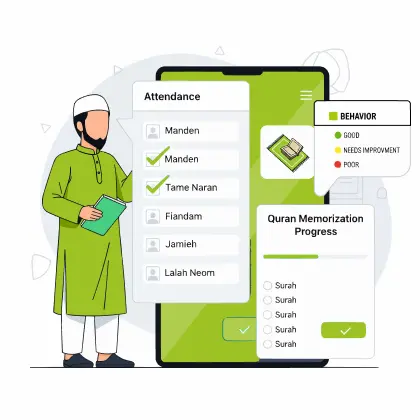
For Bangladesh’s Hafizia madrasas and the Hifz departments of Aliya and Qawmi institutions, Hifz tracking is the most important and most completely absent feature in generic software.
The software must natively support Bangladesh’s four-stage Hifz system:
| Stage | What the Software Records |
| Sabak | Which Surah and ayahs; accepted or needs repetition; Tajweed notes |
| Sabak Para | Which Juz under active reinforcement; recitation quality |
| Dhor | Which portion assigned; recitation quality; weak portions flagged |
| Manzil | Which of the 7 manzil portions; weekly completion tracking |
Additional Hifz tracking features needed:
- Overall progress view per student — how many Juz memorised total; completion projection
- Parent-facing daily update — “Today’s Sabak: Surah Al-Baqara, ayahs 1–7. Accepted.”
- Teacher alert when a student’s Sabak hasn’t advanced in 3+ days
- Juz completion log with dates — a permanent record of the Hifz journey
- Full Quran completion record for the Ameen ceremony documentation
For the full explanation of the Sabak–Sabak Para–Dhor–Manzil system, see Hafizia Madrasa in Bangladesh.
Aliya-Specific Needs: BMEB Compliance
Aliya madrasas have specific requirements driven by BMEB governance:
Student data for BMEB examination registration: BMEB annual examinations require student registration with specific data fields. Software that maintains student records in a format that maps to BMEB requirements saves significant administrative time at examination season.
Result recording: BMEB examination results need to be recorded against student records — by subject and level.
Government MPO staff records: Aliya madrasas with MPO-supported teachers need to maintain staff records that satisfy government requirements.
Reporting: BMEB may require periodic reporting from affiliated institutions — student counts, pass rates, and other metrics that are straightforward to produce from digital records but laborious from paper.
Qawmi-Specific Needs: BEFAQ and Financial Independence
Qawmi madrasas have specific needs driven by their independent governance and donation-based funding:
BEFAQ examination registration: Annual student registration for BEFAQ examinations — similar to BMEB but through BEFAQ’s own system.
Donation management: Unlike Aliya madrasas with fee income, Qawmi institutions primarily receive Zakat and Sadaqah donations. Software must handle:
- Recording named donors with donation amount, date, and purpose
- Generating Islamic-appropriate donation receipts
- Tracking in-kind donations
- Producing annual donation summaries for governance and transparency
Zakat accountability: Donors who pay Zakat through a madrasa have a religious obligation to know their Zakat was used correctly. Clean financial records are an act of institutional amanah (trustworthiness) — not just administrative good practice.
Mosque Maktab Needs: Simplicity First
For Bangladesh’s mosque maktabs — the imams and mosque committees managing informal Quran education — the primary software requirement is radical simplicity:
The imam is not a technology professional. Software for mosque maktabs must be operable by someone with basic smartphone literacy, in Bengali, on a low-cost Android device.
Core features only:
- Student enrolment (name, guardian contact, Quran level)
- Daily attendance
- Quran progress (which Juz reached; Tajweed level)
- Fee collection record
- WhatsApp message to parent
Pricing that works: A mosque maktab running on community goodwill cannot pay SaaS pricing designed for CBSE schools. Affordable pricing — ideally under 500 BDT/month — is essential.
Offline capability: Mosque maktabs in rural and semi-urban areas may have intermittent internet. The app must work offline and sync when connected.
Why Generic School Software Fails
| Generic School Software Assumption | Bangladesh Madrasa Reality |
| Subjects: Maths, Science, English | Dars-e-Nizami subjects; Quran; Hifz — not in any generic list |
| Fee-based tuition model | Donation/Zakat model — entirely different financial structure |
| English-language interface | Bengali-speaking administrators and teachers |
| Academic timetable: periods and grades | Hifz is continuous, not periodic; levels differ from school grades |
| Parent reports: academic grades | Parents want Quran progress: Sabak, Sabak Para, Juz reached |
| Annual examination: multiple subjects | BMEB/BEFAQ examinations have different structure to school exams |
| Western school calendar | Islamic calendar matters — Ramadan, Eid affect scheduling |
Generic school management software built for fee-charging secular schools matches none of the assumptions of Bangladesh’s madrasa sector. Forcing Islamic education into its framework creates more work, not less.
Language and Interface Requirements
| Requirement | Why It Matters |
| Bengali interface | Administrators and teachers are Bengali-literate; English-only software is unusable |
| Bengali data entry | Student names, parent names, teacher notes must be enterable in Bangla script |
| Bengali reports | Fee receipts, progress reports, and summaries must be readable by Bengali-literate users |
| Urdu support (optional) | Some Qawmi madrasas use Urdu for certain records |
| Simple navigation | Non-technical users need obvious, intuitive workflows |
| Mobile-first | Smartphones are the primary computing device; desktop-first software fails |
Frequently Asked Questions
Q: Do BMEB-affiliated Aliya madrasas have to use specific software?
BMEB does not currently mandate specific software. However, BMEB is gradually moving toward digital examination registration and reporting, and Aliya madrasas with good digital records will be better positioned to participate in these systems.
Q: Is there software specifically designed for Bangladesh madrasas?
Purpose-built Islamic education software like Ilmify is designed for the South Asian Islamic education context — including Bangladesh madrasas and maktabs. Generic school management software is not designed for this context and requires significant workarounds to use in a madrasa setting.
Q: How much should a Bangladesh madrasa budget for management software?
The relevant question is value relative to cost. For a Hafizia madrasa with 50 students, software that reduces administrative time by 30 minutes per day and provides parents with daily Hifz updates is worth several thousand taka per month. For a small mosque maktab, 300–500 BDT/month is a reasonable budget. Purpose-built software is typically priced to be accessible to charity-funded institutions.
Q: Can the same software work for Aliya, Qawmi, and mosque maktab institutions?
Good Islamic education software should be flexible enough to serve all three contexts — with the ability to configure for Aliya academic levels, Qawmi Dars-e-Nizami structure, and simple mosque maktab Quran tracking. The core functions (student management, attendance, fees, parent communication) are the same; the specific workflows differ.
Q: How does software handle the donation model that Qawmi madrasas use?
Purpose-built madrasa software includes donation management features — recording Zakat and Sadaqah with donor details, generating appropriate receipts, and producing summaries. This is entirely absent from generic fee-based school software.
Conclusion
Bangladesh’s madrasa sector — Aliya, Qawmi, Hafizia, and mosque maktab — needs management software that is purpose-built for the Islamic education context: Bengali interface, Hifz tracking with Sabak/Sabak Para/Dhor/Manzil, donation-model financial management, and simplicity that works for administrators who are Islamic scholars, not technology professionals.
The alternative — paper registers, WhatsApp broadcasts, and memory-based Hifz tracking — serves the sector poorly and creates growing risk as governance expectations and compliance requirements increase.
Ilmify is built for Bangladesh’s madrasa and maktab sector — with Bengali-friendly interface, native Hifz tracking, Aliya and Qawmi workflows, donation management, and parent communication tools in one affordable mobile-first platform. Start your free trial →




 Arabic
  English
  Malay
Malay  Urdu
Urdu