

Introduction
When a parent enrols their child in an Islamic school or maktab, they are rarely doing so purely for academic results. They want their child to become a good Muslim — someone with manners, discipline, a relationship with Allah, and a character that reflects Islamic values. They want, in a word, Tarbiyah.
And yet, when you ask most Islamic schools what their Tarbiyah programme looks like — how they measure it, how they track it, and how they report on it — the answers are vague. “We teach Islamic values.” “The teachers model good character.” “We make dua for the students.” These things are true and important. But they are not a programme. They are an aspiration.
This guide is for Islamic school administrators who want to move from aspiration to structure — who want to understand what Tarbiyah actually means in an institutional context, what it looks like in practice, and how to measure and track it in a way that is meaningful for teachers, parents, and students alike.
The Meaning of Tarbiyah — Beyond the Dictionary Definition
The word Tarbiyah (تَرْبِيَة) comes from the Arabic root ر-ب-و (r-b-w), which carries meanings of growth, nurturing, and raising — in the same way one raises a child or cultivates a plant. In Islamic scholarship, Tarbiyah refers to the holistic nurturing of a human being: their spiritual, moral, intellectual, physical, and social development in accordance with Islamic principles.
This is distinct from mere instruction (Ta’lim, which we will address below). Tarbiyah is not about what a student knows — it is about who they are becoming.
The Prophet Muhammad ﷺ described his own mission in these terms: “I was sent to perfect noble character” (Ahmad). The entirety of prophetic education was Tarbiyah — a lived example of character, patience, gentleness, justice, and God-consciousness that his companions absorbed not just through lectures but through proximity, observation, and correction over time.
For an Islamic school, Tarbiyah is the attempt to replicate this model in an institutional context: to create an environment, a relationship between teacher and student, and a set of structured practices that develop character alongside academic and Quranic learning.
Tarbiyah vs Ta’lim: Understanding the Distinction
Understanding the difference between Tarbiyah and Ta’lim is foundational for any administrator trying to build a programme around the former.
Ta’lim (تَعْلِيم) is instruction — the transmission of knowledge. It is what happens when a teacher explains the rules of Tajweed, teaches the meaning of an Ayah, or instructs a student in the pillars of Wudu. Ta’lim is measurable in the familiar academic sense: did the student learn the information? Can they reproduce it? Did they pass the test?
Tarbiyah, by contrast, is formation — the shaping of character, values, and behaviour. It is what happens when a student learns not just that punctuality is Islamic, but actually becomes a punctual person. Not just that honesty is a virtue, but develops a disposition of truthfulness in their dealings. Not just that Salah is obligatory, but develops a relationship with Salah that is intrinsically motivated rather than externally enforced.
| Dimension | Ta’lim | Tarbiyah |
| Focus | Knowledge | Character |
| Output | What the student knows | Who the student is becoming |
| Measurement | Test scores, recitation | Behaviour, habits, values |
| Timeframe | Lesson by lesson | Months and years |
| Teacher role | Instructor | Role model and guide |
| Can be assessed? | Yes — objectively | Yes — but requires observation and nuance |
The critical insight for administrators: most Islamic schools have robust Ta’lim systems (syllabi, grade books, exam schedules) and almost no structured Tarbiyah system. The implicit assumption is that Tarbiyah just happens — that a good Islamic environment produces good Islamic character without deliberate effort or structured tracking. This assumption is understandable but not borne out by evidence.
The Four Dimensions of Tarbiyah in an Islamic School
Scholars of Islamic education have categorised Tarbiyah across several dimensions. For a practical institutional framework, four dimensions are most tractable:
1. Spiritual Tarbiyah (روحانية)
The development of a student’s relationship with Allah — their God-consciousness (Taqwa), their commitment to worship, their engagement with dua and dhikr, and their understanding of the purpose of life in Islamic terms.
Practical indicators:
- Quality and regularity of Salah (both inside and outside school)
- Engagement with dua — does the student make dua independently?
- Observable Taqwa — does the student show awareness of Allah in their conduct?
- Understanding and practice of Sunnah acts of worship
2. Moral Tarbiyah (أخلاقية)
The development of good character (Akhlaq) — truthfulness, honesty, trustworthiness, generosity, patience, humility, and the avoidance of lying, backbiting, arrogance, and coarseness.
Practical indicators:
- Truthfulness in dealings with teachers and peers
- Behaviour toward younger or weaker students (empathy, protection, not bullying)
- Response to correction — does the student accept guidance without defensiveness?
- Honesty in academic work (no cheating, full effort)
3. Social Tarbiyah (اجتماعية)
The development of Islamic social conduct — greeting with Salam, showing respect to elders, maintaining family ties (Silat ur-Rahim), supporting the community, and avoiding behaviour that harms others.
Practical indicators:
- Use of Islamic greetings in school
- Respect for teachers, staff, and visitors
- Behaviour in group settings — cooperation vs conflict
- Treatment of peers from different backgrounds
4. Personal Tarbiyah (شخصية)
The development of personal discipline, good habits, physical cleanliness (Taharah), time management, and the self-regulation that enables a Muslim to fulfil their responsibilities.
Practical indicators:
- Punctuality to class and prayer
- Personal cleanliness and appearance aligned with Islamic guidelines
- Completion of homework and commitments
- Ability to manage time across Quran revision, studies, and prayer
What a Tarbiyah Programme Looks Like in Practice
A Tarbiyah programme is not a separate class that runs on Thursday afternoons. It is woven into the fabric of the institution — into how teachers interact with students, how the school day is structured, what is celebrated and what is corrected, and how parents are kept informed.
Elements of a Structured Tarbiyah Programme
Morning opening ritual: Beginning each day with collective dua, a brief reminder (Nasihah), and intention (Niyyah) — consciously framing the school day as an act of worship.
Salah integration: Praying together as a school community is the single most powerful Tarbiyah practice available to an Islamic school. The act of standing together before Allah, in rows, at appointed times — without exception — is a lived lesson in discipline, humility, and community.
Teacher modelling: The most powerful Tarbiyah tool is the teacher’s own character. Students absorb how their teacher treats them, how they respond to mistakes, whether they keep their promises, and how they speak about others. No programme can substitute for this.
Structured character goals: Individual Tarbiyah goals set at the beginning of each term — “this term, [Student] is working on punctuality and reducing lateness to Salah” — with regular check-ins.
Recognition of character, not just achievement: Publicly recognising a student who helped a classmate, showed honesty in a difficult situation, or demonstrated patience — not just academic or Hifz achievement — signals that character is valued equally.
Parent communication: Sharing Tarbiyah observations with parents — both positive and developmental — so that home and school are working toward the same character goals.
Why Tarbiyah Must Be Measured — and Why This Is Difficult
Some educators resist the idea of measuring Tarbiyah. “Character cannot be quantified.” “A grade for good manners reduces it to a performance.” These concerns are worth taking seriously.
But the alternative is worse. Without any measurement, Tarbiyah becomes invisible — and what is invisible receives no attention, no resources, and no accountability. A school that says Tarbiyah is important but does not track it is a school where Tarbiyah gradually loses ground to the things that are tracked: grades, Hifz pages, exam results.
The goal of Tarbiyah measurement is not to produce a score that defines a child. It is to:
- Give teachers a structured framework for observing character development
- Create a record that shows trajectory over time (improving, stable, declining)
- Enable meaningful parent conversations about their child’s character development
- Identify students who need specific support in specific areas
- Hold the institution accountable for taking character seriously
Measurement does not have to mean a numerical grade. A teacher’s qualitative observation, recorded consistently across four dimensions, is measurement. A traffic-light system (Progressing Well / Developing / Needs Attention) applied to specific Tarbiyah indicators is measurement. What matters is that someone is looking, recording, and acting on what they see.
The Problem with Relying on Teacher Intuition Alone
Most Islamic schools rely entirely on teacher intuition for Tarbiyah assessment. The teacher knows which students are well-mannered and which are not. They address problems when they arise. They note improvement when they see it.
This approach has two significant weaknesses:
It is not transferable. When a teacher leaves — as teachers inevitably do — all of their Tarbiyah knowledge about the students leaves with them. The next teacher starts from zero. There is no record, no trajectory, no context.
It is not communicable to parents. A teacher’s intuitive sense that “Ahmed is making good progress with his character” is not the same as a structured Tarbiyah report that says “This term, Ahmed has shown consistent improvement in punctuality to Salah, maintaining greetings with Salam, and completing his commitments. The area we are focusing on next term is managing frustration in group settings.” The second is a professional communication that parents can act on; the first is an impression.
The solution is structured observation — a set of defined Tarbiyah indicators, observed consistently, recorded in a system that persists beyond any individual teacher.
How to Structure Tarbiyah Assessment in Your Institution
Step 1: Define Your Tarbiyah Indicators
Choose 8–12 specific, observable behaviours across the four dimensions. These should be:
- Specific enough to observe (“uses Salam greeting with teachers and peers” not “has good manners”)
- Positive (what the student does, not what they fail to do)
- Appropriate for the student’s age
Example indicators for a maktab:
Spiritual: Arrives for Salah on time | Performs Wudu correctly without reminders | Makes dua independently after Salah
Moral: Speaks truthfully, even when difficult | Shows kindness to peers | Accepts correction without arguing
Social: Greets with Salam consistently | Shows respect to teachers and visitors | Cooperates in group activities
Personal: Arrives to class on time | Completes assigned revision | Maintains cleanliness of space and appearance
Step 2: Define Your Assessment Scale
Keep it simple — three levels work better than seven:
- Progressing Well: Behaviour is consistent and positive
- Developing: Improvement is visible; occasional lapses
- Needs Attention: Behaviour is inconsistent or requires active intervention
Step 3: Assess Every Student Each Term
Each teacher assesses every student across all indicators at the end of each term. This takes 5–10 minutes per student when the indicators are well-defined. The key is consistency — the same indicators, the same scale, the same frequency.
Step 4: Report to Parents
Share the Tarbiyah assessment with parents — separately from academic results, and with appropriate framing. A Tarbiyah report is not a complaint. It is a snapshot of a student’s character journey, shared in the spirit of partnership.
Step 5: Set Next-Term Tarbiyah Goals
At the start of each term, agree one or two specific Tarbiyah goals with the student (where age-appropriate) and the parent. This transforms assessment from retrospective judgement into forward-looking development.
How Ilmify’s Tarbiyah Tracking Module Works
Ilmify is the only Islamic school management platform with a built-in Tarbiyah tracking module. No other competitor — Muntazim, IBEAMS, Dugsi, e-maktab, or any other platform in the market — has this feature.
What Ilmify’s Tarbiyah module tracks:
- Manners and conduct: Observable Akhlaq indicators assessed per student per term
- Daily routines: Punctuality, Wudu compliance, greeting habits, homework completion
- Islamic activities: Participation in collective worship, Islamic events, community service
- Goal setting: Individual Tarbiyah goals set per student, tracked over the term
How it works for teachers:
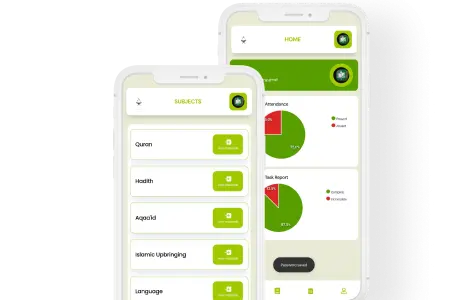
Teachers access the Tarbiyah assessment through the Ilmify app at the end of each term. For each student, they rate the defined indicators on a simple scale and add brief notes where relevant. The entire assessment for a class of 15 students takes under an hour.
How it works for parents:
Parents receive a Tarbiyah summary report through the parent portal — separate from the Hifz and academic report — showing their child’s character development across the four dimensions, with teacher notes and next-term goals.
How it works for administrators:
Administrators can see aggregate Tarbiyah data across the institution — which dimensions are showing consistent strengths, which are areas of concern across the student body, and which individual students need follow-up attention.
💡 The only Islamic school platform with built-in Tarbiyah trackingNo competitor offers this. Ilmify gives your institution the tools to take character development as seriously as Hifz and academics.Explore Ilmify’s Tarbiyah Tracking Module →
Conclusion
Tarbiyah is the heart of Islamic education — and the dimension most often left to chance. An Islamic school that takes Tarbiyah seriously defines it clearly, structures a programme around it, observes and records it consistently, and communicates it to parents as a genuine partner in the student’s character development.
This requires tools. Not complex tools — but a structured framework, a consistent recording system, and a communication channel to parents. Ilmify provides all three through its dedicated Tarbiyah tracking module — the only one of its kind in any Islamic school management platform.
See how Ilmify’s Tarbiyah module works →
Related articles in this series:




 Arabic
  English
  Malay
Malay  Urdu
Urdu