
Introduction
Idara-e-Deeniyat operates a network of tens of thousands of affiliated maktabs serving an estimated 1.6 million students across India. By any measure, it is a massive educational organisation. And yet, if you visit a typical Deeniyat maktab on a Tuesday evening, you will find the teacher recording attendance in a paper register, tracking student Quran progress in a handwritten notebook, and communicating with parents through a WhatsApp group.
This is not a criticism — paper registers work. But as administrative demands grow and India’s Muslim community becomes increasingly digitally literate, the question of digital tools for Deeniyat-affiliated maktabs has become impossible to ignore. This article audits what currently exists, where the gaps are, and what the ideal solution would look like.
What Does Idara-e-Deeniyat Currently Offer Digitally?
The Deeniyat Website
Idara-e-Deeniyat maintains a website providing:
- Information about the organisation and its history
- Details about the curriculum and course structure
- Contact information for the head and state offices
- Some resources for affiliated centres
The website is functional and informative, but is primarily a static resource — not an operational tool for maktab administrators.
Online Study Resources
Following the COVID-19 period, Idara-e-Deeniyat developed some online learning content — recorded lessons, audio recitations, and PDF versions of certain textbooks — available through its website and associated YouTube channels and WhatsApp groups. These are useful for:
- Students who miss classes
- Self-study for advanced learners
- Teachers wanting supplementary material
However, they do not constitute a learning management system (LMS). They are largely ad hoc resources rather than a structured digital curriculum.
What Is Missing: No Maktab Management App
| Digital Need | Currently Available from Deeniyat? |
| Online study resources | ✅ Partial |
| Curriculum information online | ✅ Yes |
| Student enrolment system | ❌ No |
| Attendance tracking tool | ❌ No |
| Quran progress tracker | ❌ No |
| Fee management system | ❌ No |
| Parent communication portal | ❌ No |
| Examination registration system | ❌ No |
| Teacher management tool | ❌ No |
As of 2026, Idara-e-Deeniyat does not have a dedicated maktab management application. This is the central gap in its digital offering.
What Maktab Administrators Are Actually Using
In the absence of official Deeniyat digital tools, maktab administrators have assembled patchwork solutions:
WhatsApp Groups
WhatsApp is the primary communication tool for almost every Deeniyat maktab in India. Typical usage:
- A parents’ group for attendance updates, homework reminders, announcements
- A committee/teacher group for internal coordination
- Sharing scanned marksheets or progress updates
Limitations: Unstructured, no searchable records, no integration with fees or progress data, no privacy (all group members see each other).
Google Sheets or Excel
Some technically comfortable administrators maintain student registers, attendance records, and fee tracking in Google Sheets or Excel. Works for small maktabs (under 30–40 students).
Limitations: Requires spreadsheet skills; multiple sheets become hard to maintain; no parent-facing interface; no mobile-optimised daily entry.
Paper Registers
The majority of Deeniyat maktabs — particularly outside major cities — use paper registers for everything.
Limitations: No backup if lost; difficult to generate summary reports; time-consuming for examination registration; no parent visibility.
| Tool | Cost | Quran Tracking | Parent Comms | Scalability |
| Paper registers | Free | Manual only | None | Low |
| WhatsApp groups | Free | None | Informal | Low |
| Google Sheets | Free | Manual only | None | Medium |
| Purpose-built maktab app | Low monthly fee | Built-in | Automated | High |
The Specific Digital Needs of a Deeniyat Maktab
Understanding what Deeniyat maktabs actually need from a digital tool requires understanding their specific operational context.
Student Management
A Deeniyat maktab needs to maintain:
- A register of enrolled students with basic details (name, age, parent contact, level)
- Record of which Deeniyat level each student is enrolled in
- History of level progression year on year
Attendance Tracking
Daily attendance needs to:
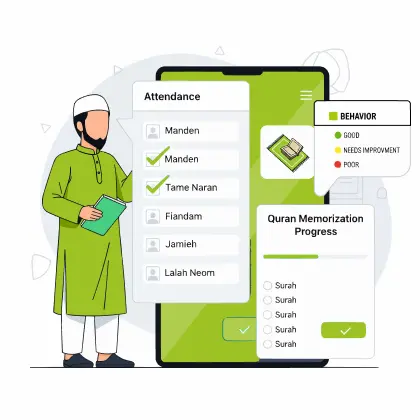
- Allow the teacher to mark attendance quickly on a phone (under 2 minutes for a class of 20–30)
- Automatically calculate attendance percentages
- Flag students with concerning absence patterns
- Generate monthly reports for the mosque committee
Quran Progress Tracking
This is the most distinctive requirement — and where generic education software most commonly fails. Deeniyat maktabs track:
| Term | Meaning |
| Sabak | The new portion covered in today’s lesson |
| Sabak Para | Recently covered portion still under reinforcement |
| Dhor | Revision of older memorised portions |
| Manzil | Scheduled large revision (weekly/fortnightly) |
| Nazra progress | How far through the Quran the student has reached |
A Deeniyat maktab management tool must use these terms natively. A system tracking “lesson progress” generically will not be adopted by teachers who think in terms of Sabak and Dhor.
For a detailed explanation of how these terms are used in practice, see How Indian Maktabs Track Quran Progress.
Fee Management
Most maktabs collect modest monthly fees or rely on donations. A fee management system should:
- Record each student’s fee status (paid, partially paid, outstanding, exempted)
- Generate automated reminders to parents with outstanding fees
- Track income over time for the mosque committee’s financial reporting
- Support UPI and digital payment methods
Parent Communication
Parents want to know their child is attending and progressing. A parent-facing tool should:
- Send attendance notifications daily or weekly
- Share Quran progress updates — where is my child in their Nazra? What was today’s Sabak?
- Communicate fee status
- Send announcements (examination dates, holidays, special sessions)
Why Generic Education Software Doesn’t Work
Many generic school management software products are available in India — some free, some paid. Designed for mainstream schools, they typically offer student enrolment, timetable management, fee collection, homework assignment, and parent communication. But they fail for Deeniyat maktabs because:
| Feature Gap | Why It Matters for Deeniyat |
| No Quran progress tracking | Teachers think in Sabak / Dhor / Manzil — not “lesson number” |
| No Islamic calendar integration | Ramadan, examination periods, special sessions are structurally different |
| No part-time session design | Evening / weekend maktab structure is not supported |
| Pricing too high | Most tools cost ₹2,000–₹10,000+/month — unsustainable on maktab budgets |
| No Urdu / Arabic interface | Teachers and admins prefer familiar script and language |
The typical outcome: software is trialled briefly, found overwhelming or inadequate, abandoned, and the paper register returns.
What the Ideal Deeniyat Digital Tool Looks Like
Based on the operational needs above, the ideal digital tool for a Deeniyat-affiliated maktab would be:
Mobile-first. Most maktab teachers and administrators use smartphones, not computers. Everything must work excellently on a phone.
Deeniyat-specific workflows. Student levels (Nursery to Muallim), Quran progress tracking with Sabak/Sabak Para/Dhor/Manzil, examination registration — all built in, not adapted from a generic model.
Extremely simple. A maktab teacher is an Islamic educator, not a software user. The tool must require minimal training and feel immediately intuitive.
Free or very low cost. Most Deeniyat maktabs operate on very tight budgets. A tool costing more than ₹500–₹1,000 per month will not be adopted at scale.
Urdu and regional language support. Teacher and administrator interfaces should be usable in their preferred language.
Parent visibility. Even a simple parent-facing progress card or WhatsApp-linked notification dramatically increases parent engagement.
No IT support required. The mosque committee cannot hire a system administrator. The tool must be self-maintaining and cloud-based.
What Needs to Change at the Idara-e-Deeniyat Level
For Deeniyat-affiliated maktabs to genuinely modernise their administration, change is needed at two levels:
At the individual maktab level: Mosque committees need to be willing to invest a small amount of time — and in some cases a small amount of money — in adopting digital tools. The inertia of “we’ve always done it this way” is the biggest obstacle.
At the Idara-e-Deeniyat level: The organisation itself has a significant opportunity — either developing its own tool or partnering with an existing provider, and promoting it actively through the Deeniyat network. A centrally recommended tool would dramatically accelerate digital adoption across affiliated maktabs. Many other Islamic education bodies globally have taken this step. Idara-e-Deeniyat has the scale to do the same.
Frequently Asked Questions
Q: Does Idara-e-Deeniyat have an official app for maktab management?
Not as of 2026. Idara-e-Deeniyat has an online presence and some digital study resources, but no dedicated maktab management application for affiliated centres.
Q: What is the best free tool for a small Deeniyat maktab right now?
For a maktab of under 20 students, Google Sheets for records and a WhatsApp group for parent communication is functional. Beyond that scale, a purpose-built maktab app becomes significantly more efficient.
Q: Why doesn’t generic school management software work for maktabs?
Because generic tools don’t understand Quran progress tracking (Sabak, Sabak Para, Dhor, Manzil), are priced for full-time schools rather than mosque-based part-time maktabs, and usually lack Urdu or Arabic language support.
Q: How important is parent communication for a Deeniyat maktab?
Very important. Parents who receive regular updates on their child’s attendance and Quran progress are more likely to enforce attendance, engage with the teacher, and support the maktab financially. Automated parent notifications are one of the highest-value features of any maktab management tool.
Q: Is there maktab management software that supports both Deeniyat and Samastha terminology?
Yes — Ilmify supports both North Indian Deeniyat terminology (Sabak, Sabak Para, Dhor, Manzil) and South Indian/Kerala Samastha terminology (including Aamuktha), making it suitable for institutions across India.
Conclusion
As of 2026, Idara-e-Deeniyat does not have a dedicated maktab management application. Affiliated centres rely on paper registers, WhatsApp groups, and ad hoc spreadsheets to manage their operations. While these approaches work at small scale, they create real administrative burden and limit the quality of information available to mosque committees, teachers, and parents.
The ideal digital tool for a Deeniyat maktab is mobile-first, extremely simple, free or very low cost, and built specifically around Islamic education workflows — including native Quran progress tracking using Sabak, Sabak Para, Dhor, and Manzil.
Ilmify is that tool. Purpose-built for Indian maktabs — Deeniyat-affiliated and otherwise — it handles student management, daily attendance, Quran progress tracking in the exact terminology teachers already use, fee management, and automated parent notifications. No IT support, no complex onboarding. Explore Ilmify →





 Arabic
  English
  Malay
Malay  Urdu
Urdu