

Introduction
The Deobandi maktab tradition is the dominant model of part-time Islamic education across Australia and New Zealand. Tracing its origin to the Darul Uloom Deoband in India (founded 1867) and its Australian-New Zealand expression most directly to the South African Indian Muslim community, this tradition has built the most systematic and institutionally robust part-time Islamic education infrastructure in both countries. Understanding it — its curriculum, its institutional model, its genealogy, and its current practice — is essential for anyone seeking to understand Islamic education in this part of the world.
Origins: The South African Connection
The Deobandi maktab tradition as it exists in Australia and New Zealand does not come directly from India — it comes, overwhelmingly, via South Africa. The South African Indian Muslim community, whose ancestors came from Gujarat and other parts of India as indentured labourers in the nineteenth century, maintained their Deobandi Islamic tradition tenaciously in the face of the apartheid system. South African bodies like the Jamiatul Ulama KwaZulu-Natal (JUL KZN) and the Ta’limi Board KZN developed comprehensive maktab management systems, teacher training programmes, and curriculum frameworks over more than a century of operation.
The key institutional export from South Africa to Australia and New Zealand is the Tasheel Series — a structured, Grade 1 through Grade 12 equivalent Islamic studies curriculum developed by South African ulama covering Fiqh, Hadith, Aqeedah, Sirah, and Akhlaq. The curriculum was designed to be “tried, tested and systematic,” progressively building Islamic knowledge from basic wudhu and salaah through to business transactions and inheritance law over a twelve-year sequence. Its explicit aim is to ensure that every Muslim child who completes the programme has a comprehensive functional understanding of the practical requirements of Islamic life.
The Tasheel Series is now used across multiple countries, and its deployment in Australia and New Zealand is part of a broader global pattern of South African Deobandi Islamic education reaching diaspora Muslim communities around the world.
The Tasheel Series and Related Curricula: What They Teach
The Tasheel Series structures Islamic studies across 12 grade levels. At each grade, students cover:
Fiqh (Islamic Jurisprudence): Beginning with Taharah (purity), Wudhu and Ghusl, Salaah in its forms and rules, Saum (fasting), Zakaat, and Hajj, before progressing to the laws governing marriage, business transactions, and inheritance. The curriculum’s goal is that every student, by the end of Grade 12, understands and can correctly practise every major Fiqh requirement applicable to them as a Muslim adult.
Aqeedah (Islamic Creed): Core beliefs about Allah, the prophets, the angels, the books, and the Day of Judgment — taught progressively through accessible frameworks that become more sophisticated at higher grades.
Hadith (Prophetic Traditions): Selected hadith memorisation at each level, progressively building a student’s connection to the Prophetic tradition through direct textual engagement.
Sirah (Prophetic Biography): The life of the Prophet Muhammad (peace be upon him) told chronologically, with increasing historical detail at higher grades.
Akhlaq wal Adaab (Morals and Etiquette): Islamic manners, social conduct, family relationships, and character formation — the everyday lived dimension of Islamic practice.
Some Australian maktabs have transitioned away from the Tasheel Series to alternative curricula. Darul Hikmah Australia (Fawkner and Craigieburn, Melbourne) previously used the Tasheel Series but has switched to the An-Nasihah Islamic Studies Syllabus — a UK-developed curriculum — while continuing to use the Ta’limi Board KZN (South Africa) for Du’a and Hadith memorisation. This combination reflects a pragmatic approach: taking the best elements of different curriculum traditions rather than exclusively following one.
Similarly, some New Zealand and Australian maktabs use the Safar Publications curriculum from the UK alongside or instead of the Tasheel Series. The Manawatu Muslims Association in Palmerston North, New Zealand, explicitly lists both “Safar/Tasheel curriculum” as options at its madrasah.
Institutions Practising the Deobandi Maktab Model
Australia
Darul Uloom Islamic Academy, Brisbane (est. 1994)
Founded by Imam Quddoos in 1994 as one of the first madrasahs in Brisbane, the Darul Uloom Islamic Academy exemplifies the founding-generation Deobandi maktab ethos. Its name — Darul Uloom, meaning “house of sciences” — directly references the Deoband tradition. Its volunteer-teacher model, annual Quran Competition, and Open Day are characteristic features of the South African-origin maktab culture.
Madrasa Fatima Azzahra, Fawkner Melbourne
The most formally structured Deobandi institution in Australia for women. Its explicit Deobandi lineage — traced through Ustadha Sajida Abid Faruqi, who herself studied under Shaykh Abdur-Rashid Nu’mani and specialised in ifta’ under Mufti Taqi Usmani — is the clearest example of the Deoband scholarly tradition operating in Australia at the Alimah programme level. The institute notes that 96 female Alimahs have graduated through the Deobandi methodology in Australia as of 2025.
Darul Hikmah Australia, Fawkner and Craigieburn Melbourne
Two makātib in Melbourne’s northern suburbs, explicitly organised around the maktab model with a published curriculum, formal student withdrawal procedures, and structured Hifdh programmes. The curriculum transition from Tasheel to An-Nasihah (while retaining Ta’limi Board KZN material for Dua and Hadith) shows institutional curriculum sophistication.
New Zealand
Madrasah Uthmaaniyah, Auckland Islamic Trust
The most clearly Deobandi-tradition maktab in New Zealand. Its explicit use of the Tasheel Series, its Hifdh faculty producing Huffaz, its description of the maktab’s “pivotal role in developing the children of the Ummah” — language directly continuous with Jamiatul Ulama South Africa’s institutional vocabulary — and its note that “the Ulama of South Africa had initiated” the Tasheel Series make the institutional lineage explicit. Principal Moulana Muhammad Ashfaaq Motara; approximately 200 students across Hifdh, weekday, weekend, and Stepping Stones (4–5 year olds) faculties.
Madrasahtul Islamiyah, Wellington (7/11 Queens Drive, Kilbirnie)
Uses the Tasheel Series explicitly. Operating Monday–Friday 4:30–6:00pm. Structured around the New Zealand school term calendar (four terms per year). Run as a charitable trust (Madrasahtul Islamiyah NZ Trust / MINT), with IRD tax credit status for donations. Fully volunteer-staffed. Curriculum covers Fiqh, Hadith, Tafseer, History, Aqeedah, Akhlaq wal Adaab, and Quranic studies.
The Maktab Model: Key Structural Features
The Deobandi maktab tradition has several defining structural features that distinguish it from other models of part-time Islamic education:
Daily attendance: Unlike weekend-only schools, the traditional maktab operates five days per week — typically before school (morning session) or after school (afternoon session). At Madrasah Uthmaaniyah Auckland, Hifdh students sacrifice “a total of 5 hours every day” to the programme. This intensity is considered necessary for Hifdh and for serious Diniyyat education.
The Hifdh priority: Every serious Deobandi maktab runs or aspires to run a Hifdh programme alongside its regular Diniyyat classes. The production of Huffaz — those who have memorised the complete Quran — is considered both a religious obligation and a community honour. Five students completed Hifdh at Madrasah Uthmaaniyah in the 2020 Jalsah (annual celebration).
The Jalsah/Annual Function: Deobandi maktabs typically hold an annual celebration at which students present their Quranic achievements, Hifdh completions are honoured, and the community is invited to witness. This functions both as a celebration and as accountability — making the maktab’s work visible to the community.
The Ta’limi Board connection: South African maktabs are managed with guidance from the Ta’limi Board KZN, which provides curriculum materials, teacher training, and institutional governance frameworks. Australian and New Zealand maktabs operating in this tradition often continue to use Ta’limi Board materials (particularly for Du’a and Hadith memorisation) even when they have independently developed or adopted other curriculum components.
Volunteer teachers: A large proportion of Deobandi maktab teachers are community volunteers — themselves products of the maktab system — rather than professional Islamic education staff. This creates a powerful culture of continuity (teachers who received their education in the same system now returning to transmit it) but also creates the administrative fragility characteristic of volunteer-dependent institutions.
The Administrative Gap in the Deobandi Maktab System
The Deobandi maktab tradition is educationally sophisticated — its curriculum is more systematically structured than most other part-time Islamic education models — but it has historically been administratively underdeveloped. The same traditions that generate remarkable educational depth create institutional fragility:
- The “notebook register” — attendance and Quran progression in the teacher’s handwritten book — is standard practice even in well-resourced maktabs
- Student Hifdh progression is tracked in the teacher’s memory and personal notes, not in a shared institutional system
- Parent communication happens informally (WhatsApp, after-class conversation) rather than through structured individual reporting
- Fee collection is often cash-based with informal receipts or none at all
- When the teacher or imam leaves, institutional records — years of Quran progression data — can disappear
For a maktab with 200 students like Madrasah Uthmaaniyah, or a Hifdh programme managing 20 students across three simultaneous revision streams (Sabak, Sabaq Para, and Dhor), the absence of digital management systems is not merely an inconvenience. It is an institutional risk. A student’s three years of Hifdh progress is as valuable to their family as any academic record — and it deserves to be maintained with the same institutional care.
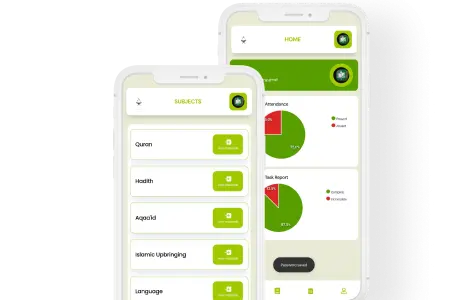
The solution is a management platform built for the Islamic educational context: tracking Iqra and Quran progression per student per session, managing three-stream Hifdh records, handling fee collection with receipts, and providing individual parent portals — maintained on institutional servers, not in the teacher’s notebook.




 Arabic
  English
  Malay
Malay  Urdu
Urdu