
Introduction
WhatsApp groups get chaotic fast — dozens of parents in one thread, important announcements buried under casual chat, and no reliable way to track who’s actually seen a message before a deadline passes. A dedicated parent communication module inside a school management system like Ilmify replaces this with a structured portal and app that both parents and teachers actually want to use, rather than tolerating out of necessity because no better alternative was ever offered.
Why WhatsApp Groups Fail as School Infrastructure
WhatsApp is genuinely convenient for informal communication, which is exactly why so many Saudi schools default to it for parent-teacher communication despite its real limitations as school infrastructure. A class WhatsApp group with 30 sets of parents inevitably drifts toward casual conversation alongside important announcements, making it genuinely difficult for a parent to reliably distinguish a critical school notice from routine chatter happening in the same thread. There’s no structured way to confirm who’s seen an announcement, no clean audit trail for a school administrator reviewing communication history months later, and no way to send a targeted message to a specific parent without either broadcasting to the whole group or exchanging personal phone numbers that blur professional boundaries between staff and families in ways many schools would prefer to avoid.
What Good Parent Communication Software Handles
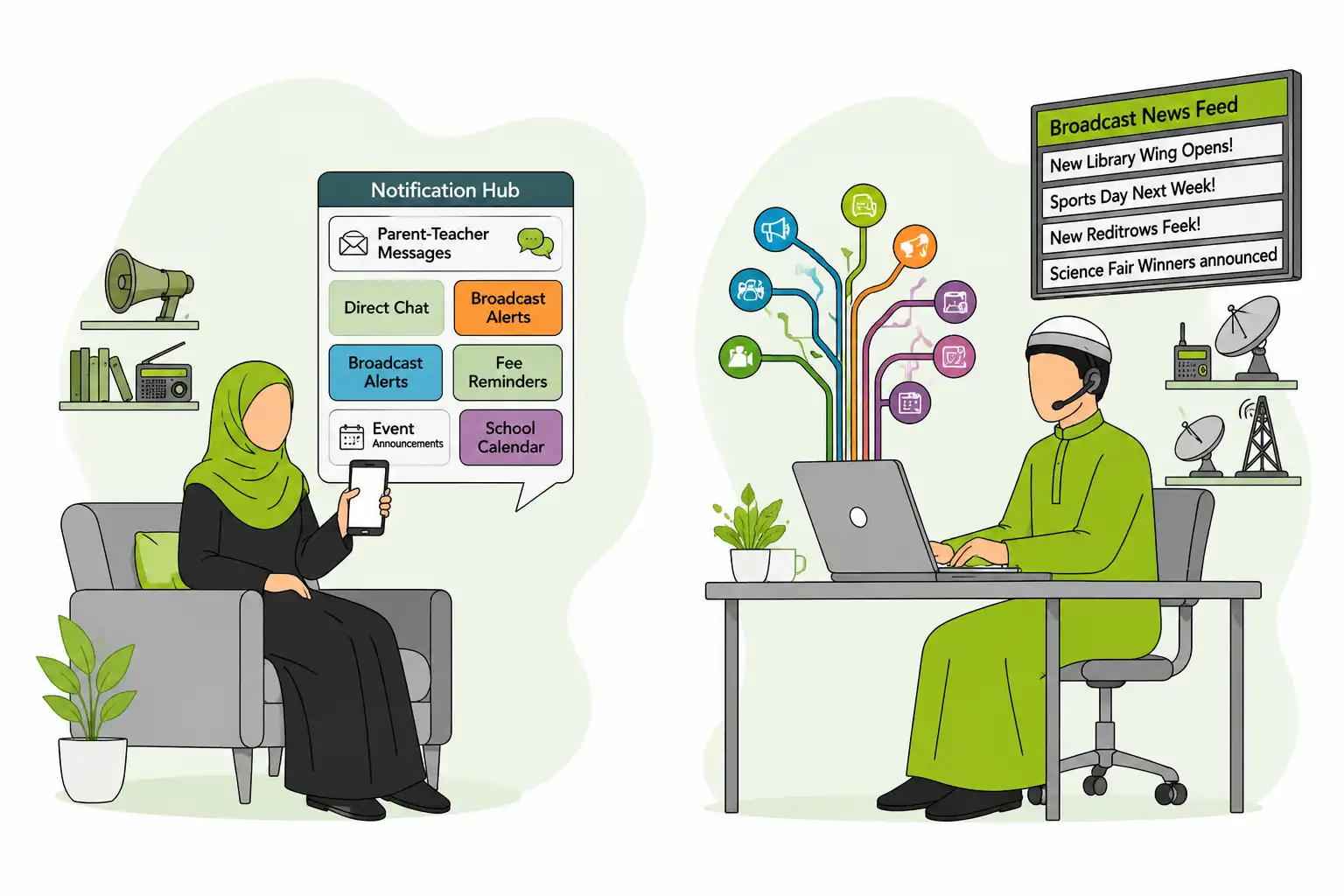
Branded parent portal and app. Grades, attendance, and announcements in one place, structured and organized rather than scattered across group chats where important information competes with casual conversation for a parent’s attention.
Read receipts. Confirmation that important announcements were actually seen by parents, giving school administrators genuine visibility into communication effectiveness rather than hoping a message was noticed among a busy parent’s other notifications.
Direct messaging. One-to-one teacher-parent conversation without exchanging personal phone numbers, maintaining a professional boundary while still enabling direct, individual communication when it’s genuinely needed for a specific student’s situation.
Push notifications. Real-time alerts for grades, absences, and school announcements, ensuring time-sensitive information reaches parents promptly rather than sitting unread in an inbox or a buried group chat that a parent hasn’t checked in several days.
| Feature | WhatsApp Group | Dedicated Parent App |
|---|---|---|
| Message organization | Chronological, mixed with casual chat | Categorized (grades, attendance, announcements) |
| Read confirmation | None reliable | Read receipts per message |
| Individual messaging | Requires personal phone numbers | Direct messaging without number exchange |
| Audit trail for administrators | None | Full communication history |
Source: Ilmify product documentation and general parent-communication software patterns
Bilingual Communication: A Practical Necessity
Bilingual communication is essential in the Saudi market — parents should be able to set Arabic or English as their default language and have every notification, grade update, and announcement appear correctly in that language, not machine-translated on the fly in a way that produces awkward or confusing phrasing that undermines the message’s clarity. This connects directly to the broader bilingual quality standard covered in Arabic School Management Software, and it matters particularly for communication specifically because a confusing or poorly translated message is more likely to generate a follow-up phone call to the school office, undermining the efficiency gain the communication tool is supposed to provide in the first place.
Read Receipts and Accountability
One of the most practically useful features in a genuinely well-built parent communication system is read-receipt tracking — visibility into whether a critical announcement (a schedule change, a permission form deadline, a fee reminder) was actually seen by the relevant parents, not just sent into the void of an app they may or may not be actively checking. This matters for accountability on both sides: a school can follow up specifically with parents who haven’t seen a time-sensitive message rather than assuming universal awareness across the entire parent body, and a school also has a clear record protecting against disputes about whether a particular piece of information was actually communicated in the event a disagreement arises later.
Emergency and Time-Sensitive Communication
Beyond routine grade updates and general announcements, a school occasionally needs to communicate genuinely urgent, time-sensitive information — an unexpected early dismissal, a weather-related closure, a safety concern requiring immediate parent awareness. A parent communication system needs a distinct capability for this category of message, one that cuts through the normal notification flow with appropriate urgency and reaches parents through the fastest available channel — often a combination of push notification and SMS to ensure delivery even if a parent isn’t actively using the app at that moment. Software that treats every message with the same priority level, whether it’s a routine grade update or a genuine emergency, doesn’t serve a school well in the moments when reliable, fast communication actually matters most.
Building Parent Engagement Beyond Notifications
The best parent communication tools go beyond one-directional notifications to support genuine two-way engagement — parents being able to ask questions, RSVP to school events, or provide feedback through the same platform rather than needing a separate channel for anything beyond receiving information passively. This kind of engagement, done well, strengthens the overall parent-school relationship in a way that pure notification delivery doesn’t, and it’s worth evaluating whether a vendor’s platform supports this broader engagement model or is built purely around one-way information push, which is a narrower and ultimately less valuable capability for building the kind of ongoing parent partnership most schools genuinely want to cultivate.
What to Ask Vendors
- Can parents choose their preferred language, and does that preference apply consistently across every notification, not just the main portal interface?
- Does the platform show read receipts, so schools know important messages were actually seen rather than just sent?
- Can teachers message parents directly without sharing personal phone numbers, maintaining appropriate professional boundaries?
- Does the app organize messages by category (grades, attendance, general announcements) rather than presenting everything as a single undifferentiated feed?
- How reliable are push notifications — do they arrive promptly, or is there a meaningful delay that undermines their usefulness for time-sensitive information?
- Does the system distinguish urgent, emergency communication from routine notifications, with an appropriately different delivery mechanism?
How This Connects to the Rest of the System
- Attendance Management — absence alerts flow directly into the parent app, ensuring real-time notification without a separate manual step
- Fee Management — payment reminders and receipts appear in the same portal parents already use for academic communication, rather than requiring a separate finance-specific app or channel
See the parent app in Ilmify. Book a demo →
Conclusion
Parent communication is one of the areas where the gap between a genuinely purpose-built tool and an informal workaround like a WhatsApp group is most visible day to day. A structured, bilingual parent app with read receipts, organized categories, appropriate emergency-communication handling, and genuine two-way engagement doesn’t just look more professional — it measurably reduces the volume of missed communications, confused parents, and follow-up phone calls that a chaotic group chat inevitably generates at scale.
👉 See the parent app in Ilmify — request a demo →
Related Articles
- School Management System & Software in KSA: The Complete Guide
- Attendance Management System for Schools in KSA
- School Fee Management Software in Saudi Arabia
- Arabic School Management Software: What to Look For
- School Management Software for Private Schools in Saudi Arabia
- Best School Management System in Saudi Arabia





 Arabic
  English
  Malay
Malay  Urdu
Urdu