

Introduction
WhatsApp is the unofficial management system of African Islamic schools. It is where attendance is announced, where Hifz milestones are celebrated, where fee reminders are posted, where the school closure due to rain is broadcast at 3:45pm, and where 85 parents argue about whether next Saturday’s event will be held rain or shine.
It is also, simultaneously, the greatest obstacle to professional, structured, and legally sound parent communication in African Islamic schools.
This guide is not anti-WhatsApp. WhatsApp is a genuinely useful tool for exactly one parent communication function: general announcements that every parent should know simultaneously. It is the digital notice board, and notice boards have their place.
What WhatsApp is not — and cannot be — is a substitute for the individual, structured, secure parent communication that modern African Muslim parents increasingly expect, and that data protection laws across the continent increasingly require.
What WhatsApp Gets Right (And Where to Keep It)
WhatsApp does one thing well for Islamic school parent communication: broadcast announcements to the whole parent body simultaneously.
School is closed tomorrow due to a public holiday. The Eid programme starts at 9am. The new term begins on 3 January. The gate will be locked at 4:30pm from next week.
These announcements have no individual student information. They are the same for all parents. Sending them via a WhatsApp group is efficient, appropriate, and works well.
Keep WhatsApp for: General announcements, event invitations, schedule changes, community notices. Nothing student-specific. Ever.
What WhatsApp Gets Wrong — And the Consequences
Problem 1: Individual Student Information Shared With 100+ Parents
When a teacher posts “Amina was absent today” in the class WhatsApp group, they have just disclosed information about Amina to every other parent in the group. Parents who have no relationship with Amina’s family now know that Amina was absent.
This seems minor until you consider the data protection dimension. In South Africa, POPIA explicitly restricts this kind of disclosure. In Kenya, Tanzania, and Egypt, similar data protection legislation is in force. In Nigeria, the Nigeria Data Protection Act 2023 applies. Sharing individual student information in a group where all parents can see it — without each parent’s consent to that specific sharing — is a compliance issue in every jurisdiction where African Islamic schools operate.
Beyond legal compliance, it is a basic dignity issue. Parents trust the school with information about their child. That trust is violated when their child’s attendance, behaviour, or academic struggles are shared with 85 other parents.
Problem 2: The Teacher’s Personal Phone as Institutional Infrastructure
The teacher’s personal WhatsApp account is the school’s parent communication system. This creates cascading problems:
- When the teacher changes their phone number, all parent contact is lost
- When the teacher leaves, the parent relationships go with them
- The teacher has no separation between their personal and professional communications
- The institution has no record of what communications were sent or when
Problem 3: Individual Queries Requiring Individual Responses — At Scale
Every parent who wants to know their child’s Hifz position, attendance, or fee status messages the teacher personally. For a teacher with 25 students, this is a constant stream of WhatsApp messages requiring individual responses — consuming hours per week that the teacher could spend on teaching.
Problem 4: Important Messages Lost in Chat Noise
A 100-member parent WhatsApp group generates dozens of messages daily. The critical announcement about next week’s examination, posted on Tuesday afternoon, is invisible to most parents by Wednesday evening — buried under emoji responses, holiday photos, and off-topic conversation.
What Individual Parent Communication Looks Like
The alternative to group WhatsApp for student-specific communication is an individual parent communication system — one where each parent receives information about their own child, specifically, securely, and without it being visible to anyone else.
The components:
Automatic individual notifications: When a student is absent and attendance has been recorded in the management system, an automatic notification goes directly to that student’s parent — “Your daughter Amina was marked absent at today’s session. If this is an error or you have notified the school, please disregard.” No teacher needs to compose this message. It is generated from the attendance data the teacher recorded.
Individual fee reminders: When a student’s account is overdue, a reminder goes to their parent — not to the class group. “Your son Ibrahim’s account has an outstanding balance of ₦4,000 for October. Please contact the school office to arrange payment.” Individual, private, non-embarrassing.
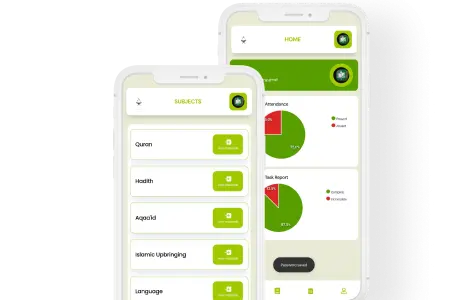
Parent portal for on-demand access: Instead of messaging the teacher to ask “where is my child in the Qur’an?”, the parent opens the parent portal on their phone and sees: current Surah and verse, last session quality rating, Sabaq Para quality, Dhor cycle status, attendance for the current month, and fee balance. The answer to every routine progress question is there without any teacher involvement.
Milestone celebration notifications: When a student completes a Juz, a Hizb, or the full Qur’an, the parent receives an automatic personalised notification: “Congratulations! Your daughter Khadijah has completed Juz 15 today. May Allah bless her memorisation.” This replaces the WhatsApp group post about one child’s milestone that every other parent sees — a less personal and less private celebration.
Implementation Across African Contexts
Nigeria
Nigerian parents are heavy WhatsApp users and, increasingly, OPay/PalmPay/social media app users. The parent portal activation message can be sent via WhatsApp: “We are launching a new system for individual student updates. You will receive a link — please activate your account to see your child’s progress, attendance, and fees at any time.”
Nigerian parents typically activate parent portal access within 24–48 hours of receiving the invitation when it is clearly explained.
Kenya
Kenyan parents are heavy M-Pesa and smartphone users. The parent portal works on any Android or iOS phone. SMS backup notifications (for parents whose smartphones may have limited data) can be configured for critical notifications (absence alerts).
South Africa
South African madrasah parents have among the highest smartphone penetration and digital literacy rates in African Islamic school communities. Parent portal adoption in South African madrasahs is typically rapid — within one week of launch, most parents have activated access. The POPIA angle is compelling for South African committees: moving student-specific communication from WhatsApp groups to individual secure channels is a regulatory compliance step, not just a courtesy.
Egypt / Morocco / North Africa
Arabic-speaking parents access the parent portal through Ilmify’s Arabic interface. The notification messages — absence alerts, milestone celebrations, fee reminders — are sent in Arabic. For Egyptian and Moroccan schools, the parent portal replaces both the WhatsApp group function and the informal door-step conversation that currently consumes teacher time at collection.
The Transition Plan: Moving From WhatsApp to Individual Communication in Two Weeks
Week 1 Day 1: Send one message to the WhatsApp group: “We are improving how we communicate with you individually. You will receive a personal invitation to our new parent app — please activate it when you receive the link. From next week, individual student updates (attendance, progress, fees) will come through the app rather than the group. The group will continue for general announcements.”
Week 1 Days 2–5: Send individual parent portal invitations through Ilmify. Follow up with parents who haven’t activated within 48 hours.
Week 2: Stop sharing any student-specific information in the WhatsApp group. If a parent asks in the group about their child’s progress, respond: “For individual student information, please check your parent portal — you should have received an invitation.” Direct them to activate if they haven’t.
Week 3 onward: WhatsApp group is a notice board only. All individual communication flows through Ilmify’s notification system and parent portal. Teacher response to individual WhatsApp progress queries is: “Please check your portal — it shows the full picture.”
How Ilmify Delivers Individual Parent Communication Across Africa
Individual absence notifications: Generated automatically from attendance records. Sent to the specific parent. Never to the group.
Hifz milestone celebrations: Automatic notification when a student completes a Juz, Hizb, or Khatm al-Qur’an. Personalised, timely, private.
Individual fee reminders: Configured intervals (7, 14, 30 days overdue). Sent individually. No group fee announcements.
Parent portal in multiple languages: English, Arabic, Urdu. Swahili, French, Somali, Hausa on the development roadmap.
Accessible on any smartphone: Android or iOS. Works on 3G data. No special hardware required.
Individual login — no group access: Each parent accesses only their own child’s data. No parent can see another child’s information.
See Ilmify’s parent communication tools for African Islamic schools →
Related articles:




 Arabic
  English
  Malay
Malay  Urdu
Urdu