

Introduction
Walk into any Islamiyya school office in Nigeria and you will find the same set of tools doing the job of managing the institution: a set of notebooks (one per teacher), a WhatsApp group (or several), a cash tin or ledger for fees, and the principal’s memory holding everything together.
These tools are familiar. They are free. And they fail consistently — losing student records when teachers leave, making it impossible for parents to check their child’s progress, creating fee chaos at term end, and placing unsustainable administrative burdens on principals who are also teaching full time.
In 2026, there is a better way. Purpose-built Islamic school management software — designed for the specific context of Hifz education, affordable for community-funded institutions, and capable of working offline — is available and accessible. This guide explains what Nigerian Islamic schools should look for, what the available options are, and why Ilmify leads the field for the Nigerian context.
What Nigerian Islamic Schools Need from Management Software
Nigerian Islamic schools operate in a specific context that most school management software — even most Islamic school software — was not designed for:
Power and internet are unreliable. Load-shedding (NEPA) affects most of Nigeria. Mobile internet is available but not always consistent, especially in rural and semi-urban areas where many Islamiyya schools and Tsangaya are located. Any software that requires constant internet access will fail regularly.
Teachers use phones, not laptops. A Mallam or Islamiyya teacher does not carry a laptop to class. They have a phone. The recording workflow must be completable on a smartphone in under 2 minutes after a session.
Hifz is the core educational function. Unlike a mainstream school where the curriculum covers many subjects, the Islamiyya school’s primary purpose — and its primary administrative challenge — is tracking Qur’anic progress. Software that cannot track Sabak, Sabaq Para, and Dhor properly is useless for the most important thing the school does.
Budgets are minimal. Most Nigerian Islamiyya schools are community-funded, operating on small fee income and community contributions. Software must be genuinely affordable — not priced for Western school budgets.
Multi-teacher, no dedicated admin. Medium and larger Islamiyya schools have multiple teachers but rarely have a dedicated administrator. Each teacher must be able to record their own class independently; the principal must be able to see the whole school without coordinating with each teacher individually.
The Nigeria-Specific Requirements Checklist
Before evaluating any software, check it against these non-negotiable requirements:
| Requirement | Test Question |
| Works offline | Can I record a session with no internet? Does it sync automatically when connected? |
| Mobile-first | Can I do everything from a smartphone? Is the recording flow designed for phone use? |
| Hifz tracking (3 streams) | Can I record Sabak position + quality, Sabaq Para quality, and Dhor cycle status separately? |
| Nazirah tracking | Can I track Qur’an reading progress for non-Hifz students? |
| Fee management | Can I record payments, issue receipts, and see outstanding balances per student? |
| Multi-teacher access | Can each teacher manage their own class without seeing other classes? |
| Parent communication | Can parents see their child’s individual progress securely? |
| Affordable for Nigeria | Is pricing accessible for a community-funded institution? |
| Android compatible | Works on Android devices (the dominant platform in Nigeria)? |
| Simple setup | Can a non-technical person set it up without IT support? |
Any software that fails more than two of these tests is not appropriate for a Nigerian Islamic school.
Available Options: What’s in the Market
Generic School Management Systems (SIMS, SchoolMaster, etc.)
These are mainstream school management platforms designed for government and private schools following national curricula. They have no concept of Hifz, Sabak, Sabaq Para, Dhor, Tarbiyah, or Salah. They are designed for desktop use. They require reliable internet. They charge pricing designed for well-funded schools. They fail on almost every Nigeria-specific requirement listed above.
Verdict: Not suitable for Nigerian Islamic schools.
Local Nigerian School Management Apps
Several Nigerian EdTech companies have built school management platforms for the general Nigerian school market. These are more affordable and mobile-friendly than international systems, but are designed for mainstream schools — term reports for English, Mathematics, and Basic Science, not Hifz progress tracking.
Verdict: Better than generic international systems, but missing the core Islamic educational function.
WhatsApp + Excel (the Current Default)
Not software — but the current reality for most Nigerian Islamiyya schools. WhatsApp groups for parent communication, Excel spreadsheets (or paper) for records, cash in hand for fees. It works until it doesn’t — and the failure mode is catastrophic (lost records, financial opacity, privacy breaches, unsustainable admin burden).
Verdict: Not a long-term solution. The risks — lost records, GDPR-equivalent issues, financial opacity — are real.
Ilmify
Purpose-built Islamic school management software. Designed specifically for Hifz education. Full three-stream Hifz tracking. Offline mode. Mobile-first. Multi-language. Affordable for community-funded institutions. Used by Islamic schools in the UK, USA, Canada, Australia, and increasingly in Africa.
Verdict: The only software in the market that meets all Nigeria-specific requirements.
Why Generic School Software Fails Nigerian Islamic Schools
The core problem with using generic school software for a Nigerian Islamiyya school is that the software was not built for what the school actually does.
A mainstream school management system tracks: student name, class, attendance, grades in English/Mathematics/Science, parent contact. It generates term reports based on these grades.
A Nigerian Islamiyya school needs to track: student name, current Surah and Ayah position (Sabak), Sabaq Para quality trend over recent sessions, Dhor cycle completion date and current revision position, attendance at each session, Arabic language progress, Islamic Studies assessment, Tarbiyah development, fee payment.
There is no way to force a mainstream school system to serve these functions without months of custom development work — which a community Islamiyya school has neither the budget nor the technical capacity to undertake.
The right tool is one that was built for this purpose from the beginning.
The Offline Mode Test: Non-Negotiable for Nigeria
When evaluating any Islamic school software for Nigeria, the offline mode test is the single most important functional test:
Step 1: Put your phone in airplane mode (all connectivity off).
Step 2: Open the software and attempt to record a Hifz session — student name, Sabak position, quality rating, attendance.
Step 3: Reconnect to the internet and check whether the session recorded offline synced correctly to the cloud.
If the software cannot complete Step 2, it is not appropriate for Nigerian conditions. If it completes Step 2 but fails Step 3, the offline data is not safe.
Ilmify’s offline mode passes this test. All session recording, student data access, and fee payment recording work without internet. Sync happens automatically when any connection (WiFi or mobile data) is available.
The Hifz Tracking Test: Can It Track Sabak, Sabaq Para, and Dhor?
The second non-negotiable test is Hifz tracking. Ask the software provider:
- Can I record a student’s Sabak — the specific Surah, starting Ayah, ending Ayah, and a quality rating — for each session?
- Can I record the quality of the Sabaq Para review separately from the Sabak?
- Can I record and track the student’s Dhor cycle — including the date of last full cycle completion and an alert when the cycle is overdue?
- Can I see, at a glance, whether each student’s Hifz is healthy across all three streams?
If the answer to any of these is no, the software cannot serve the most important function of an Islamic school that runs Hifz programmes.
Ilmify tracks all three streams — per student, per session, with quality ratings and automated flags for overdue Dhor cycles.
Why Ilmify Is the Best Fit for Nigerian Islamic Schools
Ilmify was not adapted from a British school system or a mainstream EdTech platform. It was designed from the ground up for Islamic educational institutions — and specifically for the features that matter most to Hifz education administrators.
Offline mode built for Nigerian realities: Records every session without internet. Syncs when connected. Works on budget Android devices on 2G. No NEPA problem. No data credit anxiety while recording.
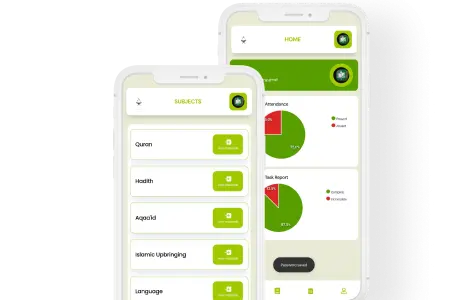
Three-stream Hifz tracking — the only platform with this: Sabak, Sabaq Para, and Dhor tracked per student, per session, with quality ratings. The principal sees each student’s Hifz health at a glance. Teachers spend 90 seconds recording after class.
Nazirah module: For students reading from the Mushaf (not on a Hifz programme), a separate Nazirah progress tracker — Surah level, Tajweed quality, milestone tracking.
Tarbiyah tracking: Character development assessment across four dimensions (Spiritual, Moral, Social, Personal) — a feature no competitor offers, and uniquely relevant to institutions whose purpose is Islamic character formation as much as Qur’anic knowledge.
Fee management with Nigerian workflow in mind: Record cash payments, mobile money transfers, and bank transfers. Issue digital receipts via WhatsApp. See outstanding balances per student. One-click monthly fee report for the trustee committee.
Multi-teacher, principal-view architecture: Each Mallam or teacher manages their own class. The principal sees the whole school without requiring each teacher to report manually.
Parent portal: Parents see their child’s Hifz progress, attendance, and fee balance individually — without a shared WhatsApp group exposing their child’s data to 200 other parents.
Android-compatible: Available on Google Play Store. Works on Android 8.0+. Compatible with the majority of Android devices in use in Nigeria.
Affordable pricing for Nigerian institutions: Contact the Ilmify team for current Nigeria-specific pricing. Designed to be accessible for community-funded institutions, not priced for European school budgets.
Getting Started: What the First Month Looks Like
Week 1: Setup
- Download Ilmify from Google Play Store
- Create institution profile (name, location, type)
- Set up teacher accounts (one per teacher)
- Configure fee amounts per student type
Week 2: Student data entry
- Enter all current students (3–5 minutes per student)
- Record each student’s current Hifz or Nazirah position
- Invite parents to the parent portal
Week 3: First live recording
- Teachers record their first sessions using Ilmify
- Principal reviews the dashboard
- Any setup questions resolved with Ilmify support
Week 4: Fee management
- Record any fee payments received this month
- Send automated reminders for outstanding balances
- Generate first monthly fee report for trustees
End of Month 1: The institution has digital records, live Hifz tracking, parent portal active, and fee management running. The administrative fragility of the notebook-and-memory system is replaced by a secure, backed-up, institutional record.
💡 The only Islamic school software built for Nigerian conditionsOffline. Mobile-first. Full Hifz tracking. Affordable.Get started with Ilmify for your Nigerian Islamic school →
Conclusion
The Nigerian Islamic school market has been underserved by technology for too long. Generic school management systems were not built for Hifz education. Local Nigerian school apps were built for mainstream schools, not Islamiyya schools. International Islamic school platforms were built for UK and US contexts, not for offline Nigerian conditions.
Ilmify is different — purpose-built for Islamic educational institutions, with the offline mode, Hifz tracking depth, and mobile-first design that Nigerian Islamic schools specifically need.
Start with Ilmify for your Nigerian Islamiyya school →
Related articles:



 Arabic
  English
  Malay
Malay  Urdu
Urdu