
Introduction
Australia’s Islamic educational institutions in 2026 span a wider range of scale, sophistication, and administrative complexity than any other country’s Muslim-minority Islamic education sector. At one end: full-time Islamic schools receiving millions of dollars in government funding, employing hundreds of staff, serving hundreds of students, and subject to full state and federal educational accountability requirements. At the other: weekend Quran schools of 30 students run by a single imam from a mosque classroom with a notebook attendance register. In between: daily maktabs, Islamic Studies enrichment centres, and Hifdh programmes serving dozens to hundreds of students.
Each of these institution types has different technology needs. This article maps those needs clearly, evaluates what the market currently offers, and identifies what Australian Islamic educational institutions should actually use in 2026.
The Technology Landscape for Full-Time Australian Islamic Schools
Full-time Islamic schools — ISAA members and others — typically already use one of the major Australian school management platforms for their core administrative and academic functions. These platforms include:
Synergetic: Used by many independent schools across Australia; handles student academic records, reporting, attendance, enrolments, billing, and parent communication. Strong for NZC/AC-aligned academic tracking. No Islamic education functionality.
Edumate: Another major Australian independent school management platform with similar capabilities — robust for general school administration, NAPLAN reporting, and financial management. No Islamic education functionality.
TASS: Used widely in Queensland and other states; similar capability profile to Synergetic and Edumate.
The Islamic education gap in these platforms: Every major Australian school management system handles the academic side of schooling well. Not one of them has any concept of Quran progression, Hifdh tracking, Iqra levels, Arabic studies specific to the Quranic tradition, or the three-stream Hifdh management model. For Islamic studies teachers managing Quran education across hundreds of students, the school’s primary management system is useless for tracking the most important element of the Islamic school’s curriculum.
The solution: Full-time Islamic schools need a two-platform approach — their primary school management system for NZC/AC academic tracking, attendance compliance, NAPLAN reporting, and financial management, alongside a dedicated Islamic education management platform for Quranic progression, Hifdh tracking, and Islamic Studies progress records. These two systems need to hold complementary data about the same students, with clear delineation of which records are managed where.
The Technology Landscape for Mosque Maktabs and Weekend Schools
The mosque maktab and weekend school sector has a different technology profile entirely. Most of these institutions currently manage with:
The notebook register: The teacher’s personal notebook, updated session by session with attendance and Quran progress notes. Technically functional for very small classes with a stable teacher. Catastrophically fragile when the teacher leaves — the institutional memory goes with the notebook.
WhatsApp groups: The universal communication tool. Free, immediate, universally understood. Adequate for general announcements. Entirely inadequate for individual parent communication, private fee discussions, individual progress reports, or anything requiring confidentiality under the Privacy Act.
Excel or Google Sheets: Used by more organised administrators to track student lists, Quran levels, and fee status. Better than notebooks. Lacks parent portals, automated notifications, receipt generation, and the Islamic educational model (it has no concept of Iqra volumes, Hifdh streams, or Tajweed notes).
Generic Sunday school apps: A few community-oriented apps exist for weekend school administration. They handle basic student registration and attendance. They have no Islamic-specific functionality — no Quran progression, no Hifdh tracking, no Arabic subject structure.
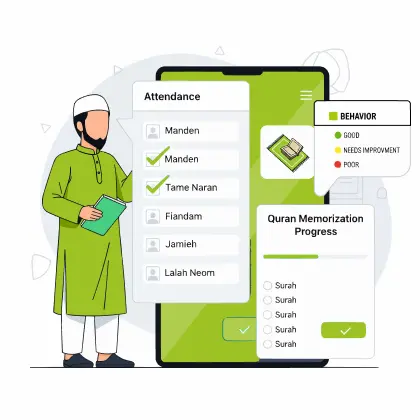
The right tool: A purpose-built Islamic education management platform that handles all the functions of a mosque maktab — student registration, Quran progression tracking per student per session, attendance with automatic parent notification, fee management with receipts, individual parent portals — in a mobile-first interface accessible on a smartphone.
What Australian Islamic Institutions Actually Need
Based on the specific requirements of the Australian context, here is what an effective management platform must provide:
1. Student Registration with Australian Compliance Fields
Student records including WWCC verification records for teachers, emergency contact information, medical details, and privacy consent documentation — structured to support the institution’s Privacy Act compliance obligations.
2. Quranic Progression Tracking — The Core Capability
For Iqra/Qaida students: Volume (1–6), lesson within volume, progress rate, quality notes. Updated by the teacher after each session from their smartphone.
For Nazirah students: Current Surah/Juz, Tajweed correction notes, reading pace relative to expected progress.
For Hifdh students: Three-stream tracking — Sabak (current new memorisation), Sabaq Para (recent revision quality), Dhor (old revision retention). Quality scores for each stream, per student, per session. A Hifdh teacher with 20 students can document each student’s complete memorisation status in under 5 minutes per session with a properly designed mobile interface.
3. Attendance with Automatic Parent Notification
Session attendance recorded on a smartphone. When a student is marked absent, an automated individual message goes to that student’s parent immediately — not a group message, an individual one.
4. Fee Management with Digital Receipts
Per-student fee accounts. Digital receipts (PDF emailed to the parent) for every payment. Monthly summary for the treasurer. Arrears list for follow-up. Compatible with Australian payment methods.
5. Individual Parent Portal
Each family has their own private login to a portal showing their child’s Quran progression, attendance history, and fee status. They cannot see any other family’s data. They can access it from their phone at any time.
6. Working With Children Check Records
Teacher management including WWCC numbers and expiry dates, with alerts when WWCCs are approaching expiry.
7. Privacy Act Compliance
Data stored securely with proper access controls. No student data on WhatsApp or in unencrypted spreadsheets. Audit trail for data access.
8. English-First with Islamic Terminology
Australian Islamic education operates in English. The platform must be primarily English, with clear support for Arabic subject names (Quran, Hifdh, Iqra, Arabic), Islamic educational concepts, and Arabic student/teacher names.
Platform Recommendations by Institution Type
Large full-time Islamic school (100+ students, government-funded): Primary school management system (Synergetic, Edumate, TASS) for academic/compliance records + Ilmify for Quranic progression and Islamic Studies tracking.
Medium Islamic school or large daily maktab (50–100 students): Ilmify as the primary management platform. Simple enough for a maktab context, capable enough for a full Islamic school’s educational tracking needs.
Small daily maktab or weekend school (under 50 students): Ilmify mobile app — affordable, simple, Islamic-context specific. The teacher records attendance and Quran progression on their phone; parents see it in their individual portal; the principal has an institutional record that survives teacher changes.
Hifdh programme (any size): Three-stream Hifdh tracking is the most specific and specialised need in Islamic education management. Ilmify’s three-stream model (Sabak/Sabaq Para/Dhor per student per session) is the only commercially available platform that handles this correctly. Any institution with a Hifdh programme should be using a platform that supports this model — everything else requires the Hifdh teacher to maintain a parallel manual record that undermines the institutional record-keeping objective.
The Business Case for Australian Maktabs: What Poor Administration Costs
The cost of poor administration in an Australian mosque maktab is not visible on a balance sheet. It shows up as:
- A student who has been at the same Iqra level for six months because no one noticed their progression had stalled
- A family who stops sending their child after a dispute about fees they insist they paid but for which there is no receipt
- A Hifdh student whose older Juz have deteriorated significantly because no one was tracking the Dhor stream
- Three years of Quran progression records that disappear when the ustadz migrates to Perth
- A privacy complaint when a family’s fee arrears are inadvertently mentioned in a WhatsApp group
These are real costs — to students, to families, to the institution’s reputation, and to the community’s trust in its Islamic educational provision. The investment in a proper management system — affordable, mobile-first, Islamic-specific — is modest relative to these costs. It is not a luxury. It is what amanah in educational administration looks like in 2026.




 Arabic
  English
  Malay
Malay  Urdu
Urdu