
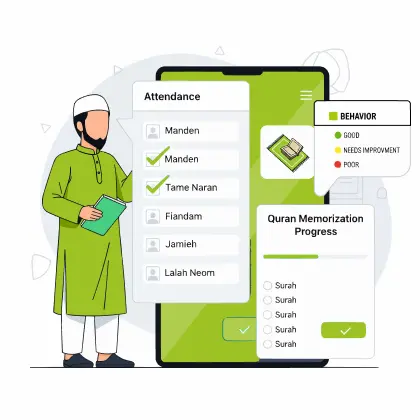
The Management Reality of Oman’s Quran Institutions
Oman has hundreds of Quran education institutions — Dar al-Quran centres spread across nine governorates, mosque Halaqat in virtually every community, government Islamic Institutes, and a growing number of private Quran schools. Every one of these institutions manages student enrolment, tracks Hifz progress, schedules Muraja’ah, records teacher attendance, and submits periodic reports to the Ministry of Awqaf.
Almost all of them do this on paper.
This is not a failure of awareness or ambition — it reflects the simple reality that no software product has been built specifically for this context. General school management software exists, but it does not understand Hifz, Muraja’ah, or Ijazah. Arabic-language educational software from the GCC market tends toward school administration (timetables, grades, attendance) rather than the specific tracking needs of Quran memorisation programmes. So centres default to paper registers, personal notebooks, and — at best — Excel spreadsheets maintained by a dedicated administrator.
The result is a sector where critical information lives in teachers’ heads rather than in accessible records, where Ministry reporting requires days of manual compilation, and where a single teacher changing roles can leave an institution unable to account for the progress of their students.
Who Needs Management Software in Oman?
Different institution types in Oman have different but overlapping management software needs:
| Institution Type | Primary Needs | Scale |
| Ministry Dar al-Quran centres | Full Hifz/Muraja’ah tracking, Ijazah workflow, Ministry reporting | 30–200 students |
| Mosque Halaqat | Basic progress tracking, attendance, parent communication | 10–50 students |
| Government Islamic Institutes | Student records, curriculum tracking, examination management | 100–500 students |
| Private Quran schools | Full feature set + fee management | 50–300 students |
| Multi-site Ministry operations | Central reporting across all governorate centres | 500–5,000+ students |
The software requirements scale with institution size, but the core needs — Hifz tracking, Muraja’ah management, Arabic interface, Ministry-format reporting — are shared across all types.
Core Requirements for Oman’s Institutions
Six functional requirements define what software for Oman’s Islamic education institutions must deliver:
| Requirement | Why It Matters for Oman |
| Hifz progress tracking | Primary educational record; must be page-accurate and searchable |
| Muraja’ah scheduling | Systematic revision is the most common failure point in Hifz programmes |
| Ijazah workflow | Ministry-registered centres must document the certification process |
| Arabic-first interface | All users work in Arabic; translated interfaces create friction |
| Ministry reporting | Regulatory compliance with Ministry of Awqaf requirements |
| Geographic flexibility | Oman’s distributed geography requires multi-site or remote access capability |
Hifz Progress Tracking
The Hifz progress record is the most fundamental document in a Quran institution’s management. For each student, it must capture:
- Daily lesson (Wajbah / Dars al-Jadid): Pages presented, quality assessment (error-free / minor errors / needs repeat), date
- Running total: Pages and Juz completed to date
- Teacher notes: Specific Tajweed issues, memorisation strengths/weaknesses
- Milestone records: When each Juz was completed and certified
- Completion date: When the student finishes the 30th Juz
This record needs to be:
- Searchable — a supervisor or Ministry reviewer can look up any student’s current status instantly
- Exportable — for Ministry reports and for student transfer records
- Accurate over years — a student may take 4–7 years to complete Hifz; the record must be maintained reliably throughout
Paper registers fail on all three counts: they are not searchable, not easily exportable, and frequently become illegible or lost over multi-year periods.
Muraja’ah Scheduling and Monitoring
Muraja’ah is the most management-intensive aspect of Hifz education, and the aspect most commonly neglected in paper-based systems. A proper Muraja’ah management system for Oman’s centres needs:
Auto-generated Muraja’ah schedules:
Based on how much each student has memorised, the system calculates their Muraja’ah Qaribah (recent revision) and Muraja’ah Ba’idah (older revision) schedules automatically. As the student’s total memorised Quran grows, the schedule updates.
Session-by-session Muraja’ah records:
At each session, the teacher records which Muraja’ah portions were presented and how they went. This creates a full revision history per student.
Overdue alerts:
If a portion of the Quran has not been revised within its scheduled window, the system flags the overdue status — alerting the teacher before the instability becomes serious.
Pre-Ijazah Muraja’ah documentation:
When a student is in the intensive pre-Ijazah revision period, the system tracks the full-Quran revision cycles and generates a completion certificate showing the dates and quality of each revision session.
Ijazah Workflow Support
For Ministry-registered Dar al-Quran centres, the Ijazah certification process needs documentary support:
| Ijazah Stage | Software Function |
| Eligibility screening | Auto-flag when student meets criteria (30 Juz completed, Muraja’ah stable, Tajweed assessed) |
| Pre-Ijazah documentation | Record intensive revision period session by session |
| Examination record | Date, examiner, result |
| Sanad chain | Teacher’s Sanad stored in their profile; linked to student’s certificate |
| Certificate generation | Formatted Ijazah certificate with student name, teacher, Riwayah, date, and Sanad summary |
| Ministry register entry | Auto-populate the Ijazah completions register for Ministry reporting |
Given that Oman’s Ministry of Awqaf maintains a register of Ijazah-holding teachers and uses that register as the basis for teacher deployment, the software’s teacher credential management is directly relevant to Ministry processes.
Arabic Interface and Omani Context
An Arabic-first interface is a hard requirement, not a preference. Specifically for Oman:
- Arabic as primary language — not an option or translation layer
- Right-to-left layout — UI must be genuinely RTL, not just translated text
- Hijri calendar — Omani institutions record dates in both Hijri and Gregorian; the software must support both
- Arabic Quran navigation — Surah names in Arabic, Juz numbering, page references to the standard Gulf Mushaf (typically the King Fahd Complex Madinah Mushaf used across the GCC)
- Omani institutional context — Ministry of Awqaf as the regulatory body, Oman-specific competition names, Omani national holidays
Ministry of Awqaf Reporting
Oman’s Ministry of Awqaf requires licensed institutions to maintain records and submit reports. Required documentation typically includes:
| Report | Frequency | Content |
| Student enrolment register | Annual / on demand | All enrolled students with enrolment dates |
| Progress summaries | Periodic | Hifz completion stage per student |
| Ijazah completions register | On each completion | Student details, teacher, Riwayah, date |
| Teacher qualifications record | Annual | Teacher names, qualifications, Ijazah |
| Attendance records | On request | Session attendance per student |
The software must generate these directly from stored data — not require administrators to manually compile information from separate sources.
Multi-governorate reporting:
The Ministry’s central offices in Muscat need consolidated reports from centres across all nine governorates. A software system used across Ministry-operated centres needs to aggregate data centrally for Ministry-level reporting while maintaining individual centre views.
Geographic Distribution and Multi-Site Management
Oman’s geography is a practical management challenge. The country stretches over 300,000 square kilometres with major centres in Muscat, Sohar, Sur, Salalah, Nizwa, and Ibri — and many smaller communities between them.
For the Ministry of Awqaf, managing a network of Dar al-Quran centres across this geography requires:
- Cloud-based system — accessible from any location with internet connectivity
- Offline capability — for centres in areas with intermittent connectivity
- Central dashboard — Ministry administrators in Muscat can view data from all centres in a single consolidated view
- Centre-level autonomy — each Dar al-Quran manages its own students and records without depending on Muscat for day-to-day operations
For private or community Quran schools in smaller towns, the same cloud accessibility means that a centre in a smaller Wilayat can use the same tools as a large Muscat centre — reducing the quality gap between urban and interior institutions.
What Generic Software Misses
The fundamental problem with using generic school management software for Oman’s Quran institutions:
| Generic School Software | Why It Fails for Oman’s Quran Schools |
| Subject grades (A/B/C) | Doesn’t capture Hifz stage, Juz completed, Muraja’ah status |
| Homework assignment | Doesn’t represent the daily Wajbah / new portion concept |
| Timetable and classes | Doesn’t support Talaqqi (individual sessions) scheduling |
| Attendance tracking only | Misses the session-quality dimension entirely |
| English or translated Arabic | Creates friction for all users; misses Omani-specific terms |
| No Ijazah or Sanad concept | Cannot support the institution’s most important credential |
These are not gaps that can be patched — they reflect a fundamental mismatch between what generic school software is designed for and what Quran institutions actually need.
The Ilmify Solution for Oman
Ilmify is built specifically for Islamic education institutions, with Gulf Tahfiz and Quran centres as the primary design context. For Oman’s institutions:
- Arabic-first, GCC-contextualised interface — designed for how Omani teachers and administrators actually work
- Hifz and Muraja’ah tracking — separate dual-stream records per student, with auto-generated revision schedules
- Ijazah workflow — from eligibility screening through Sanad documentation to certificate generation
- Ministry-format reporting — one-click generation of the records Oman’s Ministry of Awqaf requires
- Cloud-based with offline support — accessible across Oman’s distributed geography
- Multi-site management — Ministry-level consolidated reporting alongside individual centre management
Explore Ilmify for Oman’s Islamic Education Institutions →
Frequently asked questions
Q: Does Ilmify work for small mosque Halaqat as well as large Dar al-Quran centres?
Yes — Ilmify scales from small Halaqat (10–20 students with one teacher) to large multi-site networks. The interface is designed to be simple enough for a mosque imam managing a small circle, while having the depth needed for a Ministry-operated Dar al-Quran with 200 students across multiple teachers.
Q: Can the software be used in Arabic on tablets and phones?
Ilmify is designed to be mobile-accessible. Teachers in mosque Halaqat often use tablets or phones rather than desktops — the interface works on all device types in Arabic.
Q: Does the system support Ibadi-specific content or Omani curriculum?
Ilmify is a management and tracking system rather than a content platform — it tracks progress through the Quran and records teacher assessments. The content being taught (Ibadi Fiqh, etc.) is separate from the management function. The system is neutral to the scholarly tradition and supports any Hifz programme regardless of madhab.
Q: How does data backup work?
Ilmify uses cloud storage with regular automated backups. Institutional data is exportable at any time in standard formats. Data is stored securely and can be accessed by authorised users from any location.
Q: Is there Arabic customer support for Omani institutions?
Ilmify provides Arabic-language support for institutions in the GCC. Onboarding, training, and ongoing support are available in Arabic.
Conclusion
Oman’s Islamic education institutions — from the smallest mosque Halaqah in a rural Wilayat to the Ministry’s Dar al-Quran network — deserve management tools that match the seriousness of their work. The gap between the rigour of Hifz education and the informality of how it is typically managed is not inevitable. Purpose-built software closes that gap, freeing teachers to focus on teaching rather than paperwork, and giving administrators the data they need to run institutions that the Ministry of Awqaf — and the families they serve — can depend on.
Ilmify is the management platform for Gulf Quran and Islamic education institutions — Arabic-first, Hifz-aware, Ijazah-ready, Ministry-reportable. Get started →





 Arabic
  English
  Malay
Malay  Urdu
Urdu