
Islam in Oman: A Distinctive Tradition
Oman is home to approximately 3.5 million people, of whom the majority are Muslim. What makes Oman immediately distinctive in the context of Islamic education — and indeed of Islamic tradition in the broader Muslim world — is that the dominant sect of Islam in Oman is Ibadi, not Sunni or Shia. Ibadi Islam is one of the oldest branches of the religion, pre-dating the Sunni-Shia split, and Oman is the only country in the world where Ibadi Muslims constitute the majority.
This doctrinal distinctiveness shapes Oman’s Islamic education in meaningful ways. The curriculum in Omani religious institutions reflects Ibadi theology and jurisprudence alongside the Quran and Hadith sciences that are common to all Muslim scholarly traditions. Oman’s approach to Islamic education is traditionally conservative but politically non-confrontational — reflecting the late Sultan Qaboos bin Said’s deliberate policy of religious moderation and Oman’s broader diplomatic tradition of non-alignment and openness.
Islamic education in Oman serves a population that is both deeply religious and relatively cohesive in its tradition, governed by a centralised Ministry, and primarily delivered through a network of mosque schools and government-supported Quran centres.
The Ibadi Madhab: What Makes Oman Different
Ibadi Islam (الإباضية) emerged in the first Islamic century from the Khawarij movement, though Ibadis themselves reject association with Khawarij extremism. It is theologically distinct from both Sunni and Shia Islam in several ways:
| Feature | Ibadi Position | Sunni Comparison |
| Leadership (Imamah) | Elected by community consensus; not hereditary | Caliph — various positions on succession |
| Jurisprudence | Ibadi Fiqh — distinct school | Four recognised Sunni madhabs |
| Theology | Mu’tazila-influenced on some questions | Ash’ari / Maturidi majority |
| Quran and Sunnah | Shared reverence and study methodology | Same foundation |
| Qiraa’at | Primarily Hafs ‘an ‘Asim in practice | Same in GCC generally |
| Relations with non-Ibadis | Historically tolerant and inclusive | Varies |
For Islamic education, the practical implications are:
- Fiqh taught in Omani religious institutions is Ibadi Fiqh alongside comparative Fiqh
- Textbooks and curriculum materials reflect Omani Islamic scholarly tradition — not purely Hanbali (as in Saudi Arabia) or Hanafi (as in South Asia)
- Ibadi classical texts — such as works by Jabir ibn Zayd and later Ibadi scholars — form part of the advanced curriculum in Oman’s religious institutions
However, for Quran memorisation (Hifz) and Tajweed — the shared Quranic tradition — Oman’s practice is broadly aligned with the wider Muslim world. The Quran is the same; the Tajweed rules are the same; the Ijazah tradition is shared.
The Structure of Islamic Education in Oman
Islamic education in Oman operates across several layers:
| Layer | Institution Type | Age/Level |
| Community | Mosque Quran circles (Halaqat) | All ages — especially children |
| Community | Kuttab / small Quran schools | Ages 5–12 |
| Formal | Government Islamic Institutes (Ma’ahid) | Secondary level |
| Formal | College of Shari’ah at Sultan Qaboos University | Undergraduate |
| Advanced | Postgraduate Islamic studies | Graduate research |
| Specialised | Dar al-Quran / Tahfiz centres | All ages, Hifz focus |
Unlike Saudi Arabia or Egypt, Oman does not have a large parallel Islamic school system running alongside the national curriculum schools. Islamic education is more integrated into the national curriculum (Islamic studies is a mandatory subject in all Omani government schools) and supplemented by community mosque-based instruction.
Governance: Ministry of Awqaf and Religious Affairs
The Ministry of Awqaf and Religious Affairs (وزارة الأوقاف والشؤون الدينية) governs Islamic education at the community and institutional level in Oman. Its responsibilities include:
- Overseeing and funding mosque Quran education circles
- Licensing and regulating Quran memorisation centres
- Managing the Waqf (endowment) properties that fund religious institutions
- Supervising the training and appointment of imams and Quran teachers
- Running the national Quran memorisation competitions
- Maintaining the network of Dar al-Quran centres
The Ministry operates under the authority of the Sultan and reflects Oman’s tradition of centralised, moderate Islamic governance. The Ministry’s approach to curriculum is Ibadi-informed but explicitly non-extremist — reflecting the late Sultan Qaboos’s vision of Oman as a moderate Muslim state with religious continuity.
Since the ascension of Sultan Haitham bin Tariq in 2020, this orientation has continued, with increased emphasis on religious education as a tool for national cohesion and identity.
Mosque-Based Quran Education
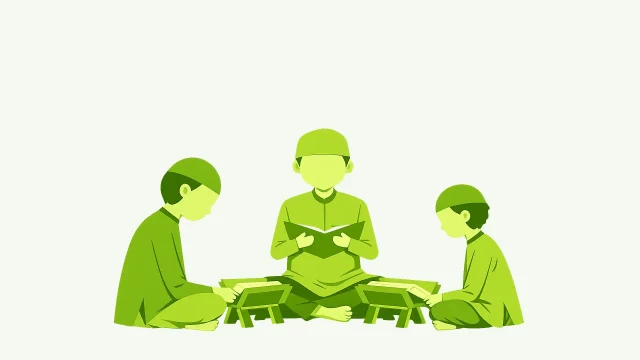
The foundational layer of Islamic education in Oman is the mosque Halaqah — the Quran study circle organised around the local mosque. These circles operate in virtually every mosque across Oman, from the Grand Mosque in Muscat to the smallest community masjid in interior Wilayats.
Typical mosque Halaqah in Oman:
- Children attend after the Asr or Maghrib prayer
- Sessions last 45–90 minutes
- Content: Quran recitation (Nazra), Tajweed basics, memorisation of selected Surahs
- Teacher: typically the mosque imam or a qualified Quran teacher employed by the Ministry
For many Omani children, the mosque Halaqah is where Islamic education begins and where the foundation for Hifz is laid. Students who demonstrate strong memorisation ability and family commitment to Hifz may then progress to a dedicated Dar al-Quran or Tahfiz programme.
Kuttab tradition:
The traditional Kuttab — a small Quran school typically run by a single teacher in the mosque or a community space — remains in use in Oman, particularly in rural and interior areas. These are informal institutions by comparison with the formal Dar al-Quran network but serve an important community role.
Formal Islamic Education Institutions in Oman
Dar al-Quran (دار القرآن)
The Ministry of Awqaf operates Dar al-Quran centres across Oman’s governorates. These are formal Tahfiz institutions offering structured Hifz programmes, Tajweed instruction, and Ijazah pathways. They are the most organised layer of non-university Islamic education in Oman.
Government Islamic Institutes (المعاهد الإسلامية)
Secondary-level institutions — equivalent to Islamic high schools — that provide intensive Islamic studies alongside the national curriculum. Graduates can proceed to university Islamic studies programmes.
College of Shari’ah and Law at Sultan Qaboos University
Sultan Qaboos University (SQU) in Muscat houses a College of Arts and Social Sciences with an Islamic studies department, and a separate College of Law. Islamic jurisprudence — particularly Ibadi Fiqh — is a significant component of the law curriculum. SQU is Oman’s premier university and produces graduates who enter Oman’s Islamic education and legal systems.
College of Shari’ah at Nizwa University
Nizwa, the historic centre of Ibadi scholarship in Oman, hosts a university with dedicated Shari’ah and Islamic studies programmes. Nizwa’s tradition as the intellectual capital of Ibadi Islam gives this institution particular significance in the context of Omani Islamic education.
| Institution | Type | Location |
| Dar al-Quran centres | Tahfiz / Quran memorisation | Multiple governorates |
| Government Islamic Institutes | Secondary Islamic education | Muscat and regions |
| Sultan Qaboos University | University — Islamic studies | Muscat |
| Nizwa University | University — Shari’ah | Nizwa |
Hifz and Quran Memorisation in Oman
Hifz — the memorisation of the complete Quran — is deeply valued in Omani society. The cultural status of a Hafiz in Oman is comparable to the rest of the Muslim world, and families invest significantly in supporting children to complete memorisation.
Hifz education in Oman happens primarily through:
- Mosque Halaqat — informal, teacher-led, community-based
- Dar al-Quran centres — formal, Ministry-governed, structured curriculum
- Private Quran teachers — individual Talaqqi sessions at home or in a small group
- Tahfiz programmes within Islamic Institutes — students in government Islamic secondary schools may pursue Hifz alongside their academic curriculum
The terminology used in Oman’s Hifz education is Arabic and follows broadly the same system as the rest of the Arabic-speaking Muslim world:
| Term | Meaning |
| Hifz (حفظ) | Memorisation |
| Muraja’ah (مراجعة) | Revision of memorised portions |
| Wajbah (واجبة) | Daily new lesson |
| Tajweed (تجويد) | Rules of correct Quranic recitation |
| Ijazah (إجازة) | Formal certification of memorisation and recitation |
| Khatm (ختم) | Completion — recitation of the full Quran |
Oman’s national Quran competition:
The Ministry of Awqaf organises an annual national competition in Quran memorisation and recitation. This competition serves as a quality benchmark for Oman’s Hifz sector and identifies Omani representatives for regional and international competitions such as the Dubai International Holy Quran Award.
Women’s Islamic Education in Oman
Women’s participation in Islamic education is significant in Oman. The Ministry of Awqaf operates dedicated women’s Quran circles and Tahfiz programmes. Female Quran teachers (Mu’allimat al-Quran) work in women’s programmes and are trained and certified by the Ministry.
Women in Oman have access to:
- Mosque Halaqat conducted by female teachers in women’s sections
- Women’s Dar al-Quran programmes in dedicated facilities
- University Islamic studies at Sultan Qaboos University (co-educational)
- Distance learning options for Islamic studies
The female Hafiza in Oman carries the same social respect as her male counterpart, and the Ministry actively promotes women’s Hifz education as part of its broader religious education mandate.
Islamic Education in Oman’s Public Schools
Islamic Education (التربية الإسلامية) is a mandatory subject in all Omani government schools from Grade 1 through Grade 12. The curriculum covers:
- Quranic recitation and memorisation (selected Surahs, increasing by grade)
- Fiqh — including Ibadi Fiqh at more advanced levels
- Tafsir (basic Quranic interpretation)
- Hadith — selected narrations and their lessons
- Islamic history and civilisation
- Ethics and Islamic conduct
The curriculum is developed by Oman’s Ministry of Education in coordination with the Ministry of Awqaf. At the secondary level, students have the option to specialise in Islamic studies within the academic track.
A notable feature of Oman’s school Islamic education is the inclusion of Ibadi content — reflecting Oman’s distinctive tradition — alongside material that would be recognisable in any Sunni curriculum. This dual coverage prepares students to understand both their own tradition and its relationship to the broader Muslim world.
Digital and Online Islamic Learning in Oman
Online Islamic education has grown in Oman as in the rest of the Gulf, accelerated by the COVID-19 period. The Ministry of Awqaf has embraced digital delivery for some programmes, and private online Quran teaching platforms serve Omani learners.
Challenges specific to Oman:
- Geographic distribution: Oman is a large country with dispersed population centres. Interior and coastal communities may have limited access to formal Tahfiz centres, making online delivery particularly valuable
- Dialect and tradition: Omani learners benefit from teachers familiar with the Ibadi tradition and Omani Islamic context, not just generic Arabic Quran teachers
- Internet infrastructure: Muscat and major cities have good connectivity; rural and interior areas less so
The Ministry of Awqaf has developed digital resources including apps and online content for religious education. Private platforms — both Omani and from other GCC countries — also serve Omani learners.
Frequently asked questions
Q: Is Oman’s Islamic education system compatible with the rest of the GCC?
Broadly yes — in Quran memorisation, Tajweed, and Ijazah, Oman’s standards are consistent with the GCC. The distinction appears in Fiqh and theology, where Ibadi perspectives are incorporated. A Hafiz or Islamic scholar trained in Oman is recognised across the Muslim world for their Quranic qualifications.
Q: Do non-Ibadi Muslims in Oman (Sunni expatriates) receive different Islamic education?
Government school Islamic education follows the Omani curriculum, which includes Ibadi content. Expatriate Sunni Muslims — who form a significant portion of Oman’s population — generally attend Omani schools and are educated in this curriculum. Private Islamic schools and community mosque education for Sunni expat communities may follow different approaches.
Q: What is the relationship between Oman’s Ministry of Awqaf and Saudi Arabia’s religious establishment?
The two operate independently. Oman follows the Ibadi tradition; Saudi Arabia is predominantly Hanbali Sunni. They maintain respectful diplomatic relations but different religious governance structures. Omani students seeking to study at Saudi Islamic universities (IU Madinah, Umm al-Qura) can do so, and some do — but Oman’s own institutions are the primary pathway for most students.
Q: How long does Hifz take in Oman’s Dar al-Quran centres?
Typical completion time is 2–5 years for students starting in childhood, depending on the intensity of the programme and the student’s ability. Adult part-time students may take longer. Oman’s Dar al-Quran centres generally offer flexible scheduling to accommodate school-age students.
Q: Is there a formal qualification in Islamic education specific to Oman?
The Ministry of Awqaf issues certificates for Quran teachers and recognises Ijazah. Sultan Qaboos University and Nizwa University issue accredited degrees in Islamic studies. Omani government Islamic Institute graduates receive a secondary-level certificate in Islamic studies recognised within the national qualifications framework.
Conclusion
Oman’s Islamic education system is shaped by the Ibadi tradition, centralised under the Ministry of Awqaf, and delivered primarily through a network of mosque Halaqat, Dar al-Quran centres, government Islamic Institutes, and public school Islamic studies. Its distinctiveness lies in the Ibadi dimension and Oman’s tradition of religious moderation and scholarly tolerance. For Quran memorisation and Ijazah — the shared tradition of all Muslim scholarly communities — Oman’s standards and practices align with the broader GCC.
Ilmify supports Oman’s Quran education institutions with Arabic-interface management tools for Hifz tracking, Muraja’ah scheduling, and Ijazah workflow — designed for the realities of GCC Tahfiz centres. Explore Ilmify →





 Arabic
  English
  Malay
Malay  Urdu
Urdu