

Introduction
There are tens of thousands of Islamiyya schools in Nigeria. Most of them are run by dedicated, knowledgeable people — Islamic scholars, community leaders, committed teachers — who received their education in Islamic sciences but received very little preparation for the administrative realities of managing an educational institution.
The result is a pattern that plays out across the country: excellent Islamic education delivered in an institution that struggles to track which students have paid, cannot tell you how far each student has progressed in their Hifz, communicates with parents through a chaotic mix of phone calls and WhatsApp messages, and loses years of student records whenever a teacher leaves.
This guide is written to change that pattern. It covers everything a Nigerian Islamiyya school administrator needs to know — governance, legal registration, staffing, curriculum structure, fee management, record-keeping, and the digital tools that make sustainable management possible — in one place.
Setting Up Your Governance Structure
Every Islamiyya school needs a clear governance structure — a defined set of people who are responsible for strategic decisions, and a clear separation between governance and day-to-day management.
The Minimum Governance Structure
Board of Trustees / School Committee (3–7 people)
The governing body. Responsible for strategic direction, major financial decisions, hiring the principal, and accountability to the community. Should include the founding scholar or Mallam, at least one community elder, one person with financial literacy, and (ideally) one parent representative.
Principal / Head Teacher
The educational and operational leader. Accountable to the Board/Committee for day-to-day management. Hires and supervises teachers, manages the curriculum, handles parent relations, and ensures records are kept.
Treasurer
Manages fee collection and financial records. Reports to the Board. Should never be the same person as the Principal — the financial control function must be separated from the spending function.
Designated Safeguarding Lead
A named person responsible for student welfare concerns. In smaller schools, this is often the Principal. Must know how to identify and report safeguarding concerns.
Common Governance Mistakes
The Mallam does everything. In many Islamiyya schools, the founding scholar fills every role simultaneously — teacher, principal, treasurer, administrator. This creates a single point of failure. When the Mallam is sick, travelling, or unavailable, everything stops. Distribute responsibilities from the beginning.
The mosque committee interferes in daily operations. The committee should set direction and hold the principal accountable — not decide which teacher takes which class or how lessons are structured. Establish the boundary clearly.
No written records of decisions. Committee decisions should be recorded in writing — even simple meeting minutes. This protects everyone if disputes arise and is required by most registration authorities.
Legal Registration in Nigeria
Federal Level
Corporate Affairs Commission (CAC): If your school is established as an incorporated body — a company limited by guarantee or an incorporated trustee — you must register with the CAC. This is not legally required for all Islamiyya schools but is increasingly necessary for:
- Opening a bank account in the institution’s name
- Accessing grants or donor funding
- Formal recognition by state education authorities
- Contracting with suppliers in the institution’s name
Most larger Islamiyya schools register as incorporated trustees under the Companies and Allied Matters Act (CAMA) 2020. The process takes 2–6 weeks and costs ₦20,000–₦50,000 in registration fees (subject to change).
State Level
Registration requirements for Islamiyya schools vary significantly by state:
Northern states with Islamic education boards: States including Kano, Kaduna, Sokoto, Zamfara, Kebbi, Niger, Jigawa, Katsina, Bauchi, and Gombe have State Islamic Education Boards (or equivalents) that register and oversee Islamic schools. Registration with the Islamic Education Board provides formal recognition, eligibility for state support programmes, and the right to issue certificates recognised by state authorities.
States without specific Islamic education boards: In southern and Middle Belt states, Islamiyya schools may register with the State Ministry of Education’s private schools directorate as private Islamic schools.
Practical guidance: Contact your State Ministry of Education or State Islamic Education Board to determine the specific registration requirements in your state. Requirements, fees, and processes vary significantly.
What Registration Typically Requires
- Written application with institution name, address, and founding documents
- Evidence of governance structure (names and IDs of trustees/committee members)
- Physical inspection of premises
- Evidence of qualified teachers
- Sample curriculum document
- Registration fee (varies by state)
Premises and Physical Infrastructure
Minimum Premises Requirements
Classroom space: A minimum of one room per class group, with adequate ventilation and lighting. A rough guide: 1.2–1.5 square metres per student. A classroom of 40 students needs at least 48–60 square metres of floor space.
Toilet and washing facilities: Separate facilities for male and female students. Wudu (ablution) facilities are essential if students pray on premises. Basic sanitation is both a practical necessity and a safeguarding requirement.
Safe arrival and departure: A defined entry and exit point. A procedure for who can collect each child. This is a safeguarding minimum — children should not be able to wander in or out of school unsupervised.
Storage: Secure storage for school records, books, and financial records. Records containing student personal information should be stored in a locked location.
Prayer space: For institutions that conduct Salah (daily prayer), a dedicated prayer space or a classroom that can be used for prayer at appropriate times.
Premises Checklist
Curriculum Design for a Nigerian Islamiyya School
A well-designed Islamiyya curriculum covers four core areas across structured levels:
Core Subject Areas
1. Qur’anic Studies
- Nursery/Foundation level: Arabic alphabet, basic pronunciation, Qaidah (Noorani Qaida or equivalent)
- Nazirah level: Reading the Qur’an fluently from the Mushaf with Tajweed
- Hifz level: Qur’an memorisation — full programme for dedicated students
2. Arabic Language
- Arabic reading and writing
- Nahw (grammar) — from primary through secondary levels
- Sarf (morphology) — at intermediate and advanced levels
- Arabic conversation — at more advanced institutions
3. Islamic Studies
- Aqeedah (Islamic theology): Pillars of Iman, attributes of Allah, the Prophets
- Fiqh (Islamic jurisprudence): Tahara, Salah, Sawm, Zakat, Hajj — practical application
- Seerah (Prophetic biography): Age-appropriate depth at each level
- Akhlaq (character and ethics): Integrated throughout, not just as a subject
- Islamic history: The Companions, the Caliphate, Islamic scholars
4. Islamic Sciences (advanced level)
- Tafseer (Qur’anic exegesis)
- Hadith studies
- Usul al-Fiqh (principles of Islamic jurisprudence)
- Arabic literature
Class Level Structure
| Level | Approximate Age | Primary Focus |
| Nursery / Pre-Islamiyya | 4–6 | Arabic alphabet, basic duas |
| Primary 1–3 (Lower) | 6–9 | Qaidah completion, Nazirah beginning, basic Fiqh |
| Primary 4–6 (Upper) | 9–12 | Nazirah completion, Islamic Studies intermediate, Arabic reading |
| Junior Secondary 1–3 | 12–15 | Hifz or advanced Nazirah, Nahw/Sarf, Islamic Studies advanced |
| Senior Secondary 1–3 | 15–18 | Hifz completion, Arabic composition, Islamic Sciences |
Integrated Islamiyya Curriculum (for schools also teaching national subjects)
If your school integrates national curriculum subjects (Mathematics, English, Basic Science), the timetable should clearly separate Islamic and national curriculum time. A typical integrated Islamiyya school day:
- 8:00–10:00am: Islamic Studies and Arabic
- 10:00am–12:00pm: Qur’an (Nazirah/Hifz)
- 12:00–1:00pm: Zuhr prayer and lunch
- 1:00–3:00pm: National curriculum subjects
Hiring and Managing Teachers
Qualifications to Look For
Qur’an teachers (Nazirah): Strong Tajweed knowledge; experience teaching children; patience with beginners. Ideally a graduate of a recognised Islamiyya or Hifz programme.
Hifz teachers: Must be a Hafiz. Must have Tajweed knowledge sufficient to identify and correct student errors. Must have experience teaching Hifz — completing it personally is necessary but not sufficient.
Arabic and Islamic Studies teachers: Ideally graduates of a Darul Uloom, Islamic university (UDUS, ABU, BUSA), or equivalent. At minimum, secondary-level Islamiyya graduate with strong subject knowledge.
For integrated schools — national curriculum teachers: Relevant subject qualification or TRCN (Teachers Registration Council of Nigeria) registration.
Teacher Contracts and Payment
Every teacher — paid or “voluntary” — should have a written agreement specifying:
- Their role and responsibilities
- Their teaching hours and schedule
- Their remuneration (monthly salary, sessional payment, or stipend)
- Notice period for either party
- The institution’s conduct and safeguarding expectations
Pay rates: Teacher pay in Nigerian Islamiyya schools varies enormously by location and institution size. In 2025–2026, competitive monthly salaries range from ₦30,000–₦80,000 for sessional/part-time teachers in urban areas. Full-time, qualified Hifz teachers at established institutions may earn ₦80,000–₦150,000/month. These are guides — actual rates vary significantly by state and institution.
Staff Records to Maintain
For every teacher and staff member:
- Full name, contact details, address
- Qualifications (copies of certificates)
- References (two, ideally — one Islamic scholar, one previous employer)
- Written contract or agreement
- Payment records
Student Enrolment and Records
Enrolment Information to Collect
For every student at enrolment:
- Full name and date of birth
- Parent/guardian name(s) and contact details (phone + WhatsApp number)
- Home address
- Previous Islamic education background (completed Qaidah? Which Surah in Nazirah? Hifz started?)
- Any medical needs or conditions relevant to the school’s care
- Emergency contact details (if different from parents)
Assessment at Enrolment
Before placing a student in a class level, conduct a short assessment:
- Can the student read Arabic? At what level?
- Where are they in their Nazirah (which Surah)?
- Have they started Hifz? If so, what is their current Sabak position?
This takes 10–15 minutes per student and ensures correct class placement — preventing both under-challenge (a student placed below their level wastes time) and over-challenge (a student placed above their level struggles and falls further behind).
What Records Must Be Maintained Per Student
- Enrolment information (above)
- Attendance — per session
- Qur’anic progress — current level, Nazirah position or Hifz position, quality ratings
- Islamic Studies performance — end-of-term assessment results
- Fee payment history — dates, amounts, receipt references
- Any pastoral or welfare notes
Qur’anic Progress Tracking
This is the most important administrative function in an Islamiyya school — and the most commonly done poorly.
The Three-Stream Hifz Tracking Model
For students on Hifz programmes, progress must be tracked across three streams simultaneously:
Sabak (Lesson): The new passage the student is currently memorising — typically 1–3 pages per day for a consistent student. Recorded as: Surah name, starting Ayah, ending Ayah. Quality rating: Excellent / Good / Needs revision.
Sabaq Para (Recent lesson): The material learned in the last 40 days or so — the buffer zone between fresh Sabak and consolidated Dhor. Reviewed daily or every other day. Quality rating per session.
Dhor (Revision): The full body of completed memorisation — everything the student has learned before the current Sabaq Para. Reviewed in a cycle — ideally completing one full Dhor cycle every 40–60 days for strong students. Dhor cycle completion date recorded; alert when overdue.
Without tracking all three streams, you have no idea whether a student’s Hifz is healthy. A student who is advancing their Sabak quickly but whose Dhor is decaying is not making progress — they are building on sand.
For Nazirah Students
Track:
- Current Surah and Ayah position
- Tajweed quality rating per session
- Milestones: Juz completion, Khatm (full completion)
- Any specific Tajweed rules that need focused work
Practical Recording System
For schools without digital tools: a paper register with one row per student, updated after every session. Include columns for: date, Sabak (position + quality), Sabaq Para (quality), Dhor (position/cycle status), attendance, notes. Simple, consistent, and much better than scattered notebooks.
For schools with digital tools: see the Ilmify section below.
Fee Structure and Collection
Designing Your Fee Structure
Before setting fees, calculate your true per-student cost:
| Cost Item | Monthly Cost (₦) |
| Teacher salaries (total ÷ student count) | Variable |
| Rent / premises maintenance | Variable |
| Electricity / generator fuel | Variable |
| Books and educational materials | Variable |
| Administration costs | Variable |
| Reserve fund contribution | 10–15% of total |
| Breakeven cost per student | Sum of above |
Set your fee at or above the breakeven cost. A common mistake is setting fees at what the community seems comfortable with — which is often below the actual cost of running the school. The result is a school that operates at a chronic deficit, cannot afford to pay teachers properly, and slowly deteriorates.
Fee Collection Best Practices
Collect monthly, not termly. Monthly collection reduces the burden on families and the financial shock of large termly payments. It also gives you a more consistent monthly cash flow.
Issue receipts for every payment. A handwritten numbered receipt is the minimum. Digital receipts (via Ilmify’s fee management module) are better — no paper to lose, automatic record-keeping.
Track balances per student. At any point, you should be able to tell which students are current, which are one month behind, and which are significantly in arrears — without having to manually review a stack of payment records.
Establish a clear policy for non-payment. Write down: what happens after one month of non-payment (reminder), two months (personal conversation with parent), three months (formal meeting and payment plan). Critically: never send a student away from class because of their parent’s fee arrears. The student has not failed — the parent has.
Hardship provision: Have a written policy for families facing genuine financial hardship. A formal application process, limited time-frame, and trustee approval for fee reductions — removing the decision from the teacher’s personal relationship with the family.
Parent Communication
What Nigerian Islamiyya School Parents Want to Know
Nigerian Muslim parents are deeply invested in their children’s Islamic education. They want to know:
- Is my child attending regularly?
- Where are they in their Qur’an programme (which Surah / which Juz)?
- Is their revision healthy, or are they forgetting what they learned?
- Is there anything I should do at home to support their learning?
- What do they owe in fees?
Most Nigerian Islamiyya schools communicate this information through informal phone calls, WhatsApp messages to group chats, and verbal updates at collection time. This approach — while familiar — has serious limitations:
WhatsApp groups breach student privacy. When attendance for a specific child is posted to a class WhatsApp group, every parent in the group now knows that child’s attendance history. This is a privacy concern and (for registered institutions) a potential data compliance issue.
Individual phone calls don’t scale. A principal who personally calls every parent with progress updates spends 10–15 hours a week on the phone — time that should be spent managing the school.
Good communication increases fee payment and reduces dropout. Parents who are informed about their child’s progress are more likely to pay fees on time and less likely to withdraw the child from the school.
The Better Communication Model
Structured weekly progress update: Brief digital message (or in-app notification) to each parent individually after their child’s sessions for the week — current Sabak position, quality rating, attendance.
Monthly summary report: A one-page summary of the month’s progress — Hifz/Nazirah advancement, attendance percentage, outstanding fee balance.
End-of-term report: Full progress report including Hifz position, Islamic Studies assessment, Tarbiyah observation, and teacher comment.
General announcements: Class schedule changes, school events, holiday timetables — sent via WhatsApp group is fine for these, since no individual student data is involved.
Safeguarding and Student Welfare
Every school that works with children has safeguarding obligations — regardless of whether it is formally registered.
Minimum Safeguarding Requirements
Designated Safeguarding Lead (DSL): A named, responsible adult — usually the Principal — who is responsible for student welfare. Should know: how to identify signs of abuse or neglect, who to contact if a concern arises (local social welfare office, police, hospital), and how to record and retain safeguarding information.
Staff conduct standards: Every teacher and staff member should know: appropriate boundaries with students (no physical discipline, no one-to-one situations with a student in a closed room without a witness), appropriate communication (no personal numbers shared with students), and what to do if they have a concern about another staff member’s conduct.
Safe arrival and departure procedure: A clear process for how students arrive at school and who collects them. A written record of authorised collectors for each student. A procedure for what happens if an unauthorised adult arrives to collect a child.
Incident recording: Any concern about a student’s welfare — a visible injury, a disclosure, a behavioural change — should be recorded in writing, dated, and kept securely. Even if the concern turns out to be minor, the record protects both the student and the institution.
The Digital Tools You Need in 2026
Running a Nigerian Islamiyya school in 2026 with paper registers and WhatsApp is not impossible — but it is significantly more difficult, more error-prone, and more fragile than it needs to be.
The digital tools a modern Islamiyya school needs are:
| Function | What You Need | What Happens Without It |
| Student records | Secure, searchable digital database | Records lost when teacher leaves |
| Hifz/Nazirah tracking | Three-stream progress per student, per session | Teachers track in notebooks; data inaccessible to principal |
| Attendance | Digital register with automatic parent notification | Manual registers; parents not informed of absences |
| Fee management | Payment tracking with receipts and balance reporting | Cash-in-hand, no reconciliation possible |
| Parent communication | Individual secure updates per student | WhatsApp group chaos, privacy breaches |
| Principal dashboard | Whole-school view without asking each teacher | Principal flies blind; problems missed |
The essential requirement for Nigeria: Any digital tool must work offline. Nigerian power and internet reliability means cloud-only systems will fail regularly. The tool must store data locally on the device and sync when connectivity is available.
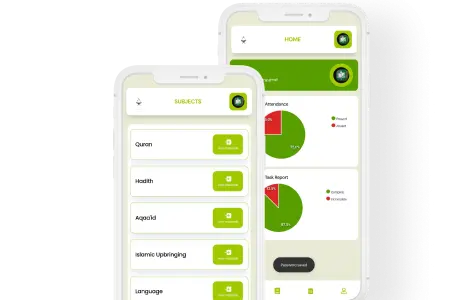
How Ilmify Supports Nigerian Islamiyya Schools
Ilmify is designed around the realities of institutions like yours — not adapted from British school software or American school management systems.
Offline mode — built for Nigerian realities: Record every session, take attendance, log Hifz progress — all on your phone, without internet. Data syncs automatically when you get a signal. NEPA or network failure does not interrupt your records.
Three-stream Hifz tracking: Sabak, Sabaq Para, and Dhor — tracked per student, per session, with quality ratings. The principal sees every student’s Hifz health at a glance. Teachers spend 90 seconds recording after class — not 15 minutes updating notebooks.
Per-student fee management: Record every payment. Issue digital receipts. See which students are current and which are in arrears without manual calculation. One-click fee reports for the trustee committee.
Individual parent updates: Parents receive progress updates individually through the Ilmify parent portal — not via a shared WhatsApp group. Each parent sees only their child’s data. Absence notifications go automatically to the right parent.
Multi-teacher structure: Each teacher manages their own class. The principal sees the whole school. No shared logins, no data confusion.
Affordable for Nigerian institutions: Ilmify’s pricing is structured for community-funded Islamic schools. Contact the Ilmify team for current Nigeria pricing — designed to be accessible for institutions of every size.
💡 Run your Islamiyya school properly — without needing an IT team or a full-time administratorMobile. Offline. Hifz-tracking. Built for Nigeria.See Ilmify for Nigerian Islamiyya Schools →
Conclusion
Running an Islamiyya school well in 2026 is not simply a matter of Islamic knowledge — it requires governance, record-keeping, financial management, safeguarding, and parent communication that match the community’s trust in the institution. The communities that establish and fund Islamiyya schools deserve institutions that operate with as much professionalism as they have contributed.
The practical tools — a governance structure, a curriculum framework, a fee management system, digital records — are not opposed to the Islamic educational tradition. They serve it, by ensuring that the institution can sustain itself, protect its students, and focus its teachers on teaching.
Ilmify provides the digital infrastructure for that sustainability — built for Nigerian Islamic schools, designed for Nigerian realities.
Start with Ilmify for your Nigerian Islamiyya school →
Related articles:




 Arabic
  English
  Malay
Malay  Urdu
Urdu