
Introduction
Every maktab in South Africa is already managing digitally. The question is not whether you use digital tools — it is whether the tools you are using are fit for purpose.
If your maktab runs on WhatsApp groups for parent communication, a spreadsheet for fees, handwritten registers for attendance, and the Ustaaz’s memory for Quranic progression, then you are managing digitally. You are just doing it with tools that were not designed for you — tools that leave critical gaps, create avoidable conflicts, and consume time and energy that should be going into the teaching and Tarbiyyah that is the maktab’s actual purpose.
This guide is an honest assessment of the digital tools that South African makaatib use in 2026, what each of them does well, where each of them fails, and what a purpose-built maktab management system needs to deliver in the South African context. It is written for principals, committee members, and teachers who want to move their maktab from ad-hoc digital improvisation to genuine institutional-quality management.
The South African Maktab’s Specific Challenges
Before comparing any tools, it is important to be precise about what the South African maktab faces that makes its situation different from a school in the UK, a madrasa in Kenya, or a Darul Uloom in India.
Load Shedding: South Africa’s national electricity supply challenges mean that power outages are a regular, predictable feature of every institution’s day. A management system that requires constant internet connectivity will fail during load shedding — creating gaps in attendance records at precisely the sessions when the teacher took attendance. Any South African maktab management system must work offline first, syncing to the cloud when power and connectivity are restored.
Mobile-First Environment: The vast majority of maktab teachers in South Africa use smartphones, not desktop computers or laptops. A system designed primarily for desktop use will not be adopted by maktab teachers, however good it is in theory. The interface must be designed for touchscreen smartphone use.
South African Fee Context: Fees are typically collected in cash at the maktab premises, though EFT and mobile payment options are increasingly common. The system must handle all of these payment methods and generate receipts that are admissible as evidence in any fee dispute.
Quranic Progression Tracking: The maktab’s core educational function is Quranic education. Any management system used in the maktab must be capable of tracking Quranic progression in the three streams that give a complete picture of each student’s Quran: the Sabak (current new lesson position), the Sabaq Para quality (consolidation of recently completed sections), and the Dhor (the state of older, previously completed sections being maintained through revision). A system that only tracks a single “Quran position” misrepresents the student’s actual state.
POPIA Compliance: South Africa’s Protection of Personal Information Act (POPIA) imposes obligations on any organisation that collects and stores personal information about individuals, including children. Student registers, contact details, and fee records are all personal information. Sharing this information in a WhatsApp group without appropriate consent is not POPIA-compliant. Any management system must store and process student data securely.
Multi-Language Support: South African Muslim communities span multiple language backgrounds — English, Afrikaans, Zulu, Gujarati, Urdu — and the teacher may need to work in Arabic for Quranic content. A management platform that is available in English and Arabic meets the most critical requirement.
The Current Reality: What Most South African Makaatib Are Using
The WhatsApp + Notebook System
The overwhelming majority of South African makaatib in 2026 run on some variation of the following combination: WhatsApp groups for parent communication, handwritten notebooks for student registers and attendance, the Ustaaz or Apa’s memory for Quranic progression, handwritten fee ledgers, and a spreadsheet or no system at all for financial reporting.
This system works — up to a point. It is free, familiar, and requires no training. It has served South African makaatib for decades. But its limitations are becoming increasingly visible as the standards parents expect from institutions rise, as regulatory requirements around data protection strengthen, and as the administrative complexity of running a maktab grows.
Where it fails:
The most serious failure of the WhatsApp + Notebook system is what happens when the Ustaaz or Apa leaves. Every student’s Quranic progression — which Surah they are reading, how well they have consolidated recent work, which Juz have been memorised and whether that memorisation is being maintained — lives in the teacher’s memory. When the teacher leaves, this knowledge leaves with them. The new teacher starts from scratch, unable to trust any written record. Students who were progressing well lose continuity. The institution loses years of accumulated pedagogical intelligence about its students.
The second serious failure is fee disputes. Without receipts for every payment, any disagreement about whether fees were paid becomes irresolvable. The parent insists they paid. The institution has no record. The dispute damages the relationship and is never cleanly resolved. This happens in virtually every maktab that runs on handwritten ledgers and cash payments without receipts.
The third failure is parent communication. The WhatsApp group is genuinely useful for general announcements — session cancellations, term dates, ceremony invitations. It becomes actively harmful when it is used for individual student information. A parent who asks publicly how their child is progressing in Quran has inadvertently invited everyone in the group to know. A fee reminder that mentions specific students’ names or implies which families are behind on payments is a POPIA violation and a humiliation. The parents’ right to confidential communication about their own child is violated every time the group is used for individual matters.
Verdict: Default starting point, better than nothing, but insufficient for the serious institutional management the maktab deserves. The priority should be to replace it with something fit for purpose.
The Spreadsheet System
Some more organised makaatib have graduated from the pure notebook system to maintaining student registers and fee records in Microsoft Excel or Google Sheets. This is a genuine improvement — digital records are searchable, can be backed up, and are less likely to be lost in the way physical registers can be.
Where it works: Basic student registers and fee ledgers can be maintained reasonably well in a spreadsheet by someone who is comfortable with the technology.
Where it fails: Spreadsheets cannot track Quranic progression with any practical efficiency. Maintaining a three-stream Hifz tracking record (Sabak, Sabaq Para, Dhor) for forty students in a spreadsheet requires a level of data entry discipline and spreadsheet skill that most maktab teachers do not have and should not need to develop. The time spent updating and reconciling the spreadsheet consumes precisely the time and energy that should be going into teaching. And Google Sheets requires internet connectivity — which means it fails during load shedding.
Verdict: Better than the notebook for financial records, but still inadequate for Quranic tracking and parent communication.
Generic School Management Apps (ClassDojo, Classting, etc.)
There is a wide range of school management apps designed for mainstream schools — ClassDojo, Additio, Classting, and others. These are used globally and are popular with teachers in conventional school settings.
Where they work: Attendance tracking, basic parent communication, and general class management are handled reasonably well by these apps. ClassDojo in particular is popular for its behaviour tracking and parent communication features.
Where they completely fail: Not one of these apps has been designed with an Islamic educational institution in mind. There is no concept of Quranic progression. There is no Sabak/Sabaq Para/Dhor tracking model. There is no understanding of the difference between reading Nazirah and memorising Hifz. There is no Arabic interface. These apps were designed for a mainstream classroom teaching maths and English — they cannot be adapted to the core educational function of the maktab without such extensive workarounds that the effort is not justified.
Additionally, most of these apps are cloud-based and require constant internet connectivity — they are not built for the load shedding reality of South Africa.
Verdict: Useful for administrative functions at a push, but completely unable to support the educational heart of the maktab. A maktab using ClassDojo as its primary management system is using a hammer to do a surgeon’s work.
Anglophone Islamic School Management Platforms
The United Kingdom, the United States, and Canada have a growing ecosystem of software platforms designed specifically for Islamic schools. These are much closer to what the South African maktab needs than generic school management apps — they understand concepts like Hifz, Tajweed, and Islamic studies subjects.
Where they work: They understand the Islamic educational context and can handle Quran tracking at a basic level. Some have parent communication features designed with Islamic school sensibilities in mind.
Where they fail for South African makaatib: These platforms are built for the Western market context. They are priced in GBP or USD. They are built for schools with reliable electricity and broadband internet. They have no offline mode. The user interface is designed for desktop computers in a school computer room, not for the smartphone of a South African Ustaaz taking attendance between recitation sessions during load shedding. They do not reflect the South African Maktab tradition — the specific language of Sabak, Sabaq Para, and Dhor; the after-school community model; the Ta’limi Board syllabus structure; the South African fee and payment context.
Verdict: Conceptually closer, but built for a context that is not South Africa. The gap between their design assumptions and the South African maktab reality is too large to bridge effectively.
What the South African Maktab Actually Needs
Based on the specific challenges outlined above, the minimum requirements for a management platform to be genuinely useful in a South African maktab in 2026 are:
1. Offline-first operation — Works without internet. Records sessions during load shedding. Syncs automatically when connection is restored. This is not optional — it is a hard requirement for any South African institution.
2. Three-stream Quranic tracking — Records Sabak (current lesson position: Surah, verse, quality), Sabaq Para (consolidation quality), and Dhor (older revision status) per student per session. Not just a single “Quran position” — all three streams, because all three streams are needed to see the student’s actual Quranic health.
3. Smartphone interface — Primary interaction via Android or iOS smartphone. The teacher should be able to take attendance and record Quranic progression in under two minutes per class during or immediately after the session.
4. Individual parent communication — Each parent receives a private portal showing their child’s Quranic progression, attendance, and fee status. Absence notifications go automatically to the right parent when attendance is taken. Fee reminders go privately and confidentially to the family concerned. No individual student information appears in the general WhatsApp group.
5. Fee management with receipts — Records cash, EFT, and mobile payments. Generates numbered receipts for every transaction. Shows outstanding balances per student. Produces a monthly treasurer summary report for the committee.
6. Arabic and English interfaces — Teachers who work in Arabic can use the system in Arabic. English is available for English-first teachers and committee members.
7. South Africa pricing — Priced in Rand at a level accessible to community-funded makaatib. Not GBP or USD pricing designed for UK Islamic schools.
Ilmify: Purpose-Built for Institutions Like the South African Maktab
Ilmify is the only platform that meets all seven of these requirements. It was designed specifically for Islamic educational institutions — and specifically with the operational realities of institutions outside the Western world in mind. That means offline-first architecture is built into the core of the platform, not added as an afterthought. That means the Quranic tracking model reflects how Quranic education actually works — three streams, not one. That means the parent communication model is built around individual confidentiality, not group broadcasts.
For the South African maktab specifically, Ilmify provides:
Offline Session Recording: Record attendance and Quranic progression during load shedding. The data is stored locally on the device and syncs to the cloud automatically when connectivity is restored. No session is ever lost to a power outage.
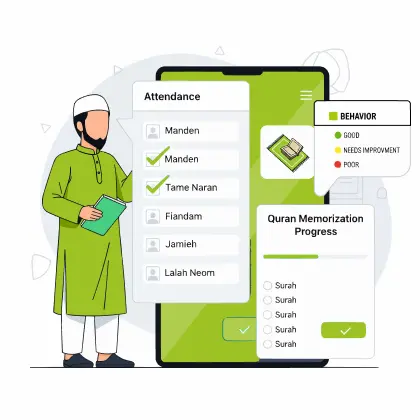
Three-Stream Hifz Tracking: After each recitation session, the teacher records the student’s Sabak position (Surah and verse), the quality of the Sabaq Para, and the current state of the Dhor. The platform’s dashboard shows the principal or head teacher the Quranic health of every student in the maktab at a glance — including flags for students whose Dhor is overdue or whose Sabaq Para quality is deteriorating.
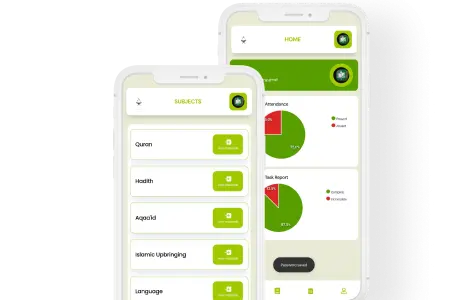
Individual Parent Portal: Each parent receives a private login. They can see their child’s Quranic progression, attendance record, fee balance, and teacher’s notes at any time — without asking the Ustaaz, without posting in the WhatsApp group, and without anyone else seeing their child’s information. When the teacher marks a student absent, the absent student’s parent automatically receives a notification. When a student completes a Juz or reaches a milestone, the parent automatically receives a congratulatory notification — no message drafted by the teacher.
Fee Management: Every payment is recorded and receipted. Outstanding balances per student are visible in real time. The monthly treasurer’s report is generated automatically from the data already entered — no manual reconciliation, no guesswork about who has and has not paid.
Arabic Interface: The complete Ilmify interface is available in Arabic, enabling Ustaads who teach and think in Arabic to use the system in their first language.
South Africa Pricing: Ilmify offers pricing adapted to the South African context. Contact the Ilmify team directly to discuss pricing in Rand for your maktab’s size and circumstances.
Making the Transition: A Practical Six-Week Plan
Introducing a new management system to a maktab that has been running on notebooks and WhatsApp groups for years does not need to be disruptive. It can be done in stages, with each stage consolidating before the next is introduced.
Weeks 1–2: Student Register Migration
Enter all enrolled students into Ilmify — full name, date of birth, parent contacts, class level. This is a one-time investment of time that the principal or a committee member can complete in an afternoon for a maktab of up to fifty students, or over two to three afternoons for a larger institution.
Weeks 3–4: Attendance and Quranic Tracking
Teachers begin recording attendance and Quranic progression after each session. Run a brief training session with all teachers — the interface is simple and most teachers find it intuitive within the first two to three sessions. By the end of week four, the habit is established.
Week 5: Parent Portal Activation
Send parent portal invitation links to all families. A brief WhatsApp message to the general group explaining the change — “We are introducing a new system that gives each family a private window into your child’s progress” — is sufficient. Early-adopter parents will immediately see the value and become advocates to hesitant parents.
Week 6: Fee System
Begin recording all fee payments in Ilmify and issuing digital receipts. The transition from handwritten ledgers to digital fee records is complete.
By the end of six weeks, the maktab has a complete digital management infrastructure in place. The handwritten register is a backup, not the primary record. Fee disputes can be resolved from the system. Parents are informed without the Ustaaz fielding dozens of individual WhatsApp messages. The Quranic progression of every student is documented and accessible to the institution. And all of this works through load shedding.
The Return on Investment
The question maktab committee members often ask is: can we afford this? The more useful question is: can we afford not to?
The hidden cost of the current system — the hours per week the Ustaaz spends answering parent queries about Quran progress and fees that a parent portal would eliminate, the time the Treasurer spends each month manually reconciling fee records, the disruption when a teacher leaves and their successor has no documentation of student progress, the reputational damage when a fee dispute escalates without documentation to resolve it — is real and significant, even if it does not appear on any budget line.
A maktab management platform does not replace the teacher or the committee. It frees the teacher to teach and the committee to lead. It protects the institution’s institutional memory. It builds the trust of parents by giving them visibility. And it ensures that the maktab that the scholars of South Africa have built over generations, and that the scholars of other countries come to study and replicate, is run with the administrative seriousness that its importance demands.




 Arabic
  English
  Malay
Malay  Urdu
Urdu