
Introduction
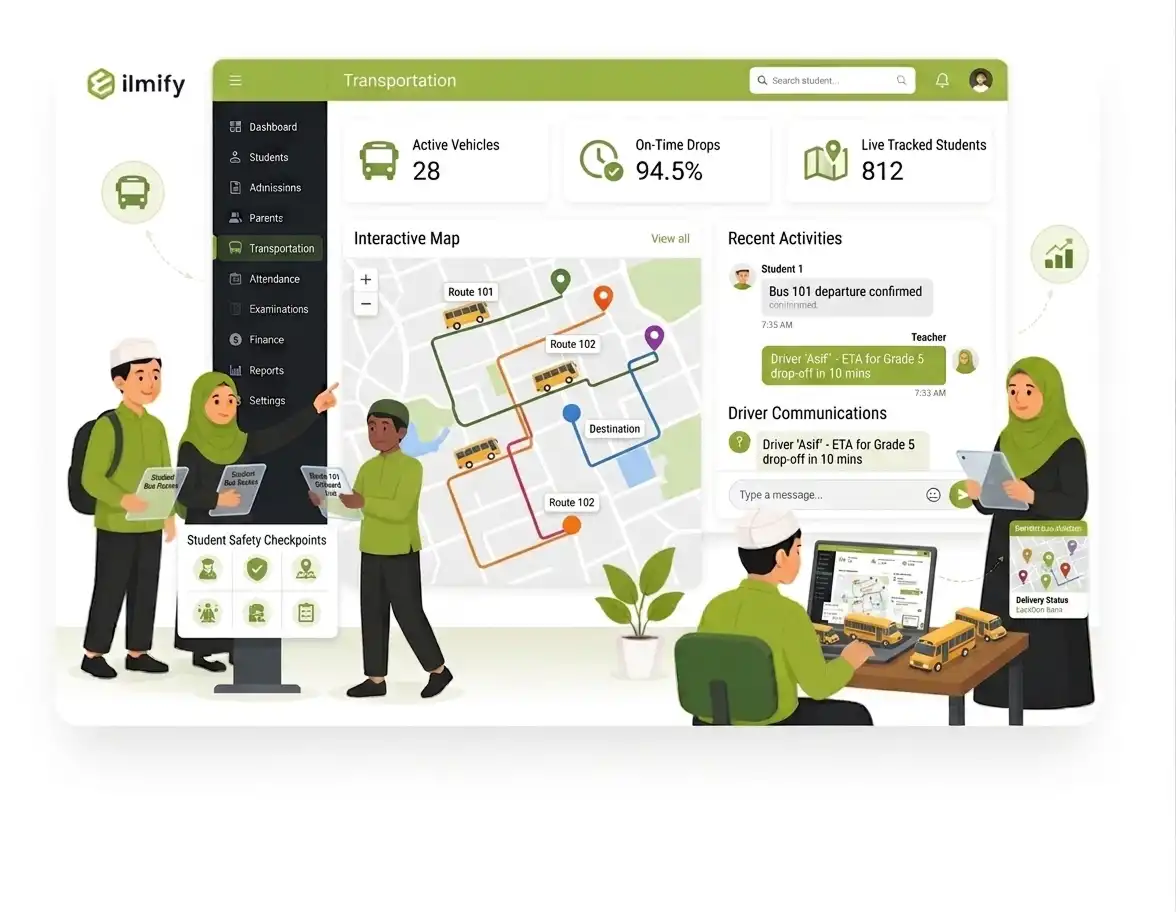
Parents want to know exactly where the school bus is, and administrators want to know a route ran safely and on schedule — a transport module inside a school management system like Ilmify gives both, live, without a separate standalone tracking app that doesn’t connect to the rest of the school’s data and requires parents to juggle multiple apps for different aspects of their child’s school day.
Why Transport Tracking Matters More Than It Seems
School transport sits at the intersection of two things parents care about intensely — their child’s safety and their own daily schedule planning. A parent waiting at a pickup point with no visibility into whether the bus is five minutes away or thirty minutes late experiences genuine, disproportionate anxiety compared to the actual risk involved, precisely because of the uncertainty rather than any specific danger. Live tracking doesn’t just add a convenience feature — it removes a recurring source of parent stress and a corresponding volume of “where’s the bus” phone calls that transport coordinators otherwise field constantly during pickup and drop-off windows, freeing that staff time for actual route management and safety oversight.
What Good Transport Software Handles
Live GPS tracking. Real-time bus location visible to both parents and transport coordinators, replacing a fixed schedule that may or may not reflect actual traffic conditions on a given day, particularly during periods of unusually heavy congestion.
Route planning. Optimized pickup and drop-off sequences per bus, reducing total route time and avoiding the inefficient, ad hoc routes that tend to accumulate as a transport system grows organically over several years without systematic review.
Parent notifications. Automated alerts when the bus is approaching a stop or has arrived, giving parents accurate, real-time information rather than requiring them to guess based on a fixed schedule that doesn’t account for day-to-day variability.
Driver and vehicle records. Licensing, maintenance schedules, and safety checks tracked in one place, connecting transport safety compliance to the same system that tracks the routes themselves, rather than a separate paper-based compliance file.
| Capability | Without Live Tracking | With Live Tracking |
|---|---|---|
| Parent visibility | Fixed schedule, no real-time information | Live location, accurate arrival estimates |
| Route optimization | Ad hoc, rarely reviewed systematically | Systematically planned and periodically reviewed |
| Safety compliance | Tracked separately from operations | Integrated with route and vehicle data |
| Administrative call volume | High during pickup/drop-off windows | Reduced significantly |
Source: Ilmify product documentation and general transport-tracking software patterns
Why Riyadh’s Sprawl Makes This a Bigger Deal
Riyadh’s geography — a genuinely sprawling city with significant distances between residential areas and many private schools — makes transport a bigger operational concern than it would be in a more compact urban layout. Traffic conditions can vary significantly day to day, meaning a fixed transport schedule that assumes consistent travel times is frequently inaccurate in practice, particularly during periods of road construction or unusual congestion patterns. Route planning and live tracking genuinely reduce parent anxiety and administrative phone calls during pickup and drop-off windows specifically because Riyadh’s traffic variability makes a static schedule an unreliable proxy for actual bus location on any given day.
Driver and Vehicle Records
Beyond live tracking, a transport module should maintain driver licensing status, vehicle maintenance schedules, and safety inspection records in one connected system rather than a separate compliance spreadsheet disconnected from day-to-day route operations. This matters both for regulatory compliance and for genuine operational safety — a system that flags an upcoming vehicle maintenance deadline or an expiring driver license proactively is meaningfully better than one that relies on a transport coordinator remembering to check a separate record manually, which introduces real risk of a compliance gap going unnoticed until it becomes a genuine problem during an inspection or, worse, an actual safety incident.
Route Planning as a Continuous Process, Not a One-Time Setup
Many schools set up their initial bus routes once, when the transport service is first established, and then rarely revisit the underlying route logic even as the student population served by each route shifts significantly over subsequent years — new families joining, others leaving, residential patterns changing across the city. Software that supports ongoing route review and optimization, rather than treating route planning as a one-time setup task, helps a school avoid accumulating years of inefficiency in its transport operations. A periodic review — comparing actual route performance data against what an optimized route would look like given the current student distribution — can reveal meaningful opportunities to reduce total route time, consolidate underutilized routes, or rebalance bus capacity across routes serving genuinely different demand levels than when they were originally designed.
Safety Protocols and Incident Reporting
Beyond routine tracking, a transport module should support documented safety protocols — a clear record of who boarded and disembarked at each stop, ideally cross-referenced against the student information system so a school can confirm every student who should have been on a route was accounted for at both ends of the journey. In the event of any incident, however minor, having a systematic incident-reporting workflow built into the transport module ensures a consistent, documented response rather than an ad hoc handling that varies depending on which staff member happens to be involved. This kind of systematic documentation also supports a school’s broader duty-of-care obligations and provides a clear record should any concern need to be reviewed after the fact.
What to Ask Vendors
- Does live tracking work reliably with the GPS hardware you already have installed, or does it require a specific proprietary device the vendor sells separately?
- Can parents see the bus location directly within the parent app, without needing to contact the school’s transport office for an update?
- Are driver licensing and vehicle maintenance records tracked alongside the route data, with proactive alerts for upcoming renewal deadlines?
- Does the system support route optimization, or only live tracking of routes that were planned manually and never revisited?
- What happens to tracking accuracy in areas with weaker GPS signal, and does the app handle this gracefully?
- Does the system support boarding/disembarking confirmation cross-referenced against student records?
How This Connects to the Rest of the System
- Student Information System (SIS) — route assignment ties directly to each student’s profile, so transport records stay accurate as students transfer, withdraw, or change addresses
- Fee Management — transport fees can be billed and tracked alongside tuition, rather than managed as a separate, disconnected billing process
- Parent-Teacher Communication — bus arrival notifications flow through the same parent app used for academic and administrative communication, rather than a separate transport-specific app parents need to install and check independently
See live bus tracking in Ilmify. Book a demo →
Conclusion
Transport tracking addresses a genuine, disproportionate source of parent anxiety and administrative call volume — one that’s particularly acute in a sprawling city like Riyadh where traffic variability makes fixed schedules unreliable. Live GPS tracking, systematic and continuously reviewed route planning, integrated driver and vehicle compliance records, and documented safety protocols together turn school transport from a recurring operational headache into a smoothly running, transparent system parents can actually trust with their children’s daily commute.
👉 See live bus tracking in Ilmify — request a demo →





 Arabic
  English
  Malay
Malay  Urdu
Urdu