
Introduction
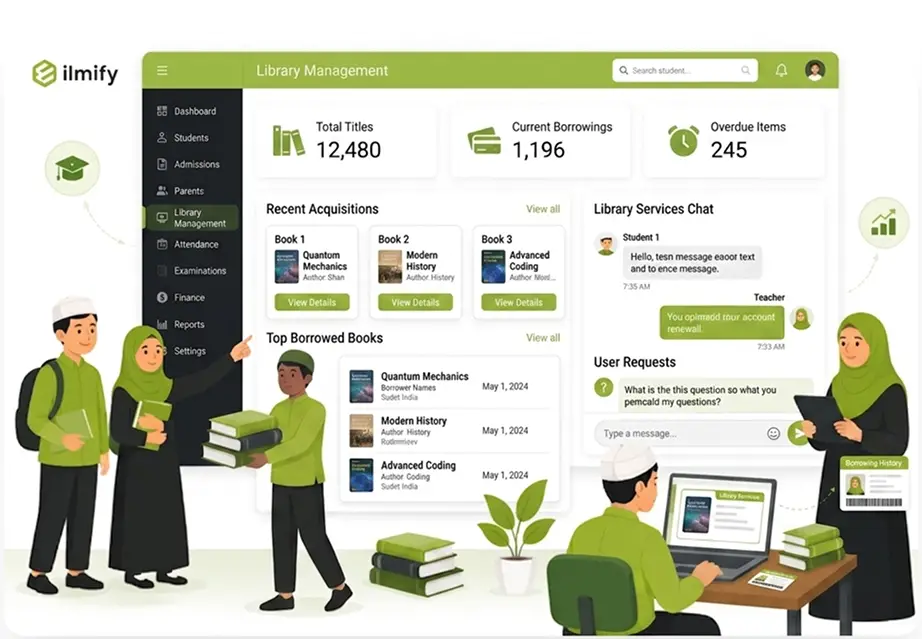
A school library outgrows a paper card catalog fast. What starts as a manageable collection of a few hundred titles, tracked on index cards or a spreadsheet a librarian updates between classes, becomes unmanageable within a few years as the collection grows, circulation volume increases, and the number of students actively borrowing multiplies. A library management module inside a school management system like Ilmify tracks every book, every loan, and every overdue fine systematically, without a librarian maintaining a separate manual system alongside the physical shelving — and it does this in a way that treats Arabic and English collections as equally native, not one as a secondary afterthought.
This guide covers what a genuinely capable library management system handles, the specific considerations that matter for Saudi school libraries, and what to check before choosing a platform.
Why Library Management Deserves Dedicated Software
A school library is a genuinely different kind of inventory-management problem than most other school operations. It’s a large, growing collection of individually valuable items that circulate constantly, with a real financial cost to the school every time a book is lost, damaged, or simply never returned because nobody tracked who borrowed it in the first place. A paper-based or spreadsheet-based system works reasonably well at small scale, but breaks down as a collection grows past a few hundred titles — at which point a librarian ends up spending a disproportionate share of their working day on manual record-keeping rather than on the parts of the job that actually support students’ reading and research needs: recommending titles, running reading programs, and helping students find what they need for a research project.
The cost of a weak library system isn’t always obvious immediately. It shows up gradually, as a slowly growing gap between what the physical shelves show and what any written record says is actually available — a discrepancy that compounds every term until an inventory reconciliation becomes a genuinely painful, multi-day undertaking rather than a routine check.
What Good Library Management Software Handles
Digital cataloging. Searchable by title, author, subject, or ISBN, in Arabic and English, replacing a physical card catalog or an unwieldy spreadsheet that quickly becomes out of date as the collection grows and changes.
Circulation tracking. A clear, always-current record of who has what book out and when it’s due back, eliminating the guesswork that comes with a paper sign-out sheet that’s easy to misplace or forget to update consistently.
Fines and reminders. Automated overdue notices sent directly to students and parents, rather than relying on a librarian to manually track due dates across potentially hundreds of active loans and follow up individually on each one.
Usage reporting. Data on which books and subjects are most borrowed, which directly informs future purchasing decisions rather than leaving a librarian to guess at demand based on memory or informal anecdote from students and teachers.
| Capability | Manual Library Management | Software-Managed Library |
|---|---|---|
| Finding a book | Physical card catalog or memory | Instant digital search by title, author, subject |
| Tracking loans | Paper sign-out sheet | Real-time circulation record |
| Overdue follow-up | Manual tracking and reminders | Automated notices to students and parents |
| Purchasing decisions | Based on librarian’s memory/anecdote | Based on actual usage data |
| Inventory reconciliation | Multi-day manual audit | Continuously accurate digital record |
Source: Ilmify product documentation and general library-management software patterns
Bilingual Cataloging: Arabic and English Together
A library catalog that only handles English titles cleanly is a real, practical gap for Saudi schools with substantial Arabic-language collections — which describes the large majority of them, particularly for younger grades, Islamic studies sections, and Arabic-language literature collections that form a core part of most schools’ libraries regardless of whether the school’s primary instructional medium is Arabic or English.
Ilmify’s cataloging supports both scripts natively, so search and sorting work correctly regardless of the language a title is cataloged in. This avoids the broken alphabetization and search failures that occur when a system built primarily for Latin-script text is asked to handle Arabic titles as a secondary feature rather than a first-class capability. A student searching for a title in Arabic should get the same reliable, accurate search experience as a student searching in English — not a degraded experience that quietly signals the system wasn’t really built with Arabic collections in mind. See Arabic School Management Software for the broader bilingual quality standard this should meet across the whole platform, not just the library module in isolation.
Usage Reporting for Purchasing Decisions
One of the most underused capabilities of a digital library system is usage reporting — data on which books, subjects, and authors are actually being borrowed, broken down by grade level or class. This transforms library purchasing from a guessing exercise based on a librarian’s general sense of what students like into a data-informed process. If a particular subject area sees consistently high circulation and long wait times for available copies, that’s a clear, evidence-based signal to invest in additional copies, rather than a subjective impression that might not accurately reflect actual student demand across different grade levels and interests.
This same data also helps identify collection gaps proactively — a subject area with unexpectedly low circulation might simply reflect weak student interest, or it might reflect an under-resourced or outdated collection that isn’t meeting a real underlying demand teachers are seeing in the classroom but that isn’t showing up in library usage because the right materials simply aren’t available yet.
Reference Materials and Curriculum-Linked Collections
Beyond general fiction and non-fiction, most Saudi school libraries maintain a substantial reference and curriculum-linked collection — textbooks held in reserve, Islamic studies reference materials, and subject-specific resources that teachers assign for research projects throughout the year. A digital catalog that can tag items by curriculum relevance — which grade level, which subject, which specific unit a resource supports — turns the library into a more actively used teaching resource rather than a passive lending facility that exists somewhat separately from day-to-day classroom instruction.
Teachers benefit directly from this kind of tagging, since they can search specifically for materials relevant to an upcoming unit rather than browsing generally and hoping to find something suitable. Librarians benefit too, since they can proactively identify when a curriculum area is under-resourced based on actual collection gaps rather than periodic, time-consuming manual review of the entire collection against the curriculum. This kind of structured tagging also supports a school’s broader academic planning — if a librarian can report precisely which subject areas and grade levels are well-served by the current collection versus which are genuinely thin, that becomes a useful, evidence-based input for both library budget planning and broader curriculum resource decisions made at the academic leadership level.
Managing Multiple Campus Libraries
School groups operating more than one campus face an additional layer of complexity worth planning for explicitly: should each campus maintain its own fully independent library catalog, or should the group operate a shared catalog with inter-campus lending capability? Both models have legitimate use cases depending on how the school group is structured, but the software needs to support whichever model actually fits the school group’s operations, rather than forcing every multi-campus operator into a single rigid structure that may not match how the campuses genuinely relate to one another administratively.
A shared catalog with cross-campus visibility allows better collection-sharing decisions and reduces duplicate purchasing of the same expensive reference materials across multiple sites — a genuine cost saving for a school group with several campuses. Independent catalogs, by contrast, may suit school groups where each campus operates with real administrative autonomy and where physical distance between campuses makes inter-campus lending impractical in any case. The right choice depends on your school group’s actual operating model, and it’s worth confirming a vendor’s software can accommodate either approach rather than forcing a single structure by default.
What to Ask Vendors
- Does the catalog search work correctly across Arabic and English titles, including mixed-script search terms that combine both languages?
- Can overdue notices be sent automatically to parents, not just students, given that younger students in particular may not check their own accounts regularly?
- Is barcode or RFID scanning supported for faster check-in and check-out during busy periods like the start of a school day, when many students are returning or borrowing books at once?
- Does usage reporting break down by grade level or class, providing genuinely actionable purchasing insight rather than just an aggregate school-wide total that obscures meaningful differences between grade levels?
- Can materials be tagged by curriculum relevance, and can teachers search directly against those tags?
- Does the system support either a shared or independent catalog structure for multi-campus school groups?
How This Connects to the Rest of the System
- Student Information System (SIS) — loan records tie directly to the student’s core profile, so librarians can see a student’s borrowing history alongside their other records without cross-referencing a separate system
- Fee Management — lost-book fines can flow directly into a student’s fee account rather than being tracked as a separate, disconnected charge that a family might overlook or a school might forget to follow up on
See the library catalog in Ilmify. Book a demo →
Conclusion
A school library outgrows manual management well before most administrators expect it to, and the cost of that outgrowth shows up gradually as lost books, unfollowed overdue fines, and purchasing decisions made without real usage data to inform them. A well-built, genuinely bilingual library module removes these gaps and turns the library’s own circulation data into a useful, evidence-based input for future collection development — while giving multi-campus school groups the flexibility to structure their libraries the way that actually fits their operations.
👉 See the library catalog in Ilmify — request a demo →





 Arabic
  English
  Malay
Malay  Urdu
Urdu