
Introduction
Almost every maktab in the world is currently being run, at least partly, through WhatsApp. The class group. The parents group. The teacher group. The group where someone posts the fee reminder every month and waits anxiously for ticks to appear. The group where a parent asks at 11pm whether their child attended that evening and gets no reply until morning. The group where the teacher shares a photo of the Hifz register and hopes everyone can read their handwriting.
WhatsApp is not a management system. It was designed for casual conversation between friends and family. Maktab administrators have adopted it because it is free, familiar, and available — not because it is suitable. And for a long time, for a small enough school, it is just about adequate.
The question this article answers is not “should you use WhatsApp?” — you will, regardless — but “when does WhatsApp become a liability rather than a convenience?” and “what does upgrading actually look like in practice?” The honest answer is that most maktabs reading this have already passed the point where WhatsApp is serving them well. This article explains why, and what to do about it.
How Maktabs Actually Use WhatsApp
Before evaluating the problem, it is worth being honest about what WhatsApp management actually looks like in a typical maktab. The pattern is remarkably consistent across schools in India, Pakistan, the UK, and beyond:
| Task | How It’s Done on WhatsApp |
| Attendance | Teacher sends a message: “Ali, Fatima, Hassan absent today” — parents read (or miss) it |
| Fee reminders | Admin posts a message to the group; parents reply “paid” or go silent |
| Progress updates | Teacher sends a voice note or text describing how a student recited today |
| Hifz tracking | Photo of handwritten register — often blurry, sometimes unread |
| Parent queries | Mixed into the group or via personal messages to the teacher’s personal number |
| Announcements | Posted to the group; seen by whoever checks WhatsApp that day |
| Complaints | Sometimes in the group, sometimes via private message, often not recorded anywhere |
This system works — barely — when the school is small (under 30 students), the teacher is extremely organised, and every parent is responsive. When any of those conditions fails, the whole system begins to fray.
What WhatsApp Does Well
Fairness requires acknowledging what WhatsApp genuinely does well for maktabs:
- Zero cost — no subscription, no setup, no hardware
- Universal adoption — every parent already has it
- Instant delivery — messages arrive immediately
- Voice notes — a teacher can describe a student’s progress verbally with nuance
- Informal warmth — the conversational format can feel less clinical than formal systems
- Media sharing — photos of homework, recordings of recitation, videos of events
For a newly started maktab with 15–20 students, a single teacher, and engaged parents, WhatsApp genuinely covers most needs. The problems emerge with scale, complexity, and time.
The Seven Problems WhatsApp Creates
Problem 1: No Permanent Records
WhatsApp messages disappear — either through deletion, phone changes, or the natural scroll of new messages pushing old ones out of sight. A parent who claims they paid a fee in November has no verifiable record. A teacher who says a student’s Hifz was at page 45 three months ago cannot prove it. There is no searchable, permanent institutional record of anything.
Problem 2: No Privacy Separation
Teachers share their personal phone numbers with parents. This blurs boundaries fundamentally — parents message teachers at all hours, teachers feel obligated to respond, and the school has no ability to manage this interaction. In the UK, this also creates GDPR concerns: personal data (student progress, fees paid, attendance) shared through personal devices is not under the school’s control.
Problem 3: No Individual Progress Tracking
WhatsApp is a broadcast and conversation tool. It cannot tell you which students have not paid fees this month, which students have missed more than three sessions, or which students’ Dhor revision has been neglected. Any tracking requires a teacher to manually compile this information from message history — which is time-consuming, error-prone, and unsustainable as student numbers grow.
Problem 4: Missed Information
A parent who is away from their phone for three days returns to 200 unread messages. The fee reminder, the announcement about the holiday schedule, and the note about their child’s Hifz correction are all buried. Critical information is missed constantly, and the school has no way of knowing who received it and who did not.
Problem 5: No Accountability for Fees
Fee management through WhatsApp is chaotic. There is no automated record of who has paid, who hasn’t, and when payment was made. The school relies on the administrator’s memory and informal notes. Parents dispute amounts. Late payers are chased through the same channel as general announcements. There is no receipt, no record, and no systematic process.
Problem 6: Group Dynamics and Conflicts
Parents’ groups on WhatsApp inevitably become sites of unwanted conversation. Parents reply to announcements with unrelated comments. Complaints aired in the group create tension. One parent’s message triggers a thread that has nothing to do with school management. The teacher who created the group for communication now has a social space they cannot fully control.
Problem 7: Nothing Transfers When People Leave
When a teacher leaves, their personal WhatsApp history goes with them. When the administrator changes, the group chat history may be inaccessible. When a parent gets a new phone, their message history resets. The school’s entire operational memory is distributed across individuals’ personal devices — none of it belongs to the institution.
The Hidden Cost of WhatsApp Management
The most insidious cost of WhatsApp management is not visible on any budget — it is teacher and administrator time.
Consider a maktab with 50 students and 2 teachers:
| Task | Time via WhatsApp | Time via Software |
| Sending attendance to parents | 15 min/day (manual messages per student) | 2 min/day (one-click bulk notification) |
| Chasing unpaid fees (monthly) | 2 hours (individual follow-up messages) | 20 min (automated reminders + filtered list) |
| Responding to progress queries | 30 min/day (parent messages to teacher’s personal number) | 10 min (parent checks portal; queries are structured) |
| Compiling monthly progress report | 3 hours (manually gathering notes from messages) | 15 min (generated from tracked session data) |
| Total monthly admin time | ~25 hours | ~5 hours |
Twenty hours per month — per school — spent not teaching. That is Tarbiyah time, Tajweed correction time, and lesson preparation time spent on administrative friction that software eliminates.
What School Management Software Actually Does
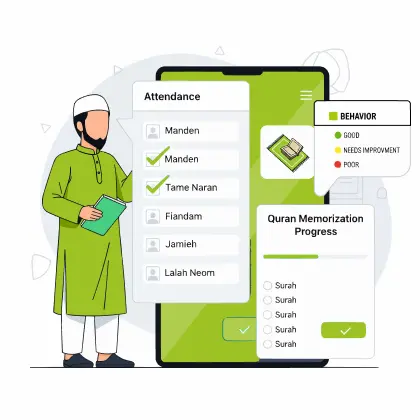
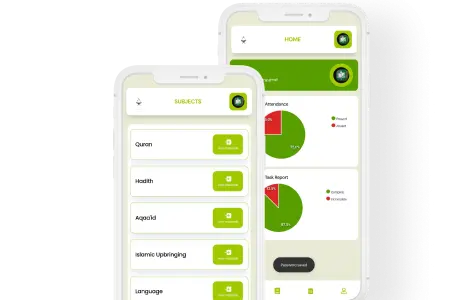
Purpose-built Islamic school management software — like Ilmify — replaces the fragmented, informal WhatsApp workflow with a structured, permanent, accessible system that belongs to the school rather than to individual devices.
Core capabilities that WhatsApp cannot replicate:
| Capability | Ilmify | |
| Hifz progress tracking (Sabak/Sabqi/Dhor) | ❌ Manual, informal | ✅ Structured, per-student, session-level |
| Attendance records | ❌ Chat messages only | ✅ Permanent digital record |
| Fee management | ❌ No tracking | ✅ Payment records, receipts, outstanding balance tracking |
| Parent communication | ❌ Personal phone, unstructured | ✅ Dedicated portal, structured messaging |
| Student progress reports | ❌ Voice notes, manual | ✅ Auto-generated from tracked data |
| Staff management | ❌ Not possible | ✅ Teacher assignments, session records |
| Historical records | ❌ Lost on phone change | ✅ Permanently stored in school account |
| GDPR compliance | ❌ Personal devices, uncontrolled | ✅ Institutional data management |
WhatsApp vs Ilmify — Direct Comparison
| Feature | Ilmify | |
| Cost | Free | Subscription (equivalent to one tutoring session/student/year) |
| Setup | Instant | 1–2 hours initial configuration |
| Hifz tracking | ❌ None | ✅ Sabak, Sabqi, Dhor — per student, per session |
| Attendance | ️ Manual messages | ✅ Automated recording and notification |
| Fee management | ❌ Informal | ✅ Full records, receipts, reminders |
| Parent communication | ️ Teacher’s personal number | ✅ School portal — no personal number sharing |
| Progress reports | ❌ Manual compilation | ✅ Auto-generated |
| Data ownership | ❌ On personal devices | ✅ School account |
| GDPR compliance | ❌ Not compliant | ✅ Designed for compliance |
| Islamic school specific | ❌ Generic | ✅ Built for maktabs, madrasahs, Hifz schools |
Signs Your Maktab Has Outgrown WhatsApp
You have outgrown WhatsApp management when:
- You have more than 30 students — the cognitive load of tracking individuals informally exceeds what one person can hold
- You have more than one teacher — coordinating multiple teachers through personal WhatsApp creates communication gaps and inconsistency
- Fee disputes happen more than once a term — no payment records means disputes are unresolvable
- Parents complain about not knowing their child’s progress — voice notes and group messages are not progress reports
- A teacher has left and taken institutional knowledge with them — the school has no independent memory
- You spend more than an hour per week on WhatsApp administration — this is teacher time that should be spent teaching
- You are in the UK — GDPR compliance requires institutional data management, not personal device sharing
- A parent has ever screenshot a group conversation and shared it outside the school — group privacy is uncontrollable
If three or more of these apply to your school, you have already passed the point where WhatsApp is adequate.
How to Transition Without Disruption
The biggest barrier to upgrading is not cost or complexity — it is inertia. The school is used to WhatsApp; parents are used to WhatsApp; teachers are used to WhatsApp. Change feels difficult.
The transition does not need to be sudden:
Week 1–2: Set up the system. Configure Ilmify with your student list, teacher assignments, and fee structure. This takes a few hours, not days.
Week 3: Run both in parallel. Continue WhatsApp for announcements while beginning to log Hifz progress and attendance in Ilmify. Do not announce the change yet — just use the system internally.
Week 4: Introduce to parents. Send a message (yes, on WhatsApp) explaining that the school is introducing a parent portal for progress updates and fee management. Provide login instructions. Keep the tone positive and practical.
Month 2 onwards: Reduce WhatsApp dependency progressively. As parents adopt the portal, shift more communication there. Keep a school announcement group on WhatsApp if needed — but stop using it for individual progress updates, fee chasing, or record-keeping.
Month 3: WhatsApp becomes supplementary. The school announcement group survives. Individual teacher-parent communication through personal numbers stops. All records live in Ilmify. The transition is complete.
👉 WhatsApp was never meant to run a school. Ilmify was built for exactly this.See what a maktab management system built specifically for Islamic schools actually looks like.Explore Ilmify → ilmify.app
Conclusion
WhatsApp will not disappear from Islamic school life — nor should it. It is excellent for informal community connection and quick announcements. But running an Islamic school’s core operations — student records, Hifz progress, fees, attendance, parent communication — through personal WhatsApp groups is not a management strategy. It is a substitute for one. The maktabs that will serve their communities best in the coming years are those that build proper institutional infrastructure now — while the school is small enough to make the change smoothly, before the chaos becomes unavoidable.
👉 Ready to give your maktab the management system it deserves? Explore Ilmify → ilmify.app
Related Articles:
- 💻 How to Transition a Maktab from Paper to Digital: A 5-Step Migration Guide
- 📊 How to Set Up a Digital Hifz Tracking System from Scratch
- 🏫 How to Start a Maktab: A Step-by-Step Guide for Mosque Committees
- 📬 How to Communicate Quran Progress to Parents Effectively
- 🇬🇧 GDPR for Maktabs and Islamic Schools: What UK Schools Must Know
- 🔒 Best Maktab Management Software for UK Islamic Schools 2026




 Arabic
  English
  Malay
Malay  Urdu
Urdu