Introduction
A parent drops off their child at maktab every evening. Three months pass. They have received one brief message from the teacher saying their child is doing “well.” They do not know which Surah their child is currently on, whether they are on track, whether there are Tajweed issues to address at home, or how their child compares to the typical pace for their age. So when a friend mentions a new Quran school that sends weekly digital progress reports, the parent is interested — not because the other school is necessarily better, but because it actually tells them what is happening.
Parent communication is not administrative housekeeping. It is the primary mechanism through which families remain engaged, committed, and trusting of the school. A maktab that communicates well with parents retains students through difficult periods, builds a reputation that generates new enrolments, and creates a partnership with families that makes the teacher’s job substantially easier. A maktab that does not communicate loses students for reasons it never knows about and never gets the chance to address.
This article is a complete, practical guide to parent communication in a maktab — what to communicate, how frequently, through which channels, and how to handle the most common difficult conversations.
Why Parent Communication Is a Retention Tool
The connection between parent communication and student retention is direct and well-documented in education research — and experienced maktab administrators will recognise it from their own observation. Families who feel informed about their child’s progress are:
- More likely to support home revision (Sabak practice, Muraja’ah)
- More likely to raise concerns before they become withdrawal decisions
- More likely to stay enrolled through difficult periods (“he’s struggling with Juz’ 15, but the teacher told us this is normal”)
- More likely to refer other families to the school
- Less likely to make comparison decisions based on other schools’ communications
Conversely, families who feel uninformed quietly disengage — sometimes weeks before the administrator realises anything is wrong. Regular, substantive parent communication is the single most cost-effective retention tool available to a maktab.
The Four Types of Parent Communication
Effective maktab communication divides into four distinct types, each with a different purpose, frequency, and appropriate channel:
| Type | Purpose | Frequency | Channel |
| Progress updates | Tell parents how their child is doing in Hifz, attendance, and conduct | Weekly | Digital report / parent portal |
| Announcements | Inform all families of dates, holidays, events, fee reminders | As needed | WhatsApp broadcast or portal notification |
| Individual conversations | Address specific concerns, Mardud verdicts, attendance problems | As needed | Phone call or in-person |
| Formal reviews | Structured progress meeting with teacher and/or principal | Termly | In-person or video call |
Each type requires a different approach. Mixing them — using the class WhatsApp group for individual child updates, for example — creates confusion and privacy problems.
What Parents Actually Want to Know
Research and practitioner experience consistently show that parents of Hifz students want to know five things, in order of priority:
- Where is my child in their Hifz? — Exact current Sabak position (Surah, page, Juz’)
- Are they progressing at a normal pace? — Context about what is typical for their stage
- Is their revision keeping up? — Are Sabqi and Dhor being covered?
- Are there any problems I should know about? — Attendance issues, Tajweed problems, behavioural concerns
- What can I do to help at home? — Specific, actionable guidance
Most maktabs fail on points 2, 4, and 5. They tell parents the current Sabak position but provide no context, no warning of problems until they are serious, and no guidance on how parents can support from home.
Weekly Progress Reports — The Foundation
A weekly progress report is the most important single communication a maktab sends. It should take the teacher 2–3 minutes to generate (from tracked session data) and the parent 2–3 minutes to read. Its value is in its regularity — a parent who receives a weekly report builds a mental model of their child’s Hifz journey over months and years.
The weekly report must include:
- Current Sabak position (Surah and page/lines as of this week)
- Pages/lines advanced this week
- Sabqi coverage indicator (was recent revision completed this week?)
- Attendance for the week
- Teacher’s brief note (2–3 sentences, honest and specific)
The weekly report should NOT include:
- Generic praise (“doing well, Alhamdulillah”) with no specific content
- Technical Tajweed terminology without explanation
- Comparisons to other students
- Alarming language that creates anxiety without providing solutions
The Student Progress Report Template
The following template can be adapted for weekly or monthly reporting: code Codedownloadcontent_copyexpand_less
══════════════════════════════════════════════
ILMIFY MAKTAB — WEEKLY HIFZ PROGRESS REPORT
══════════════════════════════════════════════
Student:      [Name]
Week ending:  [Date]
Teacher:      [Name]
══════════════════════════════════════════════

HIFZ PROGRESS
─────────────────────────────────────────────
Current Sabak: Surah [X], Juz' [X], Page [X]
This week:     Advanced [X] pages / [X] lines
This term:     Advanced [X] pages total
On track:      ✅ Ahead  |  ✅ On track  |  ⚠️ Slightly behind

REVISION
─────────────────────────────────────────────
Sabqi (recent revision):    ✅ Covered  |  ⚠️ Needs attention
Dhor (older revision):      ✅ On schedule  |  ⚠️ Behind schedule

ATTENDANCE
─────────────────────────────────────────────
Sessions attended:   [X] of [X]
Punctuality:         ✅ Consistent  |  ⚠️ Some lateness noted

TEACHER'S NOTE
─────────────────────────────────────────────
[2–3 sentences. Specific and honest. Examples:
"Aliya had an excellent week — her recitation of Surah Ya-Sin is
very solid and her Tajweed has improved noticeably. She should
revise pages 3–5 of Juz' 18 at home this week as these showed
some hesitation."

"Hassan is progressing steadily. We'd encourage 10 minutes of
Sabak revision before bedtime each night — this would help
consolidate his new material between sessions."]

NEXT WEEK'S FOCUS
─────────────────────────────────────────────
Sabak target:    [Specific portion to memorise]
Home revision:   [Specific pages/Surahs to revise at home]

══════════════════════════════════════════════
Questions? Contact [admin name] at [school contact]
NOT the teacher's personal number — all queries via school portal
══════════════════════════════════════════════
This template, generated from Ilmify’s session tracking data, takes a teacher approximately 90 seconds to complete the notes field (the rest auto-populates from tracked data). It gives parents everything they need to know in a format they can read in under two minutes.
Termly Parent Meetings — Structure and Agenda
Termly meetings are the opportunity for deeper, face-to-face conversation that weekly reports cannot provide. Every family should have a termly meeting — not just those with problems.
Termly meeting agenda (20–30 minutes per family):
| Segment | Duration | Content |
| Opening | 2 min | Warm welcome; brief acknowledgement of the term |
| Progress review | 8 min | Walk through the term’s Hifz advancement; show tracking data; discuss pace |
| Revision assessment | 5 min | Honest review of Sabqi and Dhor coverage; any significant gaps |
| Conduct and engagement | 3 min | Brief Tarbiyah observation — how is the student engaging? |
| Parent questions | 7 min | Unstructured — parent asks anything |
| Next term goals | 3 min | Set a specific, achievable goal for the coming term |
| Dua and close | 2 min | Brief dua together; warm closing |
Meeting format options:
- In-person after a session: most effective; harder to schedule for working parents
- Evening parent meeting (all families in one evening, rotating through teacher slots): efficient for the school
- Video call: accessible for remote parents or those with childcare constraints
Communicating Difficult News — Mardud, Dropout Risk, Behaviour
Difficult conversations are the test of a maktab’s communication culture. The three most common difficult communications:
Mardud Verdict
Never communicate a Mardud verdict by message. It requires a conversation — either in person or by phone — so tone and context can be communicated properly.
Script example:
“I wanted to speak with you personally about [name]’s assessment this week. Alhamdulillah, Juz’ 1–12 are very solid — [name] recited them confidently and the assessment result there is Maqbul. Juz’ 13 and 14 showed some hesitations, and the result there is that we’ll do more revision before moving on. This is completely normal at this stage — these Juz’ were memorised quickly last term and haven’t had as much Dhor time. My plan is [specific revision approach]. We’ll re-assess in 4 weeks.”
Dropout Risk
If a student is showing early signs of disengagement, contact the parent before it becomes a withdrawal request.
Script example:
“I’m calling because I care about [name]’s Hifz and I’ve noticed some changes over the last few weeks — [specific observation]. I wanted to speak with you before this becomes a bigger issue. Can you tell me how things are from your side? I want to make sure we’re supporting [name] in the right way.”
Behavioural Concern
Behavioural concerns should be communicated factually, without drama, and as a shared problem to solve.
Script example:
“I wanted to let you know about something that happened this week. [Factual description of behaviour, no exaggeration.] I’ve addressed it in class and [name] responded well. I’m raising it with you so we can both reinforce the same message at home and in school.”
Channel Strategy — What Goes Where
| Communication Type | Correct Channel | Incorrect Channel |
| Weekly progress report | Digital parent portal (Ilmify) | WhatsApp group |
| School-wide announcements | WhatsApp broadcast or portal notification | Teacher’s personal number |
| Individual progress query | Parent portal message or phone call from school number | Teacher’s personal WhatsApp |
| Urgent individual concern | Phone call from school number or admin | Class WhatsApp group |
| Formal termly review | Scheduled in-person or video meeting | Message thread |
| Fee reminders | Portal notification or WhatsApp broadcast | Class group |
The principle underlying this table: individual child information never goes in a group channel. A parent who reads their child’s progress in a group message alongside other families’ children’s names has had their privacy breached. Even a well-intentioned group update (“everyone is doing great this week!”) erodes the trust that individual reporting builds.
Setting Communication Boundaries
Without boundaries, parent communication becomes a 24/7 obligation that exhausts teachers and erodes professional relationships. Every maktab should establish and publish its communication norms:
Boundary standards to communicate at enrolment:
- Teachers are not contactable on their personal numbers — all queries go through the school’s admin contact
- Queries received after [time] will be responded to the next school day
- Progress queries are answered via the parent portal — not via WhatsApp message
- Emergency contacts (student illness, collection issues) should go to [specific number]
Managing out-of-hours contact:
Many parents will still contact teachers informally — WhatsApp, phone calls at 11pm — particularly in cultures where this is normalised. The most effective response is not confrontation but redirection: “I’ve seen your message and I’ll address this in our next session” or “Could you send this query to the school admin? They’ll make sure it reaches me properly.”
How Ilmify Supports Parent Communication
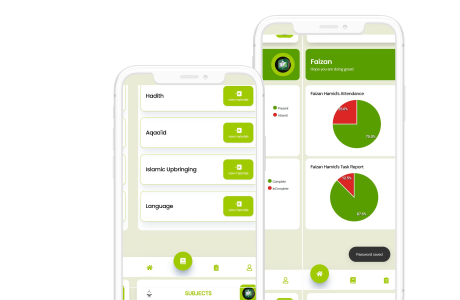
Ilmify’s parent portal turns weekly reporting from a manual effort into a near-automatic one. Teachers log sessions — Sabak position, revision tiers, quality notes — and parents access a live view of their child’s progress at any time. Weekly summaries are generated from tracked data; the teacher’s note is the only manual addition.
This means parents who check the portal at midnight on a Tuesday can see exactly where their child is in their Hifz, what was covered in today’s session, and what the teacher recommended to revise at home — without the teacher having sent a single message.
👉 Parents who know what their child is achieving stay enrolled. Give them the visibility they deserve.Explore Ilmify’s parent portal → ilmify.app
Conclusion
Parent communication is not a support task around the “real work” of Hifz teaching. It is part of the real work — one of the most important tools a maktab has for building the trust, partnership, and informed engagement that keeps families enrolled and students progressing. The templates and frameworks above give maktab administrators the practical infrastructure to communicate professionally, consistently, and in ways that genuinely serve both families and the school.
👉 Build the parent communication system that keeps families engaged and students progressing. Explore Ilmify’s parent portal → ilmify.app
Related Articles:
- 📋 How to Run Hifz Assessments: Maqbul, Mardud, and the Dawr System
- 📊 How to Set Up a Digital Hifz Tracking System from Scratch
- 🚪 How to Handle Hifz Student Dropout: Causes, Prevention, and Recovery
- 👨👩👧 How to Help Your Child Memorise the Quran at Home: A Parent’s Complete Guide
- 📱 WhatsApp vs School Management Software: When to Upgrade Your Maktab
- 🏫 How to Start a Maktab: A Step-by-Step Guide for Mosque Committees



 at
at