Introduction
Every qualified Quran teacher in the world today is connected — through an unbroken chain of teacher-student relationships — to the Prophet Muhammad ﷺ himself. This is not metaphor or aspiration. It is a documented, verifiable, and meticulously preserved chain of transmission called Sanad, and the formal credential that certifies a person within that chain is called Ijazah.
What is Ijazah? At its simplest, Ijazah (إِجَازَة) is an authorisation — a certificate granted by a qualified scholar confirming that a student has recited the Quran correctly, with complete Tajweed, directly to that scholar, and is now authorised to teach and transmit the Quran to others. But Ijazah is far more than a certificate. It is the living proof that the oral tradition of Quranic transmission — the same method used by the Prophet ﷺ when he taught his Companions — has never been broken across fourteen centuries.
For Islamic school administrators, Ijazah matters in three ways: it defines the minimum qualification a Quran teacher should have, it is a goal that the most advanced students in your Hifz programme may pursue, and it is the certification system that gives the Quran its unique claim to authenticated preservation.
What Is Ijazah?
The word Ijazah (إِجَازَة) comes from the Arabic root ج-و-ز (j-w-z), meaning “to permit” or “to pass through.” In the context of Quranic studies, an Ijazah is a formal authorisation from a qualified Quran scholar, certifying that:
- The student has recited the entire Quran (or a specified portion) directly to the scholar
- The recitation met the full standards of the Tajweed rules of a specific Riwayah
- The student is now authorised to teach and transmit the Quran under the same chain of authority
Crucially, Ijazah is not a university degree or an examination certificate. It is a personal, oral authorisation — transmitted from one human being to another, in the same way the Quran itself was transmitted. A piece of paper may accompany it, but the Ijazah itself is the verbal permission of the granting scholar.
What Is Sanad?
Sanad (سَنَد, plural: Asanid) means “chain” or “support” — specifically, the chain of named transmitters connecting the current generation of Quran teachers back to the Prophet ﷺ. Every legitimate Ijazah comes with a Sanad: a list of named individuals through whom the Quran was transmitted, generation by generation.
A simplified Sanad example for Hafs ‘an Asim:
You → Your teacher → Their teacher → … → Hafs ibn Sulayman → Imam Asim ibn Abi al-Najud → Abu Abd al-Rahman al-Sulami → Ali ibn Abi Talib (RA) / Abdullah ibn Mas’ud (RA) → The Prophet Muhammad ﷺ → Jibreel (AS) → Allah (SWT)
This chain is not theoretical. Every link in it is a named historical individual whose biography, dates, and scholarly credentials are documented in the Islamic sciences of Rijal (narrator evaluation). The integrity of the Sanad is what gives Quranic transmission its unique claim to authenticated preservation — unlike any other religious text in history, the Quran’s oral transmission chain has never been broken and never required reconstruction.
Types of Ijazah
Ijazah in Quranic studies comes in several forms depending on what is being authorised:
| Type | Arabic | Description |
| Ijazah fil-Hifz | إجازة في الحِفْظ | Authorisation for having memorised the full Quran with Tajweed |
| Ijazah fil-Qira’ah / Riwayah | إجازة في القِراءة | Authorisation in a specific Riwayah (e.g. Hafs ‘an Asim) with full Tajweed |
| Ijazah fil-‘Ashr Qira’at | إجازة في العَشْر القِراءات | Authorisation in all 10 canonical Qira’at — the most advanced level |
| Ijazah fil-Tajweed | إجازة في التَّجْوِيد | Authorisation specifically in the teaching of Tajweed rules |
| Ijazah al-Shatibiyyah | إجازة الشاطبية | Ijazah in the 7 Qira’at as codified in Ibn Shathib’s poem |
| Ijazah al-Durra | إجازة الدُّرَّة | Ijazah in the additional 3 Qira’at codified in Ibn al-Jazari’s poem |
For most Islamic schools and their teachers, the most relevant certification is Ijazah fil-Qira’ah in Hafs ‘an Asim — confirming that the teacher has recited the entire Quran in the Hafs Riwayah to a scholar who holds an unbroken chain.
The Process of Obtaining Ijazah
The Ijazah process has been standardised through centuries of practice. At its core, it is straightforward:
Step 1: Complete Memorisation (Hifz)
The student must have the entire Quran memorised with solid Tajweed before pursuing Ijazah. Ijazah is not awarded to a partial memoriser — it certifies the complete transmission of the complete text.
Step 2: Find a Qualified Mujeez (Granting Scholar)
The student identifies a scholar who holds a valid Ijazah with a connected Sanad. The scholar must be a Hafiz with demonstrated Tajweed mastery and the scholarly standing to grant authorisation. This is a critical step — an Ijazah from someone whose own chain is broken or undocumented has no standing.
Step 3: Complete Recitation — Talaqqi
The student recites the entire Quran directly to the scholar — from Al-Fatiha to An-Nas — while the scholar listens, corrects errors, and verifies Tajweed compliance. This recitation is done through Talaqqi (direct face-to-face transmission), which may be conducted in person or, increasingly, via live video where the scholar can hear and correct in real time.
Step 4: Scholar’s Verification and Authorisation
Upon completing the recitation to the scholar’s satisfaction, the scholar verbally grants the Ijazah — the authorisation — and the student becomes a link in the chain. A written certificate (also called Ijazah) is typically issued documenting:
- The student’s name
- The granting scholar’s name
- The Riwayah in which Ijazah is granted
- The Sanad — the full chain of transmission
Step 5: The Written Ijazah Document
The certificate typically lists the complete Sanad from the student back to the Prophet ﷺ. This document is a scholarly honour and should be preserved — it is the student’s documented proof of their place in the transmission chain.
How Long Does It Take to Get Ijazah?
There is no fixed timeline. The duration depends on:
| Factor | Impact on Timeline |
| Quality of Hifz going in | A Hafiz with excellent Tajweed will complete recitation to the scholar faster than one who needs correction at every session |
| Access to a qualified Mujeez | In some regions, qualified scholars are plentiful; in others (parts of the West), access requires dedicated effort |
| Frequency of sessions | Weekly sessions with a scholar extend the timeline; intensive programmes (e.g. daily recitation of 2–3 Juz’) compress it |
| Riwayah | Ijazah in Hafs alone vs all 10 Qira’at |
Typical timelines:
- Ijazah in Hafs only (for a strong Hafiz): 3–12 months of regular sessions
- Ijazah in all 7 Qira’at (Shatibiyyah): 3–7 years minimum
- Ijazah in all 10 Qira’at (including Durra): 5–10+ years
The Sanad Chain — From You to the Prophet ﷺ
The Sanad for Hafs ‘an Asim has approximately 25–35 generations between a contemporary student and the Prophet ﷺ, depending on the specific chain. Here is a condensed illustration of the chain structure:
| Generation Level | Representative Names |
| Contemporary student | [Your name] |
| Modern scholar | E.g. Sheikh Mahmoud Khalil Al-Hussary (d. 1980) |
| 20th century scholars | Various Egyptian and Arab scholars |
| Medieval scholars | Ibn al-Jazari (d. 1429 CE) |
| Classical era | Al-Shatibiyyah-era transmitters |
| Founding Imams | Hafs ibn Sulayman (d. 796 CE) |
| Qira’at Imam | Asim ibn Abi al-Najud (d. 745 CE) |
| Companion generation | Abu Abd al-Rahman al-Sulami → Ibn Mas’ud (RA) |
| Companion generation | Ali ibn Abi Talib (RA) |
| The Prophet ﷺ | Muhammad ibn Abdullah ﷺ |
| The Angel | Jibreel (AS) |
| The Source | Allah (SWT) |
Every name in a legitimate Sanad is a documented historical individual. The science of Rijal al-Hadith — narrator evaluation — applies to Quranic Sanad just as it applies to Hadith chains, ensuring that untrustworthy transmitters can be identified and excluded.
Requirements for Receiving Ijazah
Not every Hafiz is ready for Ijazah. A student seeking Ijazah must typically demonstrate:
| Requirement | Detail |
| Complete Hifz | The entire Quran memorised with no significant gaps |
| Tajweed mastery | All major rules applied consistently — Makhaarij, Noon/Meem rules, Madd, Waqf |
| Fluency | Able to recite without hesitation throughout the Quran |
| Correct Waqf | Consistent application of stopping rules, not guessing |
| Sifaat knowledge | Understanding of letter attributes and their application |
| Teacher recommendation | Typically, the student’s Hifz teacher confirms readiness before the student approaches a Mujeez |
A scholar who takes Ijazah seriously will not grant it to a student who recites with consistent Tajweed errors — even if the student has the Quran memorised. The Ijazah certifies the transmission of correct recitation, not just completion of memorisation.
Who Can Grant Ijazah?
Only a scholar who themselves holds a valid, connected Ijazah can grant one. This is the logical necessity of the chain — a broken chain cannot be repaired simply by a scholar declaring themselves qualified.
Characteristics of a legitimate Mujeez (one who grants Ijazah):
- Holds a written Ijazah document from their own teacher
- Can produce their Sanad back to the Prophet ﷺ with named individuals at each link
- Has demonstrated Hafiz status with verified Tajweed
- Has scholarly standing in the community — recognised by other scholars
Warning signs of illegitimate Ijazah:
- Scholar cannot produce a written Sanad
- Chain has unnamed or undocumented links
- Ijazah granted remotely via audio recording without live Talaqqi
- Ijazah granted without the student completing recitation to the scholar
Ijazah Across the 10 Qira’at
Ijazah can be sought in any of the 10 canonical Qira’at, though most scholars and students begin with Hafs ‘an Asim before pursuing others. The relationship between Ijazah and the Qira’at:
| Ijazah Scope | Description | Typical Duration |
| Single Riwayah (e.g. Hafs) | Most accessible; entry-level Ijazah | 3–12 months |
| 7 Qira’at (Shatibiyyah) | Covers all 7 major Riwayat | 3–7 years |
| 10 Qira’at (Shatibiyyah + Durra) | All 10 canonical modes | 5–10+ years |
| 14 Qira’at (including Shadhdh) | Extremely rare; highly specialised scholars only | 10–15+ years |
The great Qaris of history — Abdul Basit, Al-Hussary, Al-Minshawi — held Ijazah in multiple Qira’at. Their Sanad certificates are among the most treasured documents in Islamic scholarly history.
What Ijazah Means for Islamic Schools
For Islamic school administrators, Ijazah has direct operational implications:
1. Teacher hiring standard. A Quran teacher who holds a connected Ijazah in Hafs ‘an Asim is a fundamentally different qualification from one who simply memorised the Quran without documented transmission. Make Ijazah a baseline hiring criterion for your Hifz teachers.
2. Student aspiration. For advanced Hifz students — those who have completed the Quran and have solid Tajweed — Ijazah is the natural next goal. Schools that prepare students for Ijazah produce graduates who become teachers and transmitters themselves, extending the chain.
3. Institutional credibility. A school whose teachers hold Ijazah carries scholarly authority that institutions without this standard cannot claim. In the Middle East, UK Muslim community, and North America, Ijazah-holding teachers are increasingly sought by parents.
4. Record-keeping. Ijazah documents are permanent scholarly records. Schools should maintain copies of all teachers’ Ijazah certificates in their institutional records — this is both a quality assurance measure and a protection for the institution’s reputation.
How Ilmify Supports Ijazah Preparation
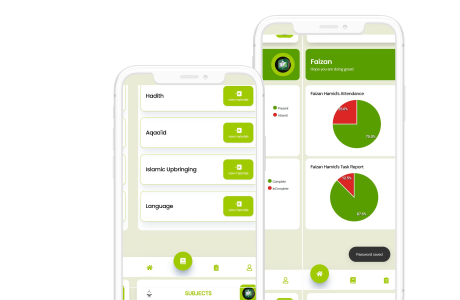
A student preparing for Ijazah needs their entire Hifz history to be clean — every Surah tested, every Juz’ verified, every Tajweed correction documented and addressed. Ilmify’s progress tracking system gives teachers and students exactly this foundation: session-by-session records of what was recited, what errors were flagged, and what the teacher’s assessment was.
When a student’s Hifz journey is tracked systematically from their first Sabak to their final Dhor review, both the student and the teacher arrive at Ijazah preparation with confidence — no guessing about which portions are weak, no undocumented gaps.
👉 Every Hafiz in your school is a potential link in the chain. Give them the foundation they deserve.See how Ilmify tracks the complete journey from Qaidah to Ijazah-ready.Explore Ilmify → ilmify.app
Conclusion
Ijazah is one of the most distinctive and spiritually significant institutions in all of Islamic scholarship. It is the living proof that the Quran as we recite it today is the same Quran that was revealed to the Prophet ﷺ — preserved not just in print, but in the mouths and memories of an unbroken chain of human beings. For Islamic schools, understanding Ijazah is understanding the standard of quality that Quranic education must aspire to — and building programmes whose students and teachers are genuinely worthy of their place in that chain.
👉 Build the foundation that Ijazah-ready students are made of. Explore Ilmify → ilmify.app
Related Articles:
- 📚 What Is Tajweed? The Complete Rules of Quranic Recitation Explained
- 🔗 What Is Talaqqi? Why the Quran Must Be Learned Face to Face
- 📖 How Many Types of Qira’at Are There? The 10 Canonical Recitations Explained
- 🌟 Top Qaris in the World: The Greatest Quran Reciters of All Time
- 📊 Hifz Tracking Using Sabak, Sabqi, and Dhor — A Complete Guide



 at
at