
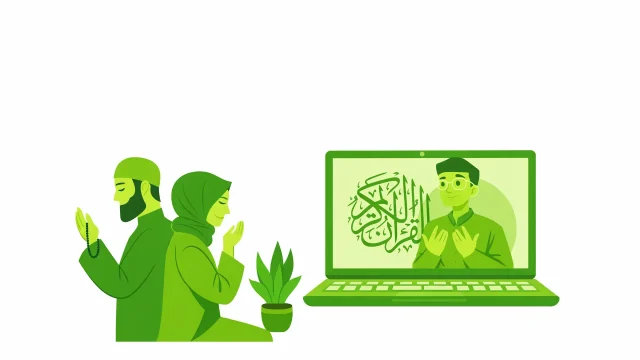
Introduction
Long before the printing press, long before audio recordings, long before online classes — the Quran was transmitted from human mouth to human ear. The Prophet Muhammad ﷺ received the Quran from Jibreel (AS) directly, through repeated oral transmission. He ﷺ then taught it to his Companions in the same way — sitting with them, reciting to them, correcting their pronunciation, and having them recite back to him. This method has never stopped. It is called Talaqqi, and it is not a historical curiosity — it is the only validated method for authentic Quranic transmission.
The rise of digital Quran learning has raised new questions about Talaqqi. Can a student learn from YouTube? Can an app replace a teacher? Can online classes count as authentic Talaqqi? These are not trivial questions — they touch the foundations of how the Quran has been preserved and whether that preservation is being maintained in the digital age. This article explains what Talaqqi is, why it is irreplaceable, and what it means practically for Islamic schools operating today.
What Is Talaqqi?
Talaqqi (تَلَقِّي) is an Arabic word derived from the root ل-ق-ي (l-q-y), meaning “to receive” or “to meet face to face.” In the context of Quranic education, Talaqqi refers to the direct, oral, face-to-face transmission of Quranic recitation from a qualified teacher to a student.
The process involves three essential elements:
- The teacher recites — demonstrating correct pronunciation, Tajweed application, and melodic delivery
- The student recites back — applying what they have heard and absorbed
- The teacher corrects — in real time, adjusting the student’s articulation, elongation, or rhythm
This is not simply “listening to a teacher.” It is a mutual, interactive, corrective exchange — a dialogue between two people in which the student’s voice is actively heard, evaluated, and refined by someone with the authority to do so. Without all three elements, there is no Talaqqi.
The Origin of Talaqqi — How the Prophet ﷺ Was Taught
The divine origin of Talaqqi is established in the Quran itself. When the Prophet ﷺ first received revelation, he ﷺ tried to repeat the words immediately as Jibreel (AS) recited them. Allah (SWT) then revealed:
“Do not move your tongue with it to hasten it. Indeed, upon Us is its collection and its recitation. So when We have recited it, follow its recitation.” (Al-Qiyamah 75:16-18)
The Prophet ﷺ was instructed to wait — to receive, to hear completely, and only then to repeat. This is the paradigm of Talaqqi: patient reception followed by faithful repetition. Jibreel (AS) would visit the Prophet ﷺ every Ramadan to review the entirety of what had been revealed — a practice that has been called the first Muraja’ah (revision) in Islamic history.
How the Prophet ﷺ Taught His Companions
The Prophet ﷺ transmitted the Quran to his Companions through the same method he received it — direct, oral, corrective transmission. Specific Companions were designated as primary Quran teachers:
| Companion | Role | Known For |
| Abdullah ibn Mas’ud (RA) | Primary Quran teacher in Kufa | The Prophet ﷺ said: “Take the Quran from four people, starting with Ibn Mas’ud” |
| Ubayy ibn Ka’b (RA) | Primary Quran teacher in Madinah | The Prophet ﷺ personally recited the Quran to him and praised his recitation |
| Zayd ibn Thabit (RA) | Led the compilation committee under Uthman (RA) | Responsible for the standardised Mushaf |
| Abu Musa al-Ash’ari (RA) | Teacher in Basra | Praised by the Prophet ﷺ for his beautiful voice |
| Mu’adh ibn Jabal (RA) | Sent to Yemen | First to formally teach the Quran in a new territory |
These Companions then taught others, who taught others — and the chain has never stopped. Every authentic Ijazah today traces back through this same network of Companions who received directly from the Prophet ﷺ.
Why Talaqqi Cannot Be Replaced by Audio or Video Recordings
This is the question that the digital age forces Islamic schools to confront directly: if a student listens to Sheikh Al-Hussary’s recordings and imitates them precisely, is that not the same as Talaqqi?
The scholars are clear, and their reasoning is compelling:
| Limitation | Why It Matters |
| No correction | A recording cannot hear the student and correct their errors. The student may be imitating incorrectly without knowing it. |
| No authentication | A recording is not a person. The Quran was transmitted by trusted, documented individuals — not media. |
| No Sanad | Listening to a recording does not make you a link in the transmission chain. The chain requires a living person who grants you authorisation. |
| No accountability | The teacher-student relationship in Talaqqi carries moral and scholarly accountability on both sides. A recording carries none. |
| Accumulated errors | Without live correction, errors compound over time. A student who has been mispronouncing ع as ا for six months has formed a deep habit that no recording can identify or address. |
Scholars also point to a theological dimension: the Quran is described in multiple hadith as something that must be received — talaqqiyan (through reception/Talaqqi). Its preservation is not just textual but oral, and oral preservation requires living transmitters.
The Role of the Teacher in Talaqqi
In the Talaqqi method, the teacher is not merely an instructor. They are a transmitter — a link in the chain — and their role carries responsibilities that go beyond curriculum delivery.
What the teacher must provide in Talaqqi:
- Demonstration — reciting correctly so the student hears the standard
- Listening — giving the student their full, attentive auditory presence
- Correction — identifying specific errors and explaining how to address them
- Validation — confirming when the student has recited correctly, which is itself a form of authorisation
- Patience — Talaqqi cannot be rushed. The teacher’s patience is part of what makes the transmission authentic.
What the student must bring:
- Presence — full attention, without distraction
- Repetition — willingness to repeat until correct
- Humility — accepting correction without defensiveness
- Consistency — regular, frequent sessions (the tradition recommends daily or near-daily)
The scholar Imam Qalun is reported to have said that he recited to Imam Nafi’ more than 70 times before receiving Ijazah. This standard of repetition and verification is what authentic Talaqqi requires.
Talaqqi and the Ijazah Chain
Talaqqi is the mechanism through which Ijazah is granted. The two are inseparable:
- Ijazah is the destination — the formal authorisation
- Talaqqi is the journey — the process of recitation and correction through which Ijazah is earned
You cannot receive an Ijazah without Talaqqi. An Ijazah granted without the student having recited the complete Quran to the granting scholar in live, interactive sessions is considered invalid by mainstream Quranic scholars.
This means that every person who holds a legitimate Ijazah today is a product of Talaqqi — they sat with a teacher, recited, were corrected, and received authorisation through a personal human interaction that mirrors, across the centuries, the way Jibreel (AS) sat with the Prophet ﷺ.
Does Online Learning Count as Talaqqi?
This is perhaps the most practically significant question for Islamic schools in 2026. The scholarly consensus that has emerged:
| Method | Talaqqi Status | Scholarly Position |
| Live video with qualified teacher (real-time, two-way audio) | ✅ Valid Talaqqi | Accepted by majority of contemporary scholars for Ijazah |
| Live phone call with qualified teacher | ✅ Valid Talaqqi | Accepted, though video is preferred |
| Pre-recorded lessons (no live interaction) | ❌ Not Talaqqi | The teacher cannot hear or correct the student |
| Audio/video recordings (Al-Hussary, Alafasy etc.) | ❌ Not Talaqqi | Cannot provide correction or authorisation |
| AI recitation apps | ❌ Not Talaqqi | An algorithm is not a transmitter in the chain |
| In-person with qualified teacher | ✅ Optimal Talaqqi | The original and ideal form |
The key principle: if the teacher can hear the student in real time and correct them live, the essential elements of Talaqqi are present regardless of the medium. If the teacher cannot hear the student at all, no amount of technical sophistication makes it Talaqqi.
Talaqqi in Different Traditions
The Talaqqi tradition manifests differently across Islamic education contexts:
| Region | Traditional Talaqqi Format | Modern Adaptations |
| South Asia | One-to-one or small group with Ustadh; student recites daily Sabak | Online Talaqqi for diaspora; WhatsApp audio for correction (limited validity) |
| Middle East / GCC | Halaqah circles in mosques; individual recitation to sheikh | Live Zoom and video sessions; dedicated online Tahfiz academies |
| North Africa | Group Talaqqi in Zawiya settings; students recite in rotation | Preserved in Morocco, Mauritania; diaspora communities maintain the tradition |
| West (UK, USA, Canada) | Weekend maktab; one-to-one when available | Strong demand for online Talaqqi; Islamic universities with online Ijazah programmes |
| Southeast Asia | Pesantren (Indonesia) and pondok settings; intensive group Talaqqi | Online academies growing; Malaysia has structured online Hifz programmes |
What Talaqqi Means for Islamic School Design
For maktab and Hifz school administrators, Talaqqi is not an optional feature of your programme — it is the definition of your programme. Some practical implications:
1. Teacher-student ratio matters more than class size. A Hifz class of 30 students with one teacher cannot provide genuine Talaqqi for each student. Best practice is one Hifz teacher per 8–12 students maximum — so each student recites individually to the teacher in every session.
2. Timetable should protect Talaqqi time. Every session should include individual recitation by every student to the teacher. Group listening exercises have value, but they cannot substitute for the individual recitation-and-correction exchange.
3. Teacher qualification starts with Talaqqi. A Quran teacher who has not themselves been through rigorous Talaqqi cannot provide it to students. Hiring teachers with documented Ijazah is the most reliable assurance that Talaqqi will actually happen in your school.
4. Document the Talaqqi. When a teacher marks a student’s Sabak as complete, that notation should reflect that the student recited to the teacher directly and corrections were made. Ilmify’s session tracking is designed precisely for this — each session record captures what was recited, what was corrected, and the teacher’s assessment.
👉 Every Talaqqi session your teachers conduct deserves to be documented.Ilmify’s tracking tools capture what was recited, what was corrected, and how the student is progressing — session by session.Explore Ilmify → ilmify.app
Conclusion
Talaqqi is not a method that Islamic schools can choose to offer or not. It is the definition of what authentic Quran teaching is. The digital age has not made Talaqqi obsolete — it has made the question of what counts as genuine Talaqqi more urgent and more precise. Islamic schools that understand this distinction — between live, interactive, corrective transmission and passive consumption of recordings — are the schools that will produce students whose recitation is genuinely authenticated, whose Tajweed is genuinely sound, and who are genuinely positioned to become transmitters themselves.
👉 Document every Talaqqi session. Track every correction. Give every student the foundation they deserve. Explore Ilmify → ilmify.app
Related Articles:
- 🏅 What Is Ijazah? How to Get Certified to Teach the Quran
- 📚 What Is Tajweed? The Complete Rules of Quranic Recitation Explained
- 📖 How Many Types of Qira’at Are There? The 10 Canonical Recitations Explained
- 🌐 Online Quran Learning vs In-Person Talaqqi: What the Scholars Say
- 📊 Hifz Tracking Using Sabak, Sabqi, and Dhor — A Complete Guide





 Arabic
  English
  Malay
Malay  Urdu
Urdu