

Introduction
Before a child in India can memorise the Quran, before they can study Hadith or Fiqh, before they can recite a single Surah in the Friday prayer with confidence, they must first learn to read. Not read in the sense of understanding Arabic — that is a later stage — but read in the sense of being able to look at the Arabic letters of the Quran and produce their correct sounds with the correct voweling. This foundational skill is called Nazra or Nazira — and acquiring it is the universal starting point of Islamic education for every Muslim child across India.
What Nazra Means
Nazra (نظرہ) or Nazira (ناظرہ) means “to look” — the term refers specifically to reading the Quran by looking at the Mushaf (the physical text), as opposed to Hifz (reciting from memory without looking). Nazra is not simply Arabic literacy — it is specifically the ability to look at any page of the Quran and recite it aloud with correct pronunciation and acceptable Tajweed (pronunciation rules).
A student who has completed Nazra:
- Can open the Quran to any Surah and read it aloud fluently
- Applies the basic Tajweed rules (Madd vowel lengths, Ghunna nasalisation, basic Waqf pausing rules)
- May or may not understand the Arabic they are reading — comprehension is a later stage of Islamic education
This is the foundational Islamic literacy that every Muslim adult is expected to have. Its absence — being unable to read the Quran — is a source of religious and social concern in Muslim communities. Its attainment is celebrated: a child who completes their first full reading of the Quran (Khatm al-Quran) receives a small family celebration marking this milestone.
The Progression: From Qaida to Nazirah Completion
Stage 1: Qaida (القاعدة)
Every student begins with the Qaida — the Arabic primer. The most widely used across India is the Noorani Qaida, developed by Molvi Noor Muhammad Ludhianvi in the 19th century and now used by millions across South Asia and the global diaspora. The Noorani Qaida teaches systematically:
- The 29 Arabic letters in isolation, with their names and sounds
- Letters in their joined forms (as they appear within Quranic words)
- Short vowels: Fathah (a), Kasrah (i), Dammah (u) and their effect on letter sounds
- Long vowels: Alif Madd, Waw Madd, Ya Madd
- Sukun (consonant without vowel — the “stopped” sound)
- Shadda (doubling of a letter — gemination)
- Tanwin (nunation — the double vowel marks at word ends)
- Introductory Tajweed rules as they arise naturally in the text
The Qaida typically takes 2–6 months depending on the child’s age and teaching intensity.
Stage 2: Juz Amma — The Gateway Surahs
After completing the Qaida, students begin the Quran itself — typically starting with the 30th Juz (Juz Amma), which contains the short Surahs most familiar from daily prayer. These short Surahs are the best starting point: the text is familiar from hearing them in prayer, the words are short, each recitation session produces visible progress, and the teacher can cover the content quickly.
Students typically work through Juz Amma reading it repeatedly until they can recite it without significant Tajweed errors. Many students also begin memorising these Surahs during this stage — since the short Surahs of Juz Amma are also the ones used in daily prayer, memorisation and Nazra reinforce each other.
Stage 3: Full Nazra — All 30 Juz
Having mastered Juz Amma, students proceed through the remaining 29 Juz. Different teachers and institutions follow different sequences — some work backward from Juz 29 to Juz 1, some work forward from Juz 1. The standard pace is 1–2 pages per session, with the teacher correcting Tajweed errors in real time as the student reads aloud.
The total time from Qaida completion to full Nazirah (all 30 Juz) typically takes 1–3 years, depending on intensity of study, age of the student, and natural aptitude.
Stage 4: Nazirah Completion — The Gateway Milestone
When a student can read all 30 Juz of the Quran fluently with reasonable Tajweed, they have completed Nazirah. This is marked in many communities by a Khatm al-Quran celebration — small but meaningful, acknowledging a genuine religious achievement. The student is now at the gateway to further Islamic education.
The Maktab as Delivery Model
Nazra education in India is delivered primarily through the maktab — the mosque-attached or community-supported Quran school operating in a time slot that does not compete with regular school hours: early morning (5:30–8:00 AM, after Fajr prayer, before school) or evening (4:00–7:00 PM, after school).
A typical Indian maktab:
- 30–80 students of mixed ages (5–14)
- 1–3 teachers (Muallim or Mualima for women’s/girls’ circles)
- A single room in the mosque, a madrasa building, or a community hall
- Minimal or no formal registration with state education authorities
- Funding from mosque donations and small monthly fees (₹50–300)
- Assessment entirely through teacher observation — no formal written examinations
The maktab teacher typically works with groups — 5–10 children reciting in rapid succession — making Tajweed correction a constant, dynamic task. The individual recitation moment (each child presenting their current page to the teacher) is the Talaqqi model at its most elementary form.
Regional Linguistic Variations
The terminology, medium of instruction, and cultural context of Nazra education varies significantly by region:
North India (UP, Bihar, Rajasthan, Delhi): Urdu-medium instruction. Arabic letters learned with Urdu names. Noorani Qaida nearly universal. “Nazra” or “Nazira” as the standard term.
West Bengal: Largely Urdu or Bengali medium, with the same Noorani Qaida methodology. Bengali Muslim communities have a particularly strong maktab network in districts like Murshidabad, Malda, and North Dinajpur.
Kerala: Malayalam-medium instruction context with Arabic taught in Arabic. The Samastha Kerala Sunni Vidyabhyasa Board integrates Nazirah as a formal component of its 12-year maktab curriculum, with students expected to complete Nazirah by Class 5–6. The term “Nazirah” is used consistently in Kerala’s board documentation.
Tamil Nadu / Karnataka: Tamil or Kannada as instruction language, with Arabic taught in Arabic script. The historic Arabi-Tamil script — Quran text written in Tamil script — was used as a bridge in older communities, enabling Tamil-speaking children to begin learning Quran recitation using the familiar Tamil alphabet before transitioning to Arabic. Modern Tamil Nadu maktabs overwhelmingly use Arabic script from the start.
Karnataka (Beary community): The Beary Muslim community of coastal Karnataka uses a Shafi’i Fiqh context and a strong Arabic education tradition, with Nazirah integrated into community Quran schools from a young age.
After Nazra: The Three Paths
After completing Nazirah, students typically choose one of three paths:
- Continue to Hifz — full memorisation of the complete 30 Juz, requiring a further 2–4 years of full-time study at a Hafizia Madrasa or dedicated Hifz programme
- Proceed to Islamic Studies — enrolment in madrasa-level education covering Hadith, Fiqh, Arabic grammar, and Tafsir, with the Alim qualification as the eventual goal
- Complete Nazirah only — focus on mainstream secular schooling, with the Quran reading skill maintained through personal practice and occasional revision at the maktab
Most children who attend the maktab system complete Nazirah and pursue basic Islamic Studies alongside their secular schooling. Full Hifz requires a separate level of commitment — full-time dedication for 2–4 years — that not every family or student undertakes.
Managing Nazra Progress: The Software Gap
The Nazra tracking challenge — simpler than Hifz but not trivial — is currently unmet by any widely used software platform:
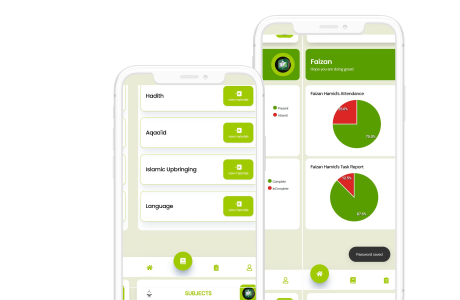
Per-student progress: Each student is at a different Juz, progressing at their own pace. A maktab teacher with 40 students needs to know instantly where each child is in their Nazirah, which Juz they are currently reading, and what Tajweed errors are recurring.
Tajweed quality tracking: Beyond “which Juz,” a useful record captures whether a student has specific persistent Tajweed errors — Madd length problems, Ghunna weakness, Makhraj (articulation point) errors. These affect the quality of the Nazirah and whether further Tajweed instruction is needed before advancing.
Completion milestone tracking: Recording when a student completes each Juz (for progress visibility), when they complete Juz Amma (a milestone), and when they complete the full 30 Juz (the Nazirah completion event). Parents want to know their child’s progress; teachers want to demonstrate the maktab’s effectiveness.
Parent communication: A simple weekly update — “Your child completed Surah Al-Baqarah today and is now on Surah Al-Imran” — communicated through a WhatsApp message or app notification, transforms the parent’s relationship with their child’s Islamic education from invisible to engaged.
For a software platform, Nazra tracking is the lowest-complexity Islamic education management feature — much simpler than the four-stream Hifz management system — and potentially the most universally needed across India’s tens of thousands of maktabs. Every one of those maktabs has students at different stages of Nazirah, every one of those teachers is tracking progress in their head or on paper, and every one of those parents has no idea where their child actually is.
See Ilmify’s Quran progress tracking features →
Conclusion
Nazra is where every Indian Muslim child’s Islamic education begins — the act of learning to look at the Quran and read it aloud. It is the most universal Islamic educational experience in India, delivered in tens of thousands of maktabs from Kashmir to Kerala, in Urdu and Bengali and Tamil and Malayalam, in mosque rooms and community halls and homes, by hundreds of thousands of teachers whose work is almost entirely invisible to any data system.
For software developers and Islamic education administrators, Nazra tracking represents both the simplest and the most universal opportunity in the Indian Islamic education market. A maktab that can tell parents exactly where their child is in the Quran — which Juz, what quality, what persistent Tajweed issues to work on at home — provides a service those parents have never had before. That visibility, built on simple Juz-by-Juz progress recording, is Ilmify’s starting point for the Indian maktab market.
See how Ilmify tracks Quran progress for Indian maktabs →
Related articles:


 at
at