
Introduction
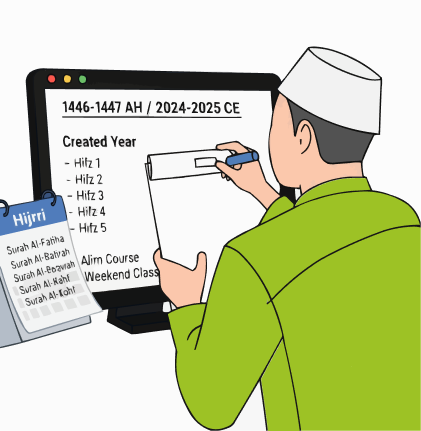
Of all the achievements in Islamic education, the one that commands the greatest universal reverence is Hifz — the complete memorisation of the Quran. All 6,236 verses, 77,430 words, and 323,671 letters of the Quran committed entirely to memory, to be recited from the heart without looking at any text. A person who has achieved this is a Hafiz (masculine) or Hafiza (feminine) — an honoured title used throughout their life, preceding their name, and carrying a weight of religious merit that no other credential quite matches.
In India, with its 200 million Muslims and 38,000+ madrasas, Hifz education is one of the most significant and one of the most challenging areas of Islamic educational management. This article explains how Hifz works in the Indian context — the terminology, the institutional structures, the daily routine, and the management challenges that scale creates.
What Hifz Involves
Hifz (حفظ) — from the Arabic root meaning “to preserve, to guard” — is not simply repetition. It is the deep internalisation of the Quran through a disciplined system of new memorisation, short-term reinforcement, and long-term revision cycling that must be maintained for the rest of the Hafiz’s life. Forgetting even a single verse of the Quran after having memorised it is considered a serious matter in Islamic tradition; the maintenance of memorisation is a lifelong religious obligation alongside the initial achievement.
A typical Hifz programme in an Indian Hafizia Madrasa:
Duration: 2–4 years of full-time study for a motivated student aged 8–14. Older students and those with weaker Arabic background may take longer.
Daily new memorisation (Sabak): 0.5 to 2 pages of the Quran per day, presented orally to the teacher in a face-to-face Talaqqi (transmission) session. The teacher listens to every word, corrects every Tajweed error, and either accepts (Maqbul / Pukka) or rejects (Mardud / Kacha) the Sabak. An accepted Sabak moves to the revision system; a rejected Sabak must be re-memorised and re-presented.
Teacher-student ratio: The Talaqqi model demands individual oral assessment of each student’s recitation. A Hifz teacher (Hafiz Sahib) can typically manage 5–15 students — each receiving their own daily Talaqqi session, their own revision schedule, and individual Tajweed correction.
The Four-Stream Revision System
The most important and most complex aspect of Hifz management is the revision system — the structured approach to preventing the deterioration of memorisation that is always in danger of fading once new Sabak has displaced it from immediate focus.
Sabak (صبق) — Daily New Memorisation
The fresh portion memorised each day. The Sabak session is the core teaching interaction — student recites to teacher, teacher corrects, accepts or rejects. The standard Sabak pace is approximately 1–2 pages per day at the early stages, settling to a sustainable 0.5–1 page as the student accumulates more to revise.
Sabak Para (صبق پارہ) — Recent-Memory Reinforcement
The cumulative total of the last 7–10 days’ new Sabak, reviewed daily to prevent it from deteriorating before it is consolidated into long-term memory. The Sabak Para session is typically performed before the new Sabak — the student recites the recent portion to the teacher or in a group, identifying any weak spots. This is the critical “bridge” between new memorisation and long-term retention.
Dhor (دور) — Long-Term Cycling Revision
The systematic cycling through all completed Juz — the entire memorised portion of the Quran reviewed on a rotating schedule. As more Juz are memorised, the Dhor schedule becomes more demanding: a student who has memorised 20 Juz must systematically cycle through them all, with each Juz reviewed at appropriate intervals to maintain retention.
Dhor management is the most technically demanding aspect of Hifz administration. The scheduling question — which Juz should a given student revise today? — requires tracking when each Juz was last reviewed, calculating review intervals based on how long ago that Juz was memorised, and adjusting for quality (a weak Juz needs more frequent review than a strong one). On paper and in a teacher’s memory, this is manageable for 5 students. For 50 students, it becomes genuinely unmanageable without a system.
Manzil (منزل) — Weekly Comprehensive Review
The Quran is traditionally divided into seven Manzil portions — roughly equal divisions used for weekly comprehensive review. A student who has memorised the full 30 Juz recites one Manzil per day, completing a full cycle through the entire Quran each week. The Manzil system provides the largest-scale retention mechanism — ensuring that no portion of the Quran goes unreviewed for more than a week.
Before completing the full Quran, students use the Manzil concept proportionally — reviewing a seventh of their memorised portion each day.
Aamuktha — The South Indian Term
In South India — particularly in Karnataka, Tamil Nadu, and Kerala — the memorised and thoroughly reviewed portion of the Quran is described as Aamuktha (ஆமுக்தா in Tamil — derived from the Sanskrit/Tamil root meaning “released, completed, fixed”). A passage that is Aamuktha is considered locked into long-term memory — solidly retained, no longer requiring the intensive review frequency of recently memorised material.
The Aamuktha concept is functionally equivalent to a portion that has passed sufficient Dhor cycles to be considered stable, but the specific term and the cultural weight given to it — the idea of a passage being “freed” or “completed” — is distinctively South Indian. In North India (UP, Bihar, Bengal), the same concept is expressed through the Dhor/Manzil framework without a separate term for “locked-in” status.
For software serving Indian Hifz institutions, this terminology difference is practically significant: a South Indian institution may use Aamuktha to categorise Juz, while a North Indian institution uses only the revision-frequency framework. A platform designed for the Indian market must accommodate both conventions.
Hafizia Madrasas — India’s Dedicated Hifz Institutions
Hafizia Madrasas are standalone institutions dedicated to Hifz — as distinct from general madrasas (where Hifz may be one element alongside Islamic Studies) or Darul Ulooms (where Hifz is a prerequisite for admission rather than the main programme).
Hafizia Madrasas are concentrated in:
- Bihar — one of the highest concentrations of Hafizia institutions in India, reflecting the state’s strong Hifz tradition and the large Muslim population in the Seemanchal region
- Uttar Pradesh — numerous Hafizia institutions across Lucknow, Kanpur, Saharanpur, Deoband
- West Bengal — a significant Hifz sector, particularly in Murshidabad and other districts with high Muslim populations
- Kerala — Hifz integrated into the Samastha board maktab system, with students completing Hifz alongside their regular schooling
Darul Uloom Deoband and the Hifz Prerequisite
Darul Uloom Deoband — India’s most prestigious Islamic seminary — requires that all applicants have already completed Hifz before admission to the Dars-e-Nizami academic programme. Specifically, completion of 3 Parah minimum (at least 3 Juz of the Quran memorised) is required for admission, and full Hifz is expected of students who proceed to the higher years.
This prerequisite reflects the classical assumption that Islamic scholarship begins with the Quran — that a scholar who does not carry the Quran in their heart lacks the foundational intimacy with the revealed text that all classical Islamic scholarship presupposes. It also means that Hafizia institutions are effectively feeder schools for the major Darul Ulooms: students who complete Hifz at a Hafizia Madrasa in Bihar or UP may then apply to Deoband or another Darul Uloom for the Dars-e-Nizami.
North India vs South India: Different Approaches
The Hifz tradition varies between North and South India in institutional model, intensity, and integration with mainstream schooling:
North India: Full-time, often residential Hafizia Madrasas, where students focus entirely on Hifz for the duration of the programme (typically 2–4 years). Students leave mainstream schooling during this period, completing it afterward or not at all. The intensity is high; daily Sabak expectations are demanding.
South India (particularly Kerala): Hifz integrated within the Samastha Kerala Sunni Vidyabhyasa Board’s 12-year maktab curriculum. Students memorise the Quran gradually alongside regular mainstream schooling — a slower pace but no interruption to secular education. The Samastha system has produced many Huffaz who hold both mainstream academic qualifications and complete Quran memorisation.
Karnataka and Tamil Nadu: A mix of both models — standalone Hafizia Madrasas (more North Indian in structure) alongside integrated approaches within Islamic trusts’ school networks.
Why Hifz Tracking Is a Critical Software Need
The daily Hifz management challenge — for a single teacher managing 10 students — already taxes the limits of memory and paper-based records. For a Hafizia Madrasa with 50+ students and 3–5 teachers, the tracking complexity becomes unmanageable without a system:
- Which student is on which page of which Juz for today’s Sabak?
- Which Juz is due for Dhor review for each student today?
- Which students have a Manzil day today?
- Which Sabak Para sections are due for each student?
- Which Juz is Aamuktha (firmly retained) vs. needing more frequent review?
- Which students have had their Sabak rejected multiple consecutive times — potentially indicating a memorisation difficulty that needs intervention?
Without a system that tracks these four streams simultaneously per student and generates automated daily schedules, Hifz teachers spend significant time on administrative calculation rather than teaching — and inevitably lose track of revision schedules for weaker students who most need the systematic attention.
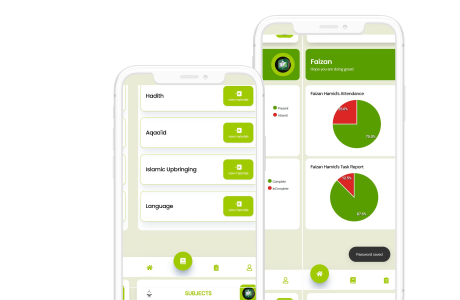
Ilmify’s Hifz tracking module automates Dhor scheduling, flags overdue revision, supports both the North Indian Sabak/Sabak Para/Dhor/Manzil framework and the South Indian Aamuktha convention, and produces daily per-student plans for each teacher — freeing the Hafiz Sahib to teach rather than calculate.
See Ilmify’s Hifz tracking module →
Conclusion
Hifz is the crowning achievement of Islamic education in India — the act that transforms a student from someone who reads the Quran into someone who carries it. Managing Hifz education properly — tracking each student’s four streams simultaneously, generating automated Dhor schedules, supporting the teacher in their individual Talaqqi sessions, and communicating progress to parents — is the most technically specific challenge in Islamic educational management.
India’s Hafizia sector — from Bihar’s dense concentration of standalone Hifz schools to Kerala’s integrated maktab Hifz programmes — represents a vast, underserved market for purpose-built Hifz tracking software. No general school management platform addresses these needs. No general Islamic education app handles the Sabak/Sabak Para/Dhor/Manzil framework with the specificity that daily Hifz management actually requires.
Ilmify does. Built from a deep understanding of how Hifz teachers actually work — and what happens when they do not have a system — it is the platform designed specifically for this challenge.
See how Ilmify’s Hifz tracking works →
Related articles:


 at
at