

Introduction
A student who memorises 1 page per day without a structured revision plan will have forgotten the first half of the Quran by the time they reach the second half. This is not a discipline problem or an intelligence problem — it is a scheduling problem.
Hifz is unique among academic disciplines because it has no natural stopping point for revision. You do not finish a chapter and move on. Every page ever memorised remains a live responsibility for the student, demanding regular revision for the rest of their life — and certainly throughout their time in the programme.
The revision schedule is the document that makes this manageable. It transforms an overwhelming responsibility (“revise everything you have memorised, forever”) into a concrete daily plan (“today, revise Juz 3, pages 47–52, and tomorrow Juz 4, pages 53–58”). This guide will walk you through building that schedule for your institution.
Why Most Hifz Programmes Struggle with Revision
The typical Hifz class devotes most of its structured time to Sabak — the new lesson. This is understandable. Sabak is what students prepare at home, what parents ask about, and what shows visible progress. A student who advances from Juz 7 to Juz 8 has a milestone to celebrate.
Revision is less visible. There is no milestone for “today I revised Juz 3 for the fourteenth time.” But without that fourteenth revision — and the fifteenth, and the sixteenth — Juz 3 does not hold. What appears to be a student progressing well through the Quran may in fact be a student accumulating weak, partially retained Ajza behind them.
By the time a student reaches Juz 20 or 25, the volume of material requiring revision has become enormous. Without a schedule, revision becomes random — teachers revise whatever comes to mind, or students revise whatever they feel like, which is always the easiest (most recently memorised) material. The early Ajza — the hardest ones to return to — get neglected.
A structured revision schedule prevents this by distributing the revision load evenly and systematically from the very beginning of the programme.
The Three Revision Streams Your Schedule Must Cover
Every Hifz revision schedule must manage three simultaneous revision streams. Each operates on a different time horizon.
Stream 1: Daily Sabak Revision (Home Preparation)
Before presenting new Sabak to the teacher, the student must have prepared it at home. This is not the teacher’s job to schedule — but the institution should provide guidance on how much home preparation time different amounts of Sabak require.
General guidance:
- 1 page Sabak: 45–90 minutes of home preparation for an average student
- Half a page: 30–45 minutes
- More than 1 page: Only appropriate for advanced students; 90–120+ minutes
Stream 2: Sabaq Para Daily Revision (Lesson Time)
The Sabaq Para — the last 1–3 Ajza — is recited at the start of every lesson. The schedule must ensure that the full Sabaq Para range is covered across the week, not just the easiest or most recent sections.
Scheduling the Sabaq Para:
If the Sabaq Para range is 2 Ajza and the student attends 5 sessions per week, the schedule allocates approximately 10 pages per session across the Sabaq Para range to ensure full coverage weekly.
| Session | Sabaq Para Coverage |
| Monday | Pages 1–10 of Sabaq Para range |
| Tuesday | Pages 11–20 |
| Wednesday | Pages 21–30 |
| Thursday | Pages 31–40 |
| Sunday | Full Sabaq Para review (light) |
Stream 3: Dhor Cyclical Revision (Lesson Time)
The Dhor covers all memorised material outside the Sabaq Para range. The schedule must ensure that every Juz in the student’s memorised bank is visited at regular intervals — the target cycle frequency depends on how much the student has memorised.
Dhor cycle planning:
| Memorised Amount | Recommended Cycle Length | Daily Dhor Load |
| Juz 1–5 | Monthly | ~5 pages/day |
| Juz 1–10 | 6–8 weeks | ~5–7 pages/day |
| Juz 1–20 | 8–12 weeks | ~7–10 pages/day |
| Juz 1–30 (full Khatm) | 3–4 months | ~7–10 pages/day |
These are guidelines — the actual pace should be calibrated to the individual student’s ability and the quality of recitation, not just the page target.
How to Calculate the Right Revision Load for Each Student
Every student’s revision schedule is different, because every student has memorised a different amount. Here is how to calculate the right daily revision load for each student in your class.
Step 1: Establish Current Memorised Baseline
How many Ajza has the student memorised? This is the starting point for all Dhor calculations.
Step 2: Determine the Target Dhor Cycle Length
Based on the table above, choose a target cycle length appropriate for the student’s memorised amount. For a student who has memorised 15 Ajza and attends 5 sessions per week, a 10-week Dhor cycle is reasonable.
Step 3: Calculate Daily Dhor Page Count
Formula: (Total pages in memorised Hifz) ÷ (Dhor cycle length in days) = Daily Dhor page requirement
Example: 15 Ajza × 20 pages per Juz = 300 pages. Over a 70-day (10-week) cycle: 300 ÷ 70 ≈ 4.3 pages of Dhor per day.
This is in addition to Sabaq Para revision. Total daily revision load: approximately 10–15 pages across Sabaq Para and Dhor.
Step 4: Assess Available Lesson Time
How much of each lesson can be allocated to revision? Typically:
- 30–40 minute lesson: 15–20 minutes for Sabak, 10–15 minutes for combined revision
- 45–60 minute lesson: 20 minutes for Sabak, 20–25 minutes for revision
If the daily revision load exceeds what can be covered in lesson time, the student needs to complete some Dhor at home. The schedule should specify which Dhor sections are for home revision and which are for lesson time.
Building the Weekly Hifz Revision Template
Here is a practical weekly template for a student who has memorised 10 Ajza, attends 5 sessions per week, and has a 45-minute lesson:
Student Profile
- Memorised: Juz 1–10 (200 pages)
- Current Sabak position: Juz 11
- Sabaq Para range: Juz 9–10 (40 pages)
- Dhor range: Juz 1–8 (160 pages)
- Target Dhor cycle: 8 weeks = 56 days
- Daily Dhor load: 160 ÷ 56 = ~2.9 pages/day (approximately 3 pages per session)
Weekly Schedule
| Session | Sabak | Sabaq Para | Dhor | Total Revision |
| Monday | New Sabak (1 page) | Juz 9, pages 1–8 | Juz 1, pages 1–3 | 11 pages |
| Tuesday | New Sabak (1 page) | Juz 9, pages 9–16 | Juz 1, pages 4–6 | 10 pages |
| Wednesday | New Sabak (1 page) | Juz 9, pages 17–20 + Juz 10, pages 1–4 | Juz 1, pages 7–9 | 11 pages |
| Thursday | New Sabak (1 page) | Juz 10, pages 5–12 | Juz 2, pages 1–3 | 11 pages |
| Sunday | Review + catch-up | Juz 10, pages 13–20 | Juz 2, pages 4–6 | 10 pages |
This template ensures that:
- Full Sabaq Para range (Juz 9–10) is covered every week
- Dhor advances approximately 15 pages per week through Juz 1–8
- Full Dhor cycle of Juz 1–8 completes in approximately 10–11 weeks
- Sabak advances 5 pages per week
Adjusting the Schedule as Students Progress
The revision schedule is not static. It must be updated whenever:
Sabaq Para range expands: As the student memorises new Ajza, they enter the Sabaq Para range and the oldest Juz in Sabaq Para graduates to Dhor. The Dhor load increases and the Sabaq Para load adjusts.
Dhor quality drops: If a teacher consistently marks Dhor quality as poor, the cycle is too fast. Lengthen the cycle, reduce the daily Dhor page count, and increase quality expectations before speed.
Student pace changes: A student going through a difficult period (illness, exams, family events) may need a temporary reduction in Sabak with more revision focus. The schedule should flex.
Ramadan: Hifz scheduling during Ramadan requires a dedicated adjustment. Many Hifz students increase their Dhor significantly during Ramadan as lesson time is often redistributed.
Internal link: For a practical guide on managing Hifz during Ramadan: Managing Hifz Progress During Ramadan: Tips for Teachers →
How to Handle Missed Sessions in a Revision Schedule
Missed sessions are the biggest enemy of a revision schedule. When a student misses a lesson, their Sabaq Para slips, their Dhor falls behind, and the carefully calibrated cycle is disrupted.
Approach 1: Catch-Up Sessions
Designate one session per week as a flexible catch-up session. This session has no new Sabak — it is entirely dedicated to catching up on missed revision. Students who had a full week recite their planned Dhor; students who missed sessions use this time to close the gap.
Approach 2: Revision Rebalancing
If a student misses more than two sessions in a row, recalculate the Dhor cycle rather than trying to catch up. Extend the cycle length by the number of missed sessions. Chasing missed pages leads to rushed, low-quality revision — which is worse than simply accepting the delay.
Approach 3: Parent Notification
When a student misses sessions that put their revision schedule at risk, parents should be notified immediately — not at the end of term. A parent who knows their child is falling behind on Dhor can arrange home revision support. A parent who only finds out in the end-of-year report cannot do anything about it.
Digital tracking makes this automatic. A system like Ilmify can flag missed sessions in real time and send parents a notification — no teacher needs to make individual calls.
Digitising Your Revision Schedule
A paper revision schedule works for a class of 5–10 students where the teacher manages everything manually. As the class grows — or when you are managing multiple teachers and multiple classes — paper schedules become unmanageable.
The problems with paper revision schedules:
- Cannot adjust for every student individually without enormous administrative work
- No visibility for parents unless the teacher manually updates them
- No automatic flagging when students fall behind
- Not accessible to substitute teachers or administrators
- Lost or damaged paper means lost records
What a digital system needs to do:
- Hold individual revision schedules for each student
- Automatically update Dhor cycle targets as new Sabak is added
- Flag students whose Dhor quality is below threshold
- Show parents the revision plan and current status
- Generate reports showing revision compliance across the class
How Ilmify Manages Revision Scheduling
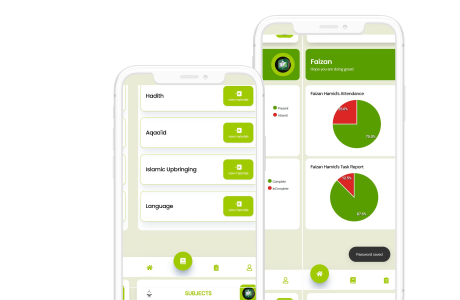
Ilmify’s Hifz tracking module is designed specifically around the three-stream revision model — Sabak, Sabaq Para, and Dhor — with built-in scheduling support for each.
Individual revision schedules: Each student in Ilmify has their own Hifz profile with their current Sabak position, Sabaq Para range, and Dhor cycle target. Teachers can update these in real time as the student progresses.
Dhor cycle tracking: Ilmify maintains a rolling Dhor cycle record showing which sections have been covered, when they were last visited, and which sections are overdue. Sections not revisited within the target cycle window are flagged automatically.
Automatic adjustments: When a teacher records a new Sabak entry, Ilmify automatically updates the student’s total memorised count and adjusts Dhor load calculations accordingly.
Missed session alerts: When a student misses a lesson, Ilmify flags the impact on their revision schedule and notifies parents through the parent app — without the teacher having to send a separate message.
Parent-facing schedule: Parents see a simplified version of their child’s revision schedule in the parent app — what their child should be revising at home this week, and how the teacher session will complement that home revision.
Internal link: Learn how to present Hifz schedule data to parents: How to Generate a Hifz Progress Report for Parents →
💡 Stop managing Hifz revision schedules on paperIlmify tracks Sabak, Sabaq Para, and Dhor for every student — and flags who’s falling behind, automatically.See Ilmify’s Hifz Scheduling Tools →
Conclusion
A Hifz revision schedule is not a bureaucratic document — it is the architecture that makes Hifz education work. Without it, revision is haphazard, early Ajza decay, and students reach Khatm with holes in their memory that take years to fill.
Building the schedule requires understanding the three revision streams, calculating the right load per student, and creating a weekly plan that covers all three systematically. Maintaining the schedule requires digital tools that adjust automatically as the student progresses, flag missed sessions, and give parents real-time visibility into how their child’s revision is going.
Ilmify is built for exactly this — a dedicated Hifz scheduling and tracking module designed for institutions, not individual apps.


 at
at