Introduction
In the Kuttab attached to a mosque in Cairo’s Heliopolis neighbourhood, a shaykh manages 28 students — each on a different Surah, each at a different point in their revision cycle. His records are in a spiral notebook that has survived three years of afternoon sessions. When he is absent, no one can read his shorthand. When the notebook is eventually replaced, the early records are transcribed to the new one — imperfectly, from memory. If this shaykh leaves for a different city, everything he knows about each student’s Hifz leaves with him.
In a Ma’had Islami in Casablanca, a principal manages 65 students across five class levels and eight subjects. Student records are split across four teacher notebooks and an Excel file on the principal’s laptop that has not been backed up in six months. End-of-term report preparation takes three days of manual compilation. One teacher’s notebook was left in a taxi last year; those students’ records were partially reconstructed from memory.
In a Khalwa in Khartoum, a khalifa has been teaching Qur’anic memorisation for 22 years. He knows every student’s position, every student’s weakness, every student’s pace — and not one line of this is written down anywhere.
These are not unusual situations. They are the standard state of madrasa administration across North Africa. This guide is the practical path out of them.
Why North African Islamic Schools Need Digital Records
The case for digitising Islamic school records is not primarily about technology — it is about institutional resilience, educational quality, and accountability to families.
Institutional resilience: When a shaykh, faqih, or teacher leaves an institution — whether through retirement, relocation, illness, or death — what happens to the years of Hifz progress and educational records they have accumulated? In the current paper/memory-based model: those records either leave with the teacher or are irretrievably lost. In a properly managed digital system: the records remain with the institution, accessible to whoever takes over.
Educational quality: A teacher managing 25 students in 25 different places in the Qur’an cannot hold all three streams (Sabak, Sabaq Para, Dhor) accurately in memory across a full academic year. Without written or digital records, revision cycles are approximate, deterioration goes undetected, and progress assessments are impressionistic. Systematic digital recording produces systematically better educational outcomes.
Accountability to families: North African Muslim families — including the large and growing diaspora communities in Europe who send children to Arabic schools in their home countries — expect structured, individual progress reporting. “Progressing well, Alhamdulillah” is not a sufficient answer to a parent who wants to know whether their child’s Dhor of Juz 1–10 is being maintained. Structured digital records enable structured progress reporting.
GDPR compliance for diaspora institutions: For North African Islamic schools with branches or affiliated institutions in Europe — or for families in the EU whose children attend schools in North Africa — GDPR principles around secure personal data storage are relevant and increasingly scrutinised.
What “Digital Records” Means in the North African Context
Digitising madrasa records in North Africa does not mean:
- Buying computers or setting up a server room
- Hiring an IT professional
- Replacing the faqih‘s teaching relationship with technology
- Requiring constant internet connectivity
It means three practical things:
Moving student data from paper to a structured digital system: Names, Qur’anic positions, parent contacts, fee payment history — stored in a secure, searchable database on a smartphone or tablet.
Recording new information digitally at the point it occurs: The faqih records this afternoon’s session — attendance, Sabak progress, Sabaq Para quality, Dhor status — on their phone immediately after class. Not from memory at the end of the week.
Automating what is currently done manually: Parent absence notifications, fee reminders, progress reports, Dhor overdue alerts — generated automatically from data already recorded, requiring no additional teacher effort.
The hardware required: a smartphone. The connectivity required: intermittent — offline recording with sync when available. The language required: Arabic — Ilmify’s interface is fully available in Arabic.
The Five Records That Must Be Digitised First
Not all records are equally urgent. Start with these five — the highest-value records with the highest cost when lost:
Priority 1: Student Master List
Every enrolled student: full name, date of birth, class level, and parent/guardian contacts. This is the institutional foundation — the record that proves who studies at your institution and how to reach their family.
Priority 2: Hifz and Qur’anic Progress
For Hifz students: current Sabak position (Surah and verse), Sabaq Para quality, Dhor cycle status — per session. For Nazirah students: current position in the Qur’an, Tajweed quality, milestones completed.
This is the record with the highest cost when lost — years of carefully tracked educational progress that cannot be reconstructed from memory.
Priority 3: Attendance
Per session, per student. The attendance record is the institutional witness to who was present and when — essential for safeguarding, parent communication, and educational quality analysis.
Priority 4: Fee Payments
Date, student, amount, payment method, receipt number — for every payment. The fee record protects both the institution (against disputed payments) and the family (proof of payment issued).
Priority 5: Staff Records
Teacher qualifications, contact details, employment terms, and any vetting documentation. When a teacher dispute or query arises, institutional staff records are the foundation of a professional response.
Step 1: Choose the Right System
For North African Islamic schools, the management system must meet five non-negotiable criteria:
Arabic interface: The system must be fully operable in Arabic — for teachers, principals, and parents. A system whose interface is primarily English creates a language barrier that will prevent adoption.
Works offline: Morocco, Egypt, Algeria, and Sudan all have significant connectivity gaps — in rural areas, during power outages, and in mosque spaces without reliable WiFi. A system that requires constant internet cannot be used consistently in these contexts.
Full three-stream Hifz tracking: Sabak, Sabaq Para, and Dhor must be separately trackable per student per session. A system that records only “current Surah” is inadequate for serious Hifz programme management.
Mobile-first: The faqih or teacher uses a smartphone — not a desktop computer. The recording interface must be designed for touchscreen mobile use, not adapted from a desktop application.
Affordable for community-funded institutions: Waqf-supported Katatib and community-funded Ma’ahid cannot afford enterprise school management software priced for Western private schools.
Ilmify meets all five criteria and is the only Islamic school management platform that does so with an Arabic-language interface specifically designed for Islamic educational concepts.
Step 2: Enter Your Existing Student Data
The initial data entry is the largest single time investment in the digitisation process — and it only happens once.
What to enter for each student:
- Full name (Arabic and English/Latin transliteration if needed)
- Date of birth
- Class level / programme track
- Parent/guardian name and phone number(s) — minimum two contacts
- Current Qur’anic position (Surah and verse for Hifz; position in Nazirah for reading students)
- Current academic year enrolment date
Time estimate: 3–5 minutes per student. A 30-student Kuttab: approximately 2–3 hours of data entry. A 60-student Ma’had: 4–6 hours. This is a one-time investment.
Handling incomplete records: Many North African institutions will find that existing paper records are incomplete. Enter what you have; flag incomplete records for the responsible teacher to complete in the first session. Do not delay digitisation waiting for perfect records — get the data you have into the system and fill gaps over the first two weeks.
Language note: Enter student names in Arabic in the Arabic-interface system. Parent phone numbers in local format — Egyptian phone numbers (01X XXXX XXXX), Moroccan (06X/07X XX XX XX), Algerian (05X/06X XX XX XX), Sudanese (+249 XX XXX XXXX).
Step 3: Onboard Your Teachers
Create accounts for each teacher or assistant with appropriate role-based access:
- Teacher role: Sees and records for their own students only
- Principal role: Sees all students, all classes, all records
- Treasurer role: Accesses fee management; no access to academic records
- Read-only role: For committee members who need reporting access without data entry
Training time: The teacher session recording interface takes under 15 minutes to learn. If a teacher can navigate WhatsApp, they can learn Ilmify’s recording interface in one guided session. Run one practice session together before going live — walk through recording attendance and one student’s Hifz update from beginning to end.
Arabic interface note: In Ilmify’s Arabic interface, all navigation, buttons, and field labels are in Arabic — right-to-left layout. For teachers accustomed to Arabic-language smartphone use, this is immediately intuitive.
Step 4: Go Live — Recording Sessions Digitally
From the agreed go-live date, teachers record every session digitally. The process per session:
- Open Ilmify immediately after the session ends (while the session is fresh)
- Take attendance — one tap per student (Present / Absent / Late)
- For each student: record Sabak position + quality, Sabaq Para quality, Dhor status
- Add any notes (optional but valuable for specific observations)
- Total time: 2–4 minutes for a class of 10–15 students
The most important habit to build: Recording immediately after the session, not later. Memory degrades quickly — the 7pm recording of the 4pm session is less accurate than the recording made at 5:30pm. Build the habit of the phone coming out as the last student leaves.
Compliance monitoring: The principal checks recording compliance weekly for the first month — viewing the dashboard to confirm every class has been recorded daily. Follow up directly with any teacher whose sessions are not appearing. This is the most important management action in the first four weeks.
Step 5: Activate Parent Communication
Send each parent their invitation to the parent portal — available in Arabic.
Communicate the change: Send a message (by WhatsApp group for this one transition announcement) explaining that student-specific information — attendance, progress, fees — will now be available through the secure parent app rather than in the group. The WhatsApp group will continue for general announcements.
From this point: Stop sharing individual student information in any group WhatsApp. Absence notifications go automatically from Ilmify to the specific parent. Progress is visible in the individual parent portal. Fee reminders go to individual parents, not to the group.
Parent portal in Arabic: Ilmify’s parent portal is available in Arabic — the interface, notifications, and all student data displays are in Arabic for North African parents.
Step 6: Retire the Paper System
After two weeks of successful digital recording (as a backup overlap period):
- Archive existing paper records in a secure location (physical storage for at least 7 years)
- Remove shared spreadsheets from any cloud storage or email attachments
- Confirm all teachers are recording consistently
- Run the first digital attendance and Hifz progress report for the principal — confirm that the data in the system matches the principal’s expectations
The paper archive is retained — not destroyed. Some North African regulatory bodies may request original paper records. But from this point, the digital system is the live record and the paper is the archive.
Handling Connectivity Challenges in North Africa
Egypt
Egypt’s urban centres (Cairo, Alexandria, Giza) have good 4G coverage. The governorates of Upper Egypt and rural areas have more variable coverage. Power outages (though less frequent than in some neighbouring countries) are a consideration. Ilmify’s offline mode ensures that sessions in any Egyptian location — including areas with weak signal — are recorded without loss.
Morocco
Morocco’s telecommunications infrastructure is well-developed in urban areas. Rural areas — particularly in the High Atlas, the Rif, the Saharan south — have more variable coverage. The offline mode is especially important for Ma’ahid and Zawiyas in these areas.
Algeria
Algeria has significant variation between Algiers and urban centres (good coverage) and the vast interior, Saharan south, and Kabylie mountain areas (variable). Any institution outside the major urban centres should treat offline mode as a baseline requirement, not a fallback.
Sudan
Sudan’s telecommunications infrastructure has been disrupted by successive political crises and conflict. Many areas have intermittent connectivity at best. Offline mode is essential for any Sudanese Islamic school digitisation project — the system must record sessions reliably without any internet assumption.
Tunisia and Libya
Tunisia has relatively good urban coverage; rural areas are more variable. Libya’s infrastructure has been severely affected by ongoing instability; offline mode is essential for any Libyan Islamic school using Ilmify.
Data Privacy in North African Context
North African countries have varying data protection frameworks:
Egypt: Egypt’s Personal Data Protection Law (Law No. 151 of 2020) imposes requirements on organisations collecting and processing personal data — including Islamic schools holding student and parent information. The law requires a legitimate purpose for data collection, appropriate security measures, and data subject rights including the right to access their data.
Morocco: Morocco’s Law No. 09-08 on the Protection of Personal Data, enforced by the CNDP (Commission Nationale de contrôle de la protection des Données à caractère Personnel), imposes similar requirements. Morocco’s framework is often cited as one of the more developed data protection regimes in Africa.
Algeria: Algeria’s Framework Law on Personal Data Protection (Law No. 18-07) came into force in 2019, with implementing regulations still developing. The principle requirements — lawful processing, security, and data subject rights — apply to Islamic schools.
Tunisia: Tunisia’s Personal Data Protection Law (Organic Law No. 2004-63) has been in force since 2004 and is enforced by the Instance Nationale de Protection des Données Personnelles (INPDP).
Practical implications for Islamic schools: In all North African jurisdictions, storing student personal data in personal WhatsApp conversations or on personal devices without institutional oversight creates legal exposure. Ilmify’s encrypted cloud storage with role-based access controls addresses these requirements.
Country-Specific Considerations
Egypt
Egyptian Islamic schools — Katatib, Al-Azhar affiliated institutes, and private Ma’ahid — should note that Al-Azhar’s administrative requirements may include specific reporting formats for affiliated institutions. Ilmify generates exportable data that can be adapted for Al-Azhar reporting purposes.
Morocco
Moroccan Islamic schools, particularly those registered with the Ministry of Habous, should ensure their digital records support the reporting requirements of their registration category. Ilmify’s flexible reporting module allows generation of ministry-style summary reports.
Sudan
Given Sudan’s current political and infrastructure challenges, the most important consideration for Sudanese Islamic schools is data security and continuity — ensuring that records are held securely and can be accessed across power and connectivity disruptions. Ilmify’s offline mode and encrypted cloud backup address both requirements.
How Ilmify Supports North African Digitisation
Ilmify is the only Islamic school management platform with a full Arabic interface, offline mode designed for North African conditions, and purpose-built three-stream Hifz tracking.
Arabic-first interface: Every screen, every button, every field label — in Arabic, right-to-left. No translation barrier for Arabic-speaking fuqaha, teachers, and parents.
Offline recording: Session recording — attendance, Sabak, Sabaq Para, Dhor — works with zero internet. Data syncs when any connection becomes available.
Full three-stream Hifz tracking: Sabak position and quality, Sabaq Para quality trend, Dhor cycle status and overdue alerts — per student, per session, in under 2 minutes.
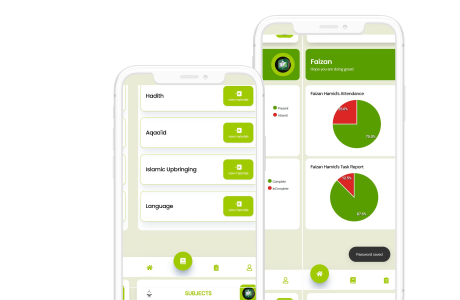
Individual parent portal in Arabic: Each parent accesses their child’s Hifz position, attendance, and fee balance in Arabic on their phone. No group WhatsApp sharing of individual student information.
Automatic notifications in Arabic: Absence alerts, Juz completion celebrations, fee reminders — sent automatically to the right parent, in Arabic, from session data the teacher has already recorded.
Fee management with receipts: Record cash and bank transfer payments, generate Arabic-language receipts, track outstanding balances by student, generate monthly financial summaries.
Data privacy compliance: Encrypted cloud storage, role-based access, individual parent portals — meeting Egypt’s Law 151/2020, Morocco’s Law 09-08, Algeria’s Law 18-07, and Tunisia’s Law 2004-63 requirements for secure personal data processing.
💡 Arabic interface. Offline mode. Full Hifz tracking. Built for North Africa.The management infrastructure North African Islamic schools have needed — and have not had until now.See Ilmify for North African Islamic Schools →
Conclusion
North Africa’s Islamic schools have been teaching the Qur’an and Islamic sciences for over a thousand years. The knowledge transmitted by fuqaha, mashayikh, and mu’allimeen across this vast tradition represents one of humanity’s great educational achievements. In 2026, that tradition deserves institutional infrastructure — records that survive teacher changes, progress visible to parents, and financial management that is transparent and accountable.
The path from paper notebooks to a functioning digital management system is shorter than it appears — one day of setup, one week of onboarding, four weeks of consistent recording, and the institutional picture that has existed only in individual memories becomes permanently, securely, and accessibly recorded.
Start your digitisation journey with Ilmify →
Related articles:

 at
at