
Introduction
Every madrasa administrator in East Africa knows the feeling. It is 8pm on a Wednesday. You are sitting down to eat. Your phone buzzes. Then buzzes again. Then again. The class WhatsApp group — 85 parents, three teachers, the mosque committee secretary, and a few people you are no longer sure why they are in the group — is active.
“Was Fatima present today?”
“Can someone tell me why sessions are cancelled on Friday?”
“My son says his teacher was absent — can the principal confirm?”
“Is the Ramadan schedule changing?”
“Can I pay fees by M-Pesa this month?”
Five separate queries, five separate conversations, all arriving at the same moment, all requiring individual responses, all on your personal phone, all at 8pm. And somewhere in the same group, three hours ago, a teacher posted that Ahmed was absent — which every one of those 85 parents can see, including the parents of children who are not Ahmed and have no business knowing Ahmed’s attendance status.
This is the WhatsApp reality in East African madrasas. It is familiar. It is exhausting. And it is, quietly, a problem with legal dimensions that most administrators have not yet had to face.
This guide names the problems clearly, explains what proper alternatives look like, and gives a practical migration path that respects the communication culture of East African Muslim communities while building something more sustainable.
How WhatsApp Became the Default — And Why It Stuck
WhatsApp’s dominance in East African madrasa management is not accidental or lazy — it is a rational response to a genuine need, using the most widely available and familiar tool.
In Kenya, Tanzania, Uganda, and across the region, WhatsApp achieved near-universal smartphone penetration among adults in the 2014–2018 period, precisely as community madrasas were growing and their administrative complexity was increasing. Parents expected communication. Teachers needed coordination. The mosque committee needed updates. WhatsApp was free, it was already on everyone’s phone, and it worked.
The alternative at the time — purpose-built school management software — was designed for Western contexts, expensive, required desktop computers, and had no concept of Hifz tracking, intermittent connectivity, or Swahili-language interfaces. Of course madrasas used WhatsApp. It was the only tool that actually worked.
What has changed is not the quality of WhatsApp — it remains excellent for its intended purpose. What has changed is that the management needs of East African madrasas have grown, the legal obligations around student data have crystallised (Tanzania’s Personal Data Protection Act 2022, Kenya’s Data Protection Act 2019), and — crucially — alternatives now exist that are genuinely designed for this context.
The question is no longer “do we use WhatsApp?” — the answer to that will remain yes for general announcements. The question is “what functions should we stop doing through WhatsApp?” — and there is a clear, practical answer.
The Five Real Problems With WhatsApp for Madrasa Management
Problem 1: Individual Student Data Shared With Everyone
When a teacher posts in a parent group “Aisha was not present today — can her parents check on her?”, every parent in that group now knows Aisha was absent. Aisha’s attendance record — personal information about a child — has been shared with 80 people who have no need or right to that information.
This happens dozens of times per week in the average madrasa. Absences, progress notes, fee reminders that name specific students — all flowing into a shared group where parents of other children can see information that is not about them.
This is not merely an etiquette issue. Under Tanzania’s Personal Data Protection Act 2022 and Kenya’s Data Protection Act 2019, personal data about individuals (including children’s attendance records) must be held and processed with appropriate security controls. A WhatsApp group shared with 80 people is not an appropriate security control for a named child’s personal information.
Problem 2: The Teacher’s Personal Phone Is the Institution’s Memory
The parent contacts are in the teacher’s personal phonebook. The class group was created from the teacher’s personal account. When the teacher leaves — to get married, to take another job, to return home after completing their studies — they take the phone, the contacts, and the group history with them.
The incoming teacher starts from scratch. The parents who relied on the group suddenly have no communication channel. The institutional memory — two years of parent relationships, group history, informal agreements about fee arrangements, notes about which students have special needs — is gone.
Problem 3: Critical Messages Disappear in Group Noise
A 90-member parent group generates significant message volume. Important announcements — fee increase, timetable change, session cancellation, Ramadan schedule — are posted and immediately buried. Parents miss them. They are not lying when they say they did not see the message; in a high-volume group, they probably did not.
The principal then receives individual queries about information that was posted publicly. The teacher sends the same information three times in a week and still gets asked. Administrative time is consumed answering questions whose answers were already provided.
Problem 4: No Record of What Was Communicated
When a parent later disputes whether they received notice of a fee increase, there is no auditable record of what was sent, who received it, and when. The WhatsApp group history can be searched — but it can also be deleted by members, it can expire, and it provides no confirmation of individual reading.
This creates real liability for the institution — particularly for communications that have financial or safeguarding implications.
Problem 5: No Boundary Between School and Personal Life
The teacher’s personal phone is the communication hub. Parents have the teacher’s personal number. Messages arrive at all hours — evenings, weekends, during family meals, during other teaching sessions. There is no professional boundary because there is no institutional communication channel separate from the teacher as an individual.
Teacher burnout is a genuine crisis in East African Islamic education. The absence of communication boundaries is a significant contributor. Every message that arrives at 10pm on the teacher’s personal phone represents a management system failure, not a parent behaviour problem.
The Data Protection Problem in Detail
Both Kenya and Tanzania now have formal data protection legislation that applies to organisations holding personal data — including madrasas.
Kenya Data Protection Act 2019 and Tanzania Personal Data Protection Act 2022 share core principles:
- Personal data must be collected for a legitimate purpose and used only for that purpose
- Personal data must be stored securely and not disclosed to unauthorised parties
- Individuals have rights to access and correct their personal data
How WhatsApp fails these tests:
Security: A WhatsApp group is controlled by whoever created it and its designated administrators, but any member can screenshot and share its contents. “Secure” storage means access is controlled and limited to authorised people. A 90-member group is not controlled access.
Purpose limitation: When a parent joins a class group, they are joining to receive information about their child and the class. They have not consented to receiving — or being the recipient of — information about other children.
Data processor agreements: WhatsApp is owned by Meta. When your madrasa uses WhatsApp to process student data, that data passes through Meta’s infrastructure under Meta’s terms — not under your institution’s data governance. You do not have a Data Processing Agreement with Meta for educational records.
The legal exposure is real. If a parent files a complaint about their child’s personal information being shared in a group, the institution has no strong defence if its practice was to post individual student data in a large WhatsApp group. Transitioning to a proper system is the legally sound course of action.
What “Proper” Parent Communication Actually Looks Like
A proper parent communication system for an East African madrasa has two components:
Component 1: Individual Parent Portal
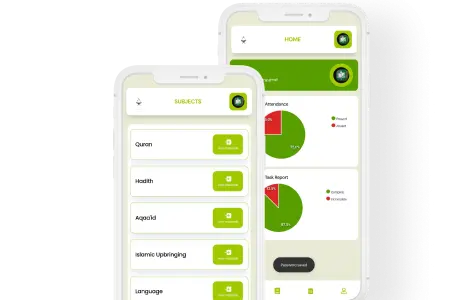
Each parent has their own secure login to a parent-facing system. They see only their own child’s information:
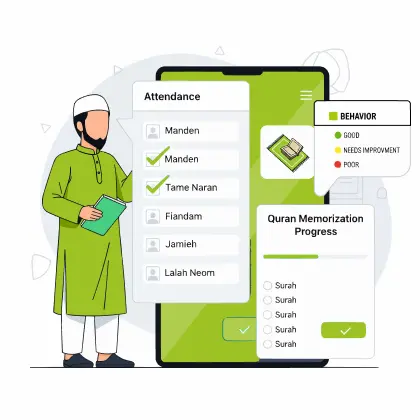
- Current Qur’anic progress (Surah, Juz, quality trend)
- Attendance record for the current term
- Fee balance and payment history
- Recent teacher notes
- Any messages from the teacher specifically about their child
The parent portal replaces all the individual WhatsApp messages about specific students. Parents check it when they want an update, without messaging the teacher. Teachers do not need to compose individual updates — the data they record after each session automatically populates the parent’s view.
Component 2: Institutional Broadcast Channel
For general announcements — session cancellations, timetable changes, Ramadan schedule, event invitations — a broadcast system that sends the same message to all parents simultaneously, with a delivery record. This function can overlap with WhatsApp (a well-managed, announcement-only group) during the transition period. Eventually it is better served by an in-system broadcast that creates a permanent record.
What to Keep WhatsApp For (And What to Retire It From)
Keep WhatsApp for:
- General school-wide announcements with no individual student information (“Sessions cancelled this Friday due to the mosque event”)
- Teacher coordination and informal staff communication
- Committee and governance discussions (in a separate, appropriate group)
- Community outreach and public-facing communication
Retire WhatsApp from:
- Any message naming a specific student (“Ahmed was absent today”)
- Individual progress updates (“Your daughter has completed Juz 15”)
- Fee reminders naming specific families (“Reminder: Family Hassan has outstanding balance”)
- Safeguarding-related communication of any kind
- Formal announcements that need an auditable record of delivery
The retirement is gradual and managed — not a dramatic overnight switch. The migration plan below handles this systematically.
The Migration Plan: Moving in Eight Weeks
Week 1–2: Set Up Your Management System
Configure Ilmify with your class structure, student list, and teacher accounts. The parent portal is ready to accept parent registrations once students are in the system.
Week 3: Send Parent Invitations
Send an invitation to every parent via WhatsApp (ironic, but effective): “We are moving individual student updates to a new secure system. You will receive an invitation link to register. This will give you live access to your child’s Qur’an progress, attendance, and fees — any time you want, without needing to contact the teacher.”
Frame the invitation as a benefit to parents — more information, more access — not as a policy change they must comply with.
Week 4: Redirect Individual Queries
When parents ask individual questions in the group (“Was my son present today?”), respond in the group: “Please check the parent portal — you can see your son’s attendance any time. If you haven’t registered yet, check the invitation message we sent last week.”
Do this consistently for two weeks. Most parents redirect to the portal within the first fortnight.
Week 5–6: Establish the Boundary Formally
Post a clear message to the group: “From [date], individual queries about attendance, progress, and fees should be directed through the parent portal or by direct message to the school’s official number [not the teacher’s personal number]. This group will continue for general school announcements.”
Week 7–8: Normalise and Reinforce
Any individual student query that comes into the group is answered with a gentle redirect. Any teacher who posts individual student information in the group is reminded of the new practice privately. The new communication norm is established and consistent.
By the end of Week 8, the WhatsApp group handles general announcements. Individual student communication happens through the portal and secure messaging. The teachers’ personal phones are theirs again after 7pm.
Managing the Resistance — Because There Will Be Resistance
There will be parents who resist. Some common objections and how to address them:
“I don’t want to download another app.” “The Ilmify app is free. It takes 2 minutes to set up. Once it’s done, you can see your child’s Qur’an progress any time without sending me a message at 10pm. Most parents find it much more convenient once they try it.”
“Why are you making this complicated?” “We are actually making it simpler. Right now you have to message the teacher and wait for a reply. With the portal, you see the information immediately, any time. The complexity is moving from your side to ours — and our side is designed to handle it.”
“WhatsApp works fine for me.” “It works for general announcements and it will continue for those. For your child’s individual progress and attendance — information that is private to your family — a secure individual system is more appropriate.”
“I’m not tech-literate.” Offer a 10-minute onboarding session — in person or via a brief video call. The parent portal is genuinely simple. The barrier is usually familiarity, not complexity.
The Offline Question: What Works When Data Is Expensive?
A significant and legitimate concern in East Africa: not all parents have affordable data plans. Not all teachers have reliable connectivity. A system that requires constant internet access will fail.
Ilmify addresses this on both sides:
For teachers: Ilmify records all session data offline. Teachers can record attendance and Hifz progress without any internet connection. Data syncs when WiFi or mobile data is available. No session is lost due to connectivity.
For parents: The parent portal loads cached information when offline — the last sync is available without data. New data is fetched when connectivity returns. The app uses minimal data on sync — a full week of session recordings for a 30-student class uses less data than loading a single webpage.
For parents in areas with very limited connectivity, the option of receiving a monthly printed progress report (generated from Ilmify data) is a practical alternative — not every parent needs digital portal access to benefit from digital record-keeping.
How Ilmify Replaces the Administrative Functions of WhatsApp
| WhatsApp Function | The Problem | Ilmify Alternative |
| Posting individual absences to the group | Shares private data with all parents | Automatic individual absence notification to the right parent only |
| Progress updates in the group | Private progress shared publicly | Parent portal — each parent sees only their own child |
| Fee reminders naming families | Financial data in a shared group | Individual fee notification to each family’s portal |
| Teacher answering parent queries at 10pm | No work/life boundary | Parents self-serve from the portal; teacher’s personal phone stays personal |
| Timetable changes and announcements | Fine in WhatsApp | Ilmify broadcast + WhatsApp as backup (announcements-only) |
| No record of what was sent | Accountability gap | Every notification logged with timestamp and delivery record |
💡 Your teachers’ personal phones should not be your school’s management systemIlmify replaces the individual-student functions of WhatsApp with a proper, secure, offline-capable system.See Ilmify for East African Madrasas →
Conclusion
WhatsApp served East African madrasas well when it was the only available tool. It is not the best tool anymore. The data protection laws of Kenya and Tanzania have caught up with the informal communication practices of Islamic schools — and the right response is not anxiety but action.
The migration from WhatsApp to a proper system is an eight-week project that permanently improves institutional governance, reduces teacher burnout, increases parent satisfaction, and puts the institution on the right side of data protection law. The tool to do it exists, it works offline, and it is affordable.
Start your migration with Ilmify →
Related articles:




 Arabic
  English
  Malay
Malay  Urdu
Urdu