
Introduction
Kenya’s Islamic educational network is one of the largest and most established in sub-Saharan Africa. Concentrated along the Swahili Coast — Mombasa, Kilifi, Lamu, Malindi — and in Nairobi’s Muslim-majority neighbourhoods, with growing networks in North Eastern Province and other regions, Kenya has an estimated 6,000 to 8,000 madrasas serving hundreds of thousands of children.
These institutions are the invisible backbone of Islamic life for Kenyan Muslim families. They operate every afternoon, five to six days a week, fitting around the government school timetable. They are staffed primarily by community volunteers and modestly paid teachers. They are governed by mosque committees, women’s associations, and individual scholars. And they are almost entirely managed without any formal administrative infrastructure.
This guide is for the Kenyan madrasa administrator — the principal, the committee chair, the dedicated volunteer — who wants to run their institution properly: with clear governance, solid records, effective fee management, meaningful parent communication, and the digital tools that make all of this sustainable without consuming every evening and weekend.
Understanding Kenya’s Madrasa Regulatory Environment
Kenya’s madrasas operate in a relatively permissive regulatory environment — the government does not require registration for supplementary Islamic schools operating after-hours alongside mainstream schooling. However, the regulatory landscape is evolving, and understanding the current framework is essential for any institution seeking to operate professionally.
The Kenya Ministry of Education oversees formal schools. Full-time Islamic schools providing primary or secondary education equivalent must register as private schools under the Basic Education Act 2013. Part-time madrasas (operating 2–3 hours per day as supplementary institutions) are not classified as schools under this Act and do not require Ministry registration.
The Supreme Council of Muslims of Kenya (SUPKEM) is the national coordinating body for Muslim affairs in Kenya. SUPKEM provides informal recognition for madrasas and Islamic institutions. Registration with SUPKEM (or your regional equivalent — Coast Muslim Communities, KIPRA, etc.) provides community credibility without creating formal regulatory obligations.
County-level Islamic education boards exist in some counties with significant Muslim populations (Mombasa, Kwale, Kilifi, Lamu, Garissa, Wajir, Mandera). These bodies may have local registration processes and may provide teacher training, curriculum support, and community recognition.
Kenya’s Data Protection Act 2019 applies to all organisations that process personal data about Kenyan citizens — including madrasas holding student and parent information. This requires that personal data be collected for a legitimate purpose, stored securely, not shared without consent, and retained only as long as necessary. While enforcement is still developing, compliance is legally required and practically important for institutions seeking government recognition or donor funding.
Governance: Setting Up Your Madrasa Committee
A functioning governance committee is the foundation of a sustainable madrasa. Without it, everything depends on one person — and when that person is absent, ill, or moves on, the institution falters.
The Minimum Governance Structure
Principal / Head Teacher: Operational leader — responsible for curriculum, teachers, students, and day-to-day administration. Reports to the committee.
Chair of Committee: Leads the governance committee, chairs meetings, and represents the institution to the community and any external bodies.
Secretary: Keeps minutes of committee meetings and handles official correspondence.
Treasurer / Finance Lead: Manages fee collection, financial records, teacher payments, and financial reporting to the committee.
Safeguarding Lead: A named individual responsible for child welfare — ensuring appropriate staff vetting, monitoring student welfare, and responding to any concerns.
Meeting Rhythm
The committee should meet at minimum once per term — three times per academic year. Meetings should be minuted (even briefly). Major decisions — fee changes, staff appointments, significant expenditure — should be committee decisions, not individual ones.
Women’s Committee Involvement
In many Kenyan madrasas, particularly along the Coast, the institution was founded by or is managed by a women’s Islamic association. This tradition is valuable and should be formalised. Women’s committee governance can be just as rigorous as mixed-gender governance; what matters is the governance structure, not the gender composition.
Registration: What Kenyan Madrasas Need to Register For
What you should register for:
- Community registration: With your mosque, SUPKEM, or relevant regional Islamic body. Low administrative burden; high community benefit.
- Kenya Data Protection Act: If you hold personal data about 10 or more students/parents. Register with the Office of the Data Protection Commissioner (ODPC). The registration process is online at odpc.go.ke.
- NGO registration (if applicable): If you receive external donations or grants, NGO registration with the NGO Coordination Board may be appropriate. Provides legal status and donor credibility.
What you may need if you grow:
- Charity/Trust registration: If your institution holds significant assets or income, formal registration as a charitable trust under the Trustees Act provides legal protection and fundraising credibility.
- Ministry of Education registration: Only if you expand to a full-time school providing primary/secondary education equivalent.
Curriculum: Designing Your Islamic Education Programme
The Standard East African Madrasa Curriculum Framework
A well-structured Kenyan madrasa curriculum is typically organised across six to eight class levels (roughly corresponding to the age range 5–15) and covers:
Level 1–2 (Ages 5–7):
- Arabic alphabet recognition (Huruf za Kiarabu)
- Basic vowels and letter forms
- Introduction to short Surahs (Surah Al-Fatiha, Surahs of Juz Amma)
- Basic Islamic practice: Kalimah, Bismillah, basic Salah movements
Level 3–4 (Ages 8–10):
- Qa’ida completion and Tajweed basics
- Beginning Nazirah (reading from the Mushaf)
- Islamic Studies: basic Aqeedah (pillars of Islam and Iman), Fiqh of Taharah and Salah
- Seerah: foundational stories of the Prophet ﷺ
Level 5–6 (Ages 11–13):
- Nazirah progression or Hifz entry
- Tajweed rules formally taught
- Islamic Studies: Zakah, Sawm, Hajj; foundational Fiqh
- Seerah: life of the Prophet ﷺ in detail
- Introduction to Arabic grammar (Nahw basics)
Level 7–8 (Ages 14–16):
- Hifz programme for committed memorisers
- Advanced Tajweed
- Comprehensive Islamic Studies: advanced Fiqh, Islamic history, Hadith basics
- Arabic language skills development
Curriculum Documentation
Write down your curriculum — even a simple one-page framework specifying what is taught at each level. This document:
- Ensures consistency when a teacher changes
- Communicates educational expectations to parents
- Supports any registration or accreditation process
- Gives new teachers a clear starting point
Staffing: Finding and Keeping Good Teachers in Kenya
Where to Find Teachers
Madrasa Resource Centre (MRC) network: The MRC has trained thousands of early childhood Islamic education teachers in East Africa. Their graduate network is the best source of qualified, trained madrasa teachers in Kenya.
Mombasa and Coast Islamic institutions: The Coast’s long Islamic scholarship tradition produces graduates from local institutions who are strong Qur’an teachers.
Al-Amin Islamic College and equivalent institutions: Teacher graduates from Kenya’s Islamic colleges.
Your own community: Former students who have gone on to Islamic studies or Darul Uloom programmes are often the most committed returning teachers.
Community mosque networks: Imam networks, SUPKEM regional connections, and word-of-mouth among Islamic educators.
What to Pay
In 2026, competitive teacher compensation in Kenyan madrasas ranges from:
- Part-time (2–3 hours/day, 5 days/week): KES 8,000–15,000/month
- Full-time madrasa teachers at established institutions: KES 15,000–30,000/month
- Highly qualified Hifz teachers: KES 20,000–40,000/month
These rates vary significantly by location — Mombasa and Nairobi command higher rates than rural areas.
Teacher Documentation
For every teacher or regular volunteer, maintain:
- Full name and national ID number
- Qualification and institution
- Contact details and next of kin
- Certificate of Good Conduct (Kenya Police clearance) — required for anyone working with children
- Written agreement specifying role, hours, and payment (even for volunteers)
The Certificate of Good Conduct (from the Kenya National Police Service’s Directorate of Criminal Investigations) is the Kenyan equivalent of a DBS check. Madrasas should require this for all teachers before they begin working with students.
Setting Fees That Work in Kenya’s Economic Context
Cost Calculation
Before setting fees, calculate your actual monthly running costs:
| Cost Category | Example (60-student afternoon madrasa, Mombasa) |
| Teacher salaries (3 teachers × KES 12,000) | KES 36,000 |
| Premises (mosque contribution or rent) | KES 5,000 |
| Materials (books, chalk, printing) | KES 3,000 |
| Utilities (electricity, water) | KES 2,000 |
| Administration | KES 2,000 |
| Reserve (10%) | KES 4,800 |
| Total monthly cost | KES 52,800 |
| Per-student monthly breakeven | KES 880 |
| Fee with 15% vacancy buffer | KES 1,000/month |
Common Fee Structures in Kenyan Madrasas
Monthly fees in Kenyan madrasas typically range from:
- Community-run mosque madrasas: KES 300–800/month
- More established private madrasas: KES 800–2,000/month
- Full Islamic schools (integrated curriculum): KES 2,000–8,000/month
Collection Methods
Accept M-Pesa — it is non-negotiable in Kenya. Provide a dedicated Paybill number or Till number for the institution (not personal M-Pesa). Every M-Pesa payment generates an automatic transaction record.
For parents who pay cash, issue numbered duplicate receipts every time. No exceptions.
Student Records: The Minimum You Must Keep
Every enrolled student should have a record containing:
Personal: Full name, date of birth, gender, parent/guardian names and phone numbers (minimum two contacts), home location, any relevant medical information.
Educational: Class level at enrolment, current class level, Qur’anic starting position, current Qur’anic position, term assessments.
Attendance: Per-session record for the current academic year.
Financial: Fee payment history, any fee waiver or reduction arrangement.
These records must be held in the institution’s system — not in the teacher’s personal phone or notebook. When a teacher leaves, the records must stay.
Qur’anic Progress Tracking
The most important educational tracking function — and the most common gap in Kenyan madrasa administration.
What to Track
For Nazirah students:
- Current Surah and verse position
- Tajweed quality rating (session by session)
- Milestones: Juz completed, Khatm al-Qur’an
For Hifz students:
- Sabak: Current memorisation position and quality rating
- Sabaq Para: Recent memorisation quality — is it consolidating properly?
- Dhor: Old revision cycle — how recently has earlier memorisation been tested? Is it decaying?
Tracking only the Sabak position (where the student currently is) without tracking Sabaq Para and Dhor quality gives an incomplete and potentially misleading picture of the student’s Qur’anic health.
Why Digital Tracking Matters
A teacher managing 20 Hifz students simultaneously — each at a different Juz, each with their own Sabaq Para and Dhor schedule — cannot hold all of this information accurately in memory. A digital system that takes 90 seconds to update after each session creates a permanent, accurate record that:
- Survives teacher changes
- Is visible to parents without requiring the teacher to be contacted
- Enables the principal to identify students falling behind before the end of term
- Generates end-of-term progress reports automatically
Attendance and Safeguarding
Take attendance at every session. For a typical afternoon madrasa running 5 days per week, this means five attendance records per week per student.
The attendance record serves three purposes:
- Safeguarding: Knowing who is on the premises and who is unexpectedly absent
- Parent communication: Informing parents of absences, particularly unexplained ones
- Performance correlation: A student who has missed 30% of sessions will not progress as expected — the attendance record explains why
Child Protection in Kenyan Madrasas
Kenya’s Children Act 2022 imposes obligations on all organisations working with children, including supplementary Islamic schools. The minimum requirements:
- All staff and regular volunteers must have a Certificate of Good Conduct
- A named child protection contact person at the institution
- A procedure for reporting concerns about a child’s welfare to the Children’s Department
- No corporal punishment (prohibited by law)
Parent Communication in a Kenyan Context
The WhatsApp Reality
Every Kenyan madrasa uses WhatsApp for parent communication. It is the default, the convenient, and often the only channel. This is understandable — but it creates problems:
Individual student information shared with entire groups. When a teacher posts “Fatuma was absent today” in the class WhatsApp group, every parent now knows Fatuma was absent. This is a data protection concern.
Important messages buried. A 120-member parent group generates dozens of messages daily. The timetable change posted on Tuesday is invisible to most parents by Wednesday.
The teacher’s personal phone as the school’s communication hub. When the teacher changes their number or leaves, the parent relationships go with them.
What Works Better
Individual notifications for student-specific information: Absences, progress updates, and fee reminders sent to individual parents — not broadcast to the group.
Group channel for general announcements only: Session cancellations, Ramadan timetable, event invitations — appropriate for the whole group because they contain no individual student data.
Parent portal for on-demand progress visibility: Parents check their child’s Qur’anic position, attendance, and fee balance when they want — without messaging the teacher.
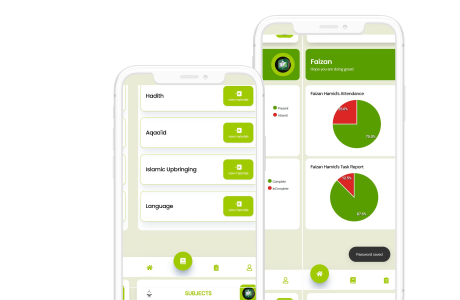
The Ilmify parent portal sends individual push notifications (absence alerts, milestone achievements, fee reminders) to each parent automatically, from data the teacher has already recorded. The WhatsApp group becomes what it should always have been: a broadcast channel for general information.
Financial Management for Kenyan Madrasas
Three Essential Practices
Separate institutional account: The madrasa must have its own M-Pesa Paybill/Till number or bank account. Never run institutional finances through a personal account.
Receipt for every payment: Cash or M-Pesa — issue a receipt. Number your receipts. Keep a copy. This is the foundation of financial accountability.
Monthly treasurer report: A simple one-page summary — total income received, total expenditure, closing balance — presented to the committee each month. This protects the treasurer from suspicion, builds community confidence, and flags financial problems early.
M-Pesa Best Practices for Kenyan Madrasas
- Register a dedicated Till or Paybill number in the institution’s name
- Appoint two authorised signatories for withdrawals (the principal and treasurer)
- Review transaction records monthly against your fee payment records
- Never share the MPESA PIN — even with trusted committee members
Managing Without Reliable Power or Internet
Kenya Power load-shedding, variable mobile data signal in many areas, and the practical reality of running an institution from a smartphone rather than a desktop — all of these require management tools designed for offline and intermittent-connectivity environments.
Any digital management system for a Kenyan madrasa must:
- Work offline: Record attendance and Hifz sessions without internet
- Sync automatically: Upload data when any connection is available
- Work on Android smartphones: The primary device for Kenyan teachers
- Use minimal data: Not every teacher has an unlimited data plan
- Handle power outages gracefully: No data loss if the phone loses power mid-session
The Digital Management Infrastructure You Need
A Kenyan madrasa in 2026 needs:
| Function | Tool | Key Requirement |
| Student records | Management system | Offline, mobile-first |
| Hifz tracking (Nazirah + full 3-stream) | Management system | Per session, quality ratings |
| Attendance | Management system | Per session, offline, parent notification |
| Fee management | Management system | M-Pesa integration awareness, receipts |
| Parent communication | Management system | Individual notifications, not group |
| Teacher management | Management system | Role-based, Certificate of Good Conduct records |
| Financial reporting | Management system | Monthly summary for committee |
How Ilmify Supports Kenyan Madrasas
Ilmify is built for Islamic schools exactly like Kenya’s madrasas — smartphone-managed, offline-capable, Hifz-focused, and operating without dedicated IT or administrative staff.
Offline mode for Kenyan conditions: KPLC outages, variable Safaricom/Airtel signal, low-data environments — Ilmify records sessions offline and syncs when connection returns.
Full Hifz and Nazirah tracking: Sabak, Sabaq Para, Dhor for Hifz students; position and Tajweed quality for Nazirah students. Per session, per student, in 90 seconds of teacher recording time.
Individual parent communication: Absence alerts go to the right parent automatically from attendance records. Parents access their child’s progress individually through the parent portal. The teacher’s personal WhatsApp is no longer the school’s parent communication system.
M-Pesa-aware fee management: Record M-Pesa payments, cash, and bank transfers in one consolidated fee ledger. Generate receipts. View outstanding balances by student. Monthly financial summaries for committee reporting.
Certificate of Good Conduct tracking: Staff profiles in Ilmify include a field for vetting documentation reference numbers and expiry dates — ensuring no teacher’s clearance lapses unnoticed.
Multi-teacher access: Each teacher manages their own class independently. The principal sees everything without manually collecting reports.
💡 Run your Kenyan madrasa properly — from your smartphoneWorks offline. Full Hifz tracking. M-Pesa-aware fee management. Affordable for community institutions.See Ilmify for Kenyan Madrasas →
Conclusion
Running a Kenyan madrasa in 2026 means navigating a complex combination of community expectations, growing regulatory requirements, parent communication demands, and educational quality obligations — typically without a dedicated administrator, often without reliable power or internet, and always on a tight budget.
The right management infrastructure makes this navigable. Not by adding complexity — by removing it: student records that stay when teachers leave; Hifz progress tracked automatically from session recordings; fees managed without end-of-month reconciliation nightmares; parents informed individually without consuming the teacher’s evenings.
That infrastructure exists. It is designed for institutions exactly like yours.
Start managing your Kenyan madrasa with Ilmify →
Related articles:

 at
at