
Introduction
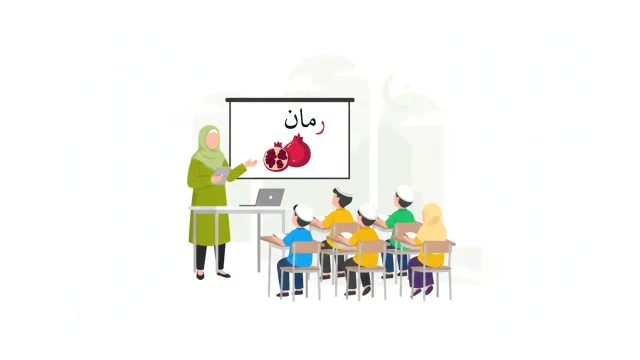
No aspect of Quran education in the Middle East is taken more seriously than Tajweed — the science of correct Quranic recitation. The word itself means “to make excellent” — and in Islamic tradition, reciting the Quran with proper Tajweed is not merely a stylistic preference but an obligation. Across Saudi Arabia, the UAE, Qatar, Oman, Egypt, Bahrain, and Kuwait, Tajweed instruction forms the backbone of every Hifz programme, every Dar al-Quran, and every serious mosque Halaqah. Understanding Tajweed across the Middle East — how it is taught, assessed, and certified — is essential context for anyone working in Quran education administration in the region.
What Is Tajweed and Why Does It Matter?
Tajweed (تجويد) is the set of rules governing the proper pronunciation of Quranic Arabic — covering the articulation points (makhraj) of each letter, the qualities (sifat) of each sound, and the rules for elongation (madd), assimilation (idgham), nasalisation (ghunnah), and stopping (waqf).
| Rule Category | Arabic | Covers |
| Articulation points | مخارج الحروف | Where in the mouth/throat each letter originates |
| Letter qualities | صفات الحروف | Heaviness, lightness, emphasis, softness |
| Noon and Meem rules | أحكام النون والميم | Izhar, Idgham, Ikhfa, Iqlab |
| Madd (elongation) | أحكام المد | When and how long to elongate vowels |
| Waqf (stopping) | أحكام الوقف | Where and how to pause during recitation |
| Qalqalah | قلقلة | The echoing sound on certain letters |
The Islamic legal position on Tajweed is that applying it is fard ‘ayn (obligatory on every individual reciting the Quran). This is why Tajweed instruction is embedded in every level of Quran education across the Middle East.
The Hafs ‘an ‘Asim Standard Across the Middle East
The dominant recitation mode across all seven Middle Eastern countries is Hafs ‘an ‘Asim — one of the ten canonical Qira’at (recitation modes). This means:
- The overwhelming majority of Tajweed instruction across the GCC and Egypt is based on the Hafs narration
- All major printed Qurans distributed in the region use Hafs
- All state examinations and Ijazah assessments for non-specialists use Hafs
| Country | Primary Recitation Mode | Notes |
| Saudi Arabia | Hafs ‘an ‘Asim | Standard in government schools and most Dar al-Quran |
| UAE | Hafs ‘an ‘Asim | IACAD-registered centres use Hafs as standard |
| Qatar | Hafs ‘an ‘Asim | Ministry of Awqaf curriculum |
| Oman | Hafs ‘an ‘Asim | Ibadi tradition also uses Hafs as primary mode |
| Egypt | Hafs ‘an ‘Asim (dominant) + multiple Qira’at | Al-Azhar maintains advanced Qira’at traditions |
| Bahrain | Hafs ‘an ‘Asim | Ministry-regulated; Hafs standard |
| Kuwait | Hafs ‘an ‘Asim | Ministry of Awqaf; Hafs standard |
Egypt is the exception — Al-Azhar’s Kulliyyat al-Quran provides formal training in all seven (and ten) canonical Qira’at modes. See Qira’at in Egypt and Qira’at: The Canonical Modes of Quranic Recitation Explained.
Country-by-Country: Tajweed Teaching and Assessment
| Country | Who Teaches Tajweed | Assessment Method | Certification |
| Saudi Arabia | Ministry-credentialed Qurra’; Haramayn Shuyukh | Oral examination by Sheikh; Ijazah recitation | Ijazah bil-Sanad; Ministry certificates |
| UAE | IACAD-approved teachers; Dar al-Quran staff | Internal assessments + Ijazah oral examination | IACAD-registered Ijazah; centre certificates |
| Qatar | Ministry of Awqaf-employed teachers | Standardised national assessments + oral exams | Ministry of Awqaf certificates; Ijazah |
| Oman | Ministry of Awqaf; mosque Imams | Oral examination; community recognition | Ministry certificates |
| Egypt | Al-Azhar-trained teachers; Kulliyyat al-Quran graduates | Formal Al-Azhar examinations; Ijazah oral | Al-Azhar degrees; Ijazah bil-Sanad |
| Bahrain | Ministry of Justice/Islamic Affairs teachers | Oral; ministry-registered assessments | Ministry certificates |
| Kuwait | Ministry of Awqaf teachers | National Tajweed examinations | Ministry of Awqaf certificates; Ijazah |
The Core Rules of Tajweed
Every Tajweed curriculum across the Middle East covers the same foundational rules:
Noon Sakinah and Tanween Rules
The four rules governing the noon (ن) without a vowel and tanween (double vowel marks):
| Rule | Arabic | When Applied |
| Izhar (Clear) | إظهار | Noon/tanween followed by throat letters |
| Idgham (Merging) | إدغام | Noon/tanween followed by ي ر م ل و ن |
| Iqlab (Conversion) | إقلاب | Noon/tanween followed by ب |
| Ikhfa (Concealment) | إخفاء | Noon/tanween followed by remaining 15 letters |
Meem Sakinah Rules
| Rule | Arabic | Application |
| Ikhfa Shafawi | إخفاء شفوي | Meem followed by ب |
| Idgham Shafawi | إدغام شفوي | Meem followed by مeem |
| Izhar Shafawi | إظهار شفوي | Meem followed by all other letters |
Madd (Elongation)
Types of elongation range from 2 to 6 counts (harakaat), with precise rules governing when each length applies — a core area of assessment in all Ijazah examinations.
How Tajweed Is Taught: From Halaqah to Formal Instruction
Talaqqi — The Foundation
All serious Tajweed instruction across the Middle East is built on Talaqqi — direct oral transmission from teacher to student. The student listens to the teacher’s recitation, imitates it, and is corrected in real time. Tajweed cannot be learned from a book alone; it requires a qualified teacher’s ear and voice. See Talaqqi: Why Direct Oral Transmission Is the Foundation of Quran Learning.
Classroom Instruction
In formal Tahfiz schools and Dar al-Quran, Tajweed theory is taught as a dedicated subject — the student learns the rules academically alongside practical application with the teacher.
Levels of Tajweed Instruction
| Level | Setting | Focus |
| Basic | Mosque Halaqah, early Tahfiz | Foundational rules; letter articulation |
| Intermediate | Dar al-Quran; Tahfiz school | Full ruleset; application during Hifz |
| Advanced | Ma’had Islami; university | Deep rule study; Qira’at foundations |
| Master | Kulliyyat al-Quran; Ijazah circles | All Qira’at; certification to teach |
Tajweed Assessment and Certification
Tajweed is assessed across the region through a combination of:
Oral Examination: The student recites before a qualified Sheikh or panel — errors are noted, corrections made, and a pass/fail decision issued. This is the universal standard for Ijazah.
Formal Written Examinations: In Al-Azhar Institutes (Egypt), UAE IACAD-registered centres, and Qatar Awqaf programmes, written Tajweed examinations test the rules academically.
Continuous Assessment: In daily Tahfiz sessions, the teacher maintains a record of the student’s Tajweed errors — these are tracked session by session and inform promotion to new memorisation.
Ijazah Examination: The highest form — a student recites the complete Quran (or a significant portion) without error to a Sheikh who holds his own Ijazah. Only then is the Ijazah granted. This is the benchmark of Tajweed excellence.
Tajweed and the Ijazah Pathway
Tajweed mastery is the gatekeeper of the Ijazah system. No Sheikh will grant an Ijazah to a student whose Tajweed is deficient — the chain of transmission (Sanad) is considered compromised if the recitation does not meet the standard of the Prophet’s ﷺ tradition.
This creates a clear institutional relationship:
- Student completes Hifz with Tajweed
- Student undergoes intensive Muraja’ah to polish recitation
- Student requests recitation sessions with an Ijazah-holding Sheikh
- Sheikh assesses Tajweed throughout — corrections continue
- Upon completion of 30 Juz to the Sheikh’s satisfaction → Ijazah is granted
Tajweed assessment records, teacher sign-offs, and Sanad documentation all need to be maintained throughout this process — and in well-run Middle Eastern Quran centres, this documentation is becoming increasingly digital.
Common Tajweed Errors in the Region
Even in the Middle East, certain errors are common among students:
| Error Type | Description | Common In |
| Madd length inaccuracy | Elongating 2-count Madds to 4-count or vice versa | All regions |
| Letter heaviness errors | Making light letters heavy (e.g., ل in non-emphatic context) | Non-native Arabic speakers (UAE expat students) |
| Ghunnah omission | Missing the nasal sound on Meem/Noon | All regions |
| Qalqalah intensity | Under- or over-echoing Qalqalah letters | All regions |
| Waqf errors | Stopping at wrong places; incorrect stopping articulation | Adult beginners |
In UAE and Qatar — where large non-Arab Muslim populations study Tajweed — additional challenges arise from the influence of first-language phonology on Arabic articulation. This is why UAE-based centres often have specialised Tajweed correction programmes for non-native Arabic speakers.
Key Statistics
| Metric | Data |
| Estimated qualified Qurra’ (Tajweed teachers) in the 7 countries | Tens of thousands |
| Al-Azhar-trained Tajweed teachers (Egypt) | Hundreds of thousands globally |
| UAE IACAD-required Tajweed qualification for centre teachers | Mandatory credential |
| Saudi Ministry of Education — Tajweed in school curriculum | All grade levels |
| Qatar National Quran Competition — Tajweed as judging criterion | 50% of marks |
Frequently asked questions
Q: Is Tajweed compulsory in all Middle Eastern Quran centres?
Yes — in all formal institutions across the GCC and Egypt, Tajweed instruction is mandatory. Even casual mosque Halaqat typically include a qualified teacher who corrects recitation. In IACAD-registered UAE centres, Tajweed qualification of teachers is a licensing requirement.
Q: How long does it take to master Tajweed?
Basic Tajweed rules can be learned in 3–6 months of consistent study. Applying them consistently during recitation takes 1–2 years of practice. Mastery — the level required for an Ijazah — requires years of supervised recitation with a qualified Sheikh.
Q: Does Egypt have higher Tajweed standards than the GCC?
Both traditions are rigorous. Saudi Arabia’s Haramayn (Makkah/Madinah) Tajweed standard is considered the global benchmark for Hafs recitation. Egypt’s Al-Azhar adds a multi-Qira’at dimension that is unmatched elsewhere. They are complementary authorities rather than competitors.
Q: Can Tajweed be learned online?
Basic rules can be studied online. However, the tradition across the Middle East firmly holds that proper Tajweed requires Talaqqi — direct teacher correction — at least for the stages that matter for Ijazah. Online platforms can supplement, but a qualified Sheikh’s real-time correction cannot be fully replaced.
Q: How is Tajweed quality tracked in Tahfiz schools?
In well-organised centres, each student’s Hifz session records include Tajweed errors noted by the teacher. Progress reports show improvement over time. At the Ijazah stage, formal recitation logs document each session with the Sheikh. Digital tools increasingly support this documentation.
Conclusion
Tajweed is not an optional refinement in Middle Eastern Quran education — it is foundational. From the first Halaqah where a child learns the letters’ articulation points, to the final Ijazah recitation before a Sheikh, Tajweed precision underpins the entire system. For administrators of Dar al-Quran centres, Tahfiz schools, and Islamic institutes across the GCC and Egypt, tracking Tajweed progress — student by student, session by session — is one of the most operationally demanding requirements of managing an institution with genuine scholarly standards.
Ilmify supports Tajweed tracking and assessment in Middle Eastern Quran institutions — logging teacher corrections, monitoring progress, and maintaining the records needed for Ijazah pathway documentation. Explore Ilmify →





 Arabic
  English
  Malay
Malay  Urdu
Urdu