
Introduction
India’s state madrasa boards represent the most sustained attempt to bring Islamic education within the framework of state oversight while preserving its religious character. These boards register Islamic educational institutions, design curriculum frameworks that blend Islamic subjects with secular content, conduct examinations, award certificates with government recognition, and disburse state funding to affiliated madrasas. They sit at the intersection of educational policy, minority rights, and the constitutional provisions that both protect and constrain religious education in a secular democratic state.
The Standard Level Structure
India’s 20+ state madrasa boards operate with different names and variations, but most follow a broadly similar progression:
Tahataniya / Ibtidaiya — Primary Level
The foundational level, roughly equivalent to primary school (Classes 1–5). Curriculum: Arabic alphabet, basic Quran recitation, basic Islamic knowledge (Aqeedah, Du’as, simple Fiqh), Urdu, and secular subjects required by the state board (Hindi, Mathematics, basic Science). Duration: 3–5 years.
Fauqaniya — Upper Primary Level
Equivalent to upper primary school (Classes 6–8). Builds on the Tahataniya curriculum with more advanced Arabic (grammar basics, Nahw introduction), more Quran study, Hadith introduction, and expanded secular subjects.
Maulvi — Secondary Level (Class 10 Equivalent)
The most widely recognised state madrasa qualification — broadly equivalent to the Class 10 school-leaving certificate. Curriculum: Quran with Tajweed, basic Hadith, Fiqh (Hanafi), Arabic language and grammar, Urdu composition, plus secular subjects (Mathematics, Science, Social Studies, Hindi/English).
Alim — Higher Secondary Level (Class 12 Equivalent)
Broadly equivalent to Class 12 (Intermediate/HSC). Curriculum: more advanced Hadith, Fiqh in greater depth, Tafsir, advanced Arabic, introductory logic, plus secular subjects at the Class 12 level. Duration: approximately 2 years after Maulvi.
Kamil — Undergraduate Level
Designed as a 2-year undergraduate-equivalent programme covering advanced Islamic subjects. Significantly affected by the 2024 Supreme Court ruling — see below.
Fazil — Postgraduate Level
The postgraduate-equivalent, for specialisation in a chosen Islamic discipline. Also affected by the 2024 ruling.
UP Board of Madrasa Education
The largest state madrasa board in India — overseeing approximately 19,000 recognised madrasas and several million students, reflecting UP’s dominant share of India’s Islamic institutions.
UP’s distinctive levels: Tahataniya → Fauqaniya → Munshi (unique to UP — a level focused on Urdu and Persian literary education) → Maulvi → Alim → Kamil → Fazil.
The 2024 legal upheaval: In March 2024, the Allahabad High Court struck down the Uttar Pradesh Madrasa Education Act 2004, declaring it unconstitutional for violating secular principles. In November 2024, the Supreme Court of India partially reversed this ruling: it upheld the Act’s core framework as constitutionally valid but struck down the Kamil and Fazil degree recognition as university equivalents.
Funding crisis: The UP government has faced criticism for delays in releasing SPQEM/SPEMM funds, with Rs. 470 crore reportedly pending as of 2024, leaving teacher salaries unpaid at some affiliated madrasas.
West Bengal Board of Madrasah Education
One of the most distinctive state boards — notable for its significant non-Muslim participation.
WB’s level structure: High Madrasah → Senior Madrasah → Alim → Fazil → Kamil → Mumtazul Muhammadin (the highest WB level — a postgraduate designation unique to West Bengal).
The WB distinction: Approximately 17% of students in West Bengal’s state madrasas are non-Muslim, and 11% of staff are non-Muslim — a striking statistic that reflects the Bengali tradition where government-affiliated madrasas in Muslim-minority areas draw students from all communities. This is unique among Indian states.
Note on spelling: West Bengal deliberately spells its institutions as “Madrasah” (with an ‘h’) — a consistent distinction in all official documentation.
Bihar Board of Madrasa Education
Bihar’s board oversees approximately 1,000+ recognised madrasas. Bihar’s Muslim population (around 17% of the state) is concentrated in specific districts — the Seemanchal region (Kishanganj, Purnia, Araria, Katihar) bordering Nepal and Bangladesh. The Bihar system follows a structure broadly similar to UP’s.
Rajasthan Board of Madrasa Education
Rajasthan’s 9% Muslim population is concentrated in Ajmer, Jaipur, Jodhpur, and border districts. The Rajasthan system includes a significant Sufi dimension — some affiliated madrasas are connected to the Dargah of Moinuddin Chishti in Ajmer and carry a Chishti Sufi theological orientation distinct from the Deobandi mainstream in UP and Bihar.
Assam — Reclassification and Controversy
Assam stands entirely apart from all other states in this story. In 2020–2023, the Assam government reclassified 1,281 state-funded madrasas as regular high schools or Sanskrit institutions — shutting down government-supported Islamic education in those institutions. This decision was deeply contested. Thousands of madrasa teachers were either retrained for secular subjects, displaced, or moved into the unregistered independent madrasa sector. No other state has taken such sweeping action against its own state madrasa board system.
SPQEM / SPEMM: Central Government Funding
The Scheme for Providing Quality Education in Madrasas (SPQEM) — reconstituted as the Scheme for Providing Education in Madrasas and Minorities (SPEMM) — is the central government’s mechanism for funding modern subjects in state-affiliated madrasas.
Under SPQEM/SPEMM, the central government provides:
- Salaries for teachers of Science, Mathematics, Social Studies, English, and Computer Science in registered madrasas
- NCERT textbooks and teaching materials for secular subjects
- Infrastructure grants through IDMI (Infrastructure Development for Minority Institutes)
The scheme is voluntary — madrasas must apply for recognition and comply with curriculum integration requirements to access funding. Implementation has been uneven across states.
The 2024 Supreme Court Ruling: Full Implications
The November 2024 Supreme Court ruling on the UP Madrasa Act has implications well beyond UP:
What was upheld: State regulation of madrasa education — including registration, curriculum oversight, and school-level examination — is constitutionally valid. States can require madrasas to teach secular subjects and can recognise madrasa certificates at school level (Maulvi as Class 10 equivalent, Alim as Class 12 equivalent).
What was struck down: State recognition of Kamil and Fazil degrees as university-equivalent qualifications. Degree-granting functions are reserved for UGC-recognised institutions.
Practical implications for students: Kamil and Fazil continue to exist as internal Islamic qualifications but lose their statutory university equivalence. Students needing university-equivalent credentials must pursue them through MANUU equivalency programmes or bridge courses into mainstream universities.
The Central Madrasa Board Proposal
The proposal for a Central Madrasa Board — a national-level regulatory body that would standardise madrasa curriculum, qualifications, and oversight across all states — has been debated for over a decade. Muslim community organisations have broadly opposed the proposal, arguing that a central board would enable greater government interference in Islamic education and undermine the community’s constitutional right (Article 30) to manage its own educational institutions. As of 2026, no Central Madrasa Board has been established.
Software Implications for State Board Madrasas
State-affiliated madrasas have specific software needs shaped directly by board affiliation:
Examination registration integration: SPQEM exams (Maulvi, Alim) require student registration with board portals. Software that pre-populates examination registration data from student records eliminates the annual manual crisis.
SPQEM/SPEMM compliance reporting: Madrasas receiving funding must demonstrate teacher presence, subject delivery, and attendance. Automated compliance reports in state board format significantly reduce administrative burden.
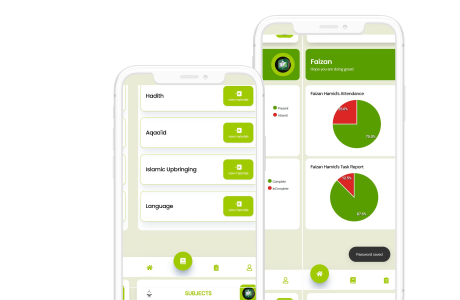
Dual curriculum tracking: State-affiliated madrasas must track both Islamic subjects (Quran, Hadith, Fiqh, Arabic) and secular subjects (Mathematics, Science, English, Hindi) — any management software must support both tracks simultaneously.
Multi-state variation: A platform serving madrasas across multiple states must accommodate different board structures — UP’s Munshi level, WB’s Mumtazul Muhammadin, Bihar’s different tier naming. Configurable board affiliation settings with state-specific level nomenclature are essential for any platform with national ambitions.
Conclusion
India’s state madrasa boards are the institutional bridge between Islamic education and the Indian state — imperfect, politically contested, and legally evolving, but essential to the educational lives of millions of students and the livelihoods of tens of thousands of teachers. The 2024 Supreme Court ruling has defined a clearer constitutional framework: states can regulate and support madrasa education at school level; university-equivalent degree recognition requires UGC mechanisms.
For institutions navigating this landscape — managing SPQEM compliance, tracking dual secular and Islamic curricula, preparing students for both board examinations and Alim-level Islamic credentials — the administrative burden is real and the software gap is wide. A platform that understands state board structures, generates compliance reports in state-required formats, and tracks both curriculum tracks in a single student record is the most immediately impactful tool any affiliated madrasa can deploy.
See how Ilmify supports state-affiliated madrasas in India →
Related articles:


 at
at