
Introduction
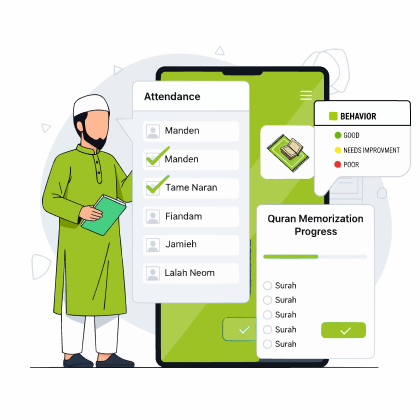
The Hifdh programme — the programme through which students memorise the complete Quran — is the most demanding and most prestigious offering of any Islamic education institution. It is also the most administratively complex. The daily three-stream structure of Sabak (new memorisation), Sabaq Para (recent revision), and Dhor (long-term revision), the individual teacher-student supervision it requires, the years of sustained commitment it demands — all of this creates management challenges that generic school administration tools are not built to handle.
Australia and New Zealand have numerous Hifdh programmes operating at different scales and structures. This article examines how they work and what they need to work well.
Hifdh Programmes Documented in Australia and New Zealand
Masjid Qubaa — Full-Time Quran Memorisation Programme (Sydney)
Masjid Qubaa’s Full-Time Quran Memorisation Programme is one of Sydney’s most established Hifdh offerings. Under Dr Shabbir Ahmed’s 32-year oversight, the programme runs alongside the mosque’s other educational offerings (Nazirah, part-time Hifdh, one-year and six-year Shari’ah courses). Students in the full-time programme commit their weekdays to Quran memorisation under direct teacher supervision.
At Masjid Qubaa, Hifdh is not a side programme — it is one of several parallel tracks, each requiring its own student records, progression tracking, teacher assignments, and parent reporting.
Darul Hikmah Australia — Hifdh Course for Girls and Part-Time Hifdh (Melbourne)
Darul Hikmah operates two Hifdh tracks from its Fawkner campus:
- Hifdh Course for Girls — a full-time girls’ Hifdh programme, one of the few such programmes in Melbourne
- Part-Time Hifdh — for students unable to commit to full-time, allowing completion over a longer period
The Part-Time Hifdh at Darul Hikmah is an important provision: full-time Hifdh requires students to sacrifice school or work time, which not every family can accommodate. Part-time allows students to memorise alongside regular schooling, progressing more slowly but without abandoning either commitment.
Masjid Qubaa — Nazirah and Part-Time Hifdh (Sydney)
A second Hifdh-related programme at Qubaa, specifically pairing Nazirah (complete Quran reading) with part-time memorisation. This combination is standard practice: students completing Nazirah have demonstrated they can read the complete Quran fluently, providing the foundation for memorisation.
Iqra Academy Australia — Huffaz Programme (Slacks Creek, QLD)
Sheikh Akram Buksh’s madrasah in Slacks Creek has produced “multiple Huffaz” — Sheikh Akram’s own website counts those who completed, with more in active training. For an after-school madrasah (4:30–6:30pm, Mon–Thu), producing Huffaz demonstrates sustained programme quality over a 17+ year period.
Al-Madinah School — Hifz Classes (Auckland, New Zealand)
Al-Madinah School explicitly offers “special Hifz classes for those who want to make their children a Hafiz of Quran” — integrated into its state school schedule for Year 1–13 students. Running Hifz within a state-integrated school context requires coordination with the NZ Ministry of Education’s curriculum requirements and timetabling.
Madrasah Uthmaaniyah — Hifdh Faculty (Auckland Islamic Trust)
Madrasah Uthmaaniyah has a dedicated Hifdh Faculty within its madrasah structure. The AIT website documents that five students completed Hifdh at the 2020 Jalsah (annual function). Students in the Hifdh faculty commit approximately “five hours every day” to the programme — a figure that highlights the intensity of full-time Hifdh compared to part-time or after-school provision.
Darul Hidayah lil Banat — Alimah Course including Quran (Auckland, New Zealand)
As a residential girls’ Darul Uloom, Darul Hidayah’s Alimah course includes Tafseer, Tajweed, and Translation of Quran as core components — though it is an Alimiyyah rather than a pure Hifdh programme. The full Quran recitation and understanding required for Alimiyyah overlaps significantly with Hifdh preparation.
Ulul Albab Islamic Institute — Tahfiz Programme (Northland, New Zealand)
Ulul Albab lists “Tahfiz — Quran Memorisation” as a programme at its Topuni rural campus. As a residential Islamic institute in rural Northland, the Tahfiz programme benefits from the concentrated daily learning environment that rural residential institutions can provide.
Ar-Rukun Mosque — Quran and Tahfiz Programme (Rockingham, WA)
The Ar-Rukun Madrasah (3 days/week, 5:30–7pm) is described as a “Quran and Tahfiz Programme.” For a Perth satellite suburb with a small Muslim community, three evenings per week of supervised Tahfiz instruction is a meaningful provision — allowing students who cannot access a full-time Hifdh institution to progress.
How Hifdh Programmes Work: The Three Streams
The traditional Hifdh programme operates on a three-stream daily structure:
Sabak (New Lesson): The student memorises a new portion of Quran each day. For most programmes, this ranges from half a page to two pages daily, depending on the student’s capacity and the teacher’s judgment. The student presents the new portion to the teacher, who assesses it for accuracy, pronunciation, and confidence.
Sabaq Para (Recent Revision): The student revises the portion memorised over the previous two to four weeks. This is the “fresh” memory that is most vulnerable to forgetting — regular revision within the first weeks of memorisation is what consolidates new learning into medium-term retention.
Dhor (Long-Term Revision): The student cycles through the portions memorised more than a month ago, ensuring that earlier learning is maintained as new learning is added. Without systematic Dhor, students commonly memorise the final juz well but find earlier juz fading.
Managing these three streams simultaneously for even 10 students produces a significant data management challenge:
- Each student has a current Sabak position (which page, which surah)
- Each student has a current Sabaq Para range (the last 2–4 weeks of memorisation)
- Each student has a Dhor schedule (a rotating cycle through all memorised material)
- The teacher records what was presented, its quality, and whether the student may progress or must repeat
- Parents receive reports on progress, areas of concern, and revision homework
For a programme with 20 students, this is 20 × 3 = 60 active data streams per session, ideally recorded after each class.
What Hifdh Tracking Software Needs to Do
Generic school administration tools (Compass, Edge/Helix SMS, KAMAR in NZ) are not built for Hifdh tracking. They handle attendance, grades, and parent communication — but they have no concept of “Juz 15, Pages 280–283, Sabak strength: 4/5, Dhor schedule: Juz 1–5 this week.”
An effective Hifdh tracking system needs:
Student Hifdh profile:
- Current memorisation position (surah, verse, page number)
- Total pages memorised to date
- Overall programme start date and projected completion
Session recording (per student, per session):
- Date
- Sabak: pages presented, pages accepted, teacher’s quality rating
- Sabaq Para: pages revised, quality rating, any pages flagged for repetition
- Dhor: which Juz/pages covered, any gaps identified
Teacher notes:
- Free-text notes for each student’s session (pronunciation issues, fatigue, personal matters affecting performance)
Revision schedule:
- Automated Dhor schedule generation — “this week, student A should revise Juz 3, 4, and 5”
- Sabaq Para window tracking — flag when recent memorisation hasn’t been revised in 14+ days
Parent-facing reports:
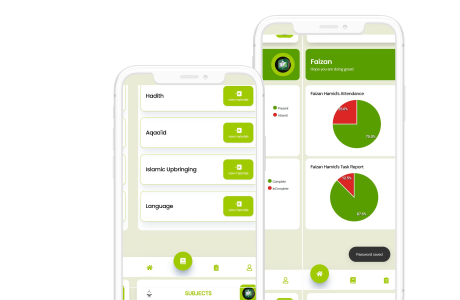
- Weekly or fortnightly summary: what was memorised this week, what needs revision at home, overall progress percentage
- Simple, readable format for parents who may not be familiar with the technical Hifdh vocabulary
Completion tracking:
- Date of final page memorisation
- Dhor completion requirement (many programmes require students to recite the complete Quran before formal certification)
- Certification record for institutional archive
Teacher-facing dashboard:
- All students in one view, with current positions and flags for students requiring attention
- Students who have fallen behind Dhor schedule flagged for intervention
- Programme statistics: total Huffaz this year, average completion time, page-per-day averages
Part-Time Hifdh: Special Management Considerations
Part-time Hifdh — as offered by Darul Hikmah and implied at several other institutions — has distinct management challenges:
Slower progression means longer records. A full-time Hifdh student might complete in 2–3 years; a part-time student might take 5–8 years. Their records span a much longer period and must be reliably maintained across potential teacher changes.
Revision gaps. A part-time student memorising 2 sessions per week instead of 5 has longer gaps between sessions, meaning forgetting occurs faster relative to progress. Hifdh tracking for part-time students needs to flag when revision windows are getting too long.
Dual-institution complexity. Part-time Hifdh students are typically also in regular school. Managing the interaction between school calendar, madrasah schedule, and Hifdh sessions requires careful coordination — and absence from madrasah due to school events needs to be tracked and followed up.
Institutional Benefits of Professional Hifdh Management
For an institution like Madrasah Uthmaaniyah (Auckland) that has produced at least 5 Huffaz by 2020, or Iqra Academy (Slacks Creek) that has produced multiple Huffaz over 17+ years, the accumulation of Hifdh records represents an institutional heritage:
- The history of which students memorised which portions under which teachers
- The average completion times by student age and programme type
- The teacher’s methodology notes and their effectiveness
- The complete record of each graduate’s Hifdh journey
This heritage has value for the institution (demonstrating its track record), for teachers (evidencing their effectiveness), and for graduates (whose Hifdh qualification is more credible when institutionally documented rather than informally attested).
A Hifdh tracking system that creates and maintains this institutional record — not just for current students but as a permanent archive of programme history — transforms a programme from an informal community service into a traceable, accountable educational achievement.


 at
at