Introduction
The COVID-19 pandemic forced Australia’s and New Zealand’s Islamic education sector online in 2020. Unlike many sectors that returned to exclusively in-person delivery when restrictions lifted, Islamic education providers largely maintained their online offerings — discovering that online delivery solved genuine problems of geographic access, scheduling, and reach. Today, online Islamic education is a permanent and growing feature of the landscape.
Why Online Islamic Education Took Root
Australia and New Zealand present particular challenges for in-person Islamic education:
Geographic dispersal. Australia’s Muslim community of 813,000 is heavily concentrated in Sydney and Melbourne, but Muslims live across every state and territory. Darwin’s ISOD madrasah, for example, serves a small Muslim community in the Northern Territory’s capital — an isolated community that could not sustain the teaching infrastructure a major city mosque can. Online delivery allows teachers in Melbourne or Sydney to reach students in Darwin, Townsville, Hobart, or Christchurch.
New Zealand’s small and distributed community. With 75,000 Muslims, New Zealand’s community is small enough that many centres cannot sustain a full-time teaching workforce. Online delivery is not an option but a necessity for institutions like Ulul Albab Islamic Institute in rural Northland, or Safura Academy serving multiple Auckland locations.
Working parents and after-school scheduling. In major cities, families increasingly live far from Islamic education centres due to housing costs. The commute to a physical maktab after a full school day is a genuine burden. Online delivery at 5pm–7pm from home removes that barrier.
Revert Muslims. For people who have recently embraced Islam and lack existing community connections, online Islamic education is often the most accessible entry point. Learn Quran and Arabic Centre explicitly notes this, providing “Reverts’ Quran and Islamic Studies Classes (Brothers and Sisters)” as a named programme.
Australia’s Online Islamic Education Providers
Learn Quran and Arabic Centre — Clyde North VIC (National Online Delivery)
Website: learn-quran-and-arabic-centre.com.au
Founder/Lead Teacher: Dr Manzur Ashraf
Physical location: Clyde North VIC (Balla Balla Community Centre, Unit 7/9 Selandra Blvd)
Dr Manzur Ashraf’s Learn Quran and Arabic Centre is one of Australia’s most sophisticated online Islamic education operations. Run from Clyde North in Melbourne’s south-eastern growth corridor, the centre provides national and international online delivery via Zoom, with face-to-face classes available locally.
Programmes:
- Iqra/Tajweed classes (Quran reading with correct pronunciation) — online and face-to-face
- Islamic Studies for Kids (52-week structured curriculum available on their website)
- Online Hifdh Program (Quran memorisation) — structured, with international teacher availability
- Quran Classes for Adults (separate male and female streams)
- Quranic Arabic Grammar (online)
- Revert/Convert support classes
The centre serves online students across NSW, VIC, QLD, TAS, SA, NT, WA, and New Zealand. Its teachers are described as “Aleem/Aleema with extensive academic teaching experience” — a direct credential signal distinguishing qualified scholars from informal teachers.
Distinctive pedagogy: The centre is explicit about its teaching approach — emphasising understanding what the Quran says (meaning and context) alongside correct recitation, not recitation alone. This contextual approach, unusual in traditional maktab settings where recitation often dominates, generates distinctive student testimonials praising the centre’s intellectual engagement.
Face-to-face timetable: Fridays 6:30–8pm and Sundays 4:30–6pm at Clyde North. Online classes from 6:30pm weekdays (Sydney time) and on weekends, scheduled by teacher availability.
Daar Aisha College — Condell Park NSW (National Online Delivery)
Website: daaraisha.org
Daar Aisha offers all its courses online and onsite simultaneously, with recordings available for students who cannot attend live. This hybrid model — confirmed in the 2026 course listings — makes Daar Aisha’s Islamic sciences curriculum accessible to women across Australia and beyond. Students in Perth, Townsville, or Auckland can follow the Sydney-based Shariah Course, Seerah modules, and IQRA Quran College without relocating.
Madrasa Fatima Azzahra — Fawkner VIC (WhatsApp Channel)
MFA maintains a WhatsApp channel for programme announcements and accepts enrolments from women across Australia for its Melbourne-based programmes, though its Alimah and Fadila programmes are onsite. The Tafsir Halaqa (free weekly Urdu circle) is onsite only.
Iqra Academy Australia — Slacks Creek QLD (Adult Online Quran)
Website: iqraacademyaustralia.com
While Iqra Academy’s madrasah (Monday–Thursday, Slacks Creek Masjid) is in-person, the centre explicitly offers Adult Quran Classes online — “for males and females,” including learning to read from scratch, recitation with Tajweed, fluency, and memorisation. Males are taught by Sheikh Akram Buksh, females by a qualified female teacher. This hybrid model — physical madrasah for children, online adult Quran for broader reach — is increasingly common.
New Zealand’s Online Islamic Education Providers
Ulul Albab Islamic Institute — Topuni, Northland
Website: ululalbabinstitute.co.nz
Location: State Hwy 1, Topuni, Kaipara (rural Northland)
Director: Dr Mohammed Farid Ali al-Fijawi
Ulul Albab is geographically the most remarkable Islamic education institution in New Zealand. Based in rural Northland — not in Auckland or Wellington — it operates a comprehensive online madrasah alongside residential programmes and community services.
Ulul Albab Fardu’l-‘Ayn Madrasah is an after-school Islamic madrasah taught entirely online since 2021, with teachers drawn from qualified Islamic scholars “from different parts of the world.” The term “Fardu’l-‘Ayn” (individual obligation) signals the curriculum’s focus on the essential knowledge every Muslim must have.
Curriculum subjects: Qa’idah/Muqaddimah, Quran recitation and memorisation of selected chapters, Aqeedah, Fiqh, Tarekh (History), Sirah, and Akhlaq.
Scheduling:
- Quran and Qa’idah classes: Monday–Thursday, 5:00pm–8:00pm (15-minute slot per student)
- Aqeedah, Fiqh, Tarekh, Sirah, and Akhlaq: Every second Friday 6:15–7:30pm
- Grade-schoolers (5–12) and teenagers (13–18) are separate groups; male and female teenagers are taught by respective teachers
Technology: Classes run via Google Classroom, a professional learning management system.
The institute also offers:
- Tahfiz Quran Memorisation Programme (onsite residential)
- Islamic Studies (‘Alamiyah) in Theology and Humanities — a formal higher Islamic studies programme
- Women, Children and Family Development programmes
- Summer Camps (Summer Camp 2025 was held)
- Publications: Bulletins on Islam and Muslims (quarterly bulletins documenting Islamic affairs in NZ)
Ulul Albab is registered as a charitable trust (CC59261). Its rural Northland location makes it an unusual base for a nationally-delivered online Islamic education programme — demonstrating that geographic isolation does not preclude educational ambition.
Safura International Learning Academy (SILA) — Auckland
Website: safuraacademy.org.nz
Phone: 022 371 6198
Safura Academy operates across three learning centres in Auckland. It offers online madrasah services at $20 per student — making it one of the most affordable formal Islamic education programmes in New Zealand. With 150+ enrolled students and 8+ qualified educators, it serves students who might not be able to afford or access more expensive or distance Islamic education.
Curriculum: Quranic Studies, Fiqh, Hadith Studies, Aqeedah, Islamic History, and Akhlaq. All subjects lead to a Certificate of Completion upon successful course completion — a formal recognition of student achievement unusual in the part-time Islamic education sector.
The $20 price point (presumably per term or per year — the website is not specific) is positioned as deliberately accessible: “Gain access to a well-structured and organised Islamic curriculum for just $20.” For families experiencing financial pressure, this affordability angle is significant.
The FastTrack Madrasah (TFT Madrasah) — Online
Website: tftmadrasah.nz
TFT Madrasah is a New Zealand online Islamic education provider focused on Quran reading and understanding. Its tagline — “Learn to Read and Understand the Qur’an | Online Islamic Education NZ” — signals a similar methodology to Dr Manzur Ashraf’s centre: emphasis on comprehension as well as correct recitation.
Madrasahtul Islamiyah — Wellington (Kilbirnie)
Website: madrasahtul-islamiyah.co.nz
Address: 7/11 Queens Drive, Kilbirnie, Wellington
Hours: Monday–Friday, 4:30pm–6:00pm
While Madrasahtul Islamiyah is a physical maktab (Tasheel Series curriculum, school term calendar, volunteer-run), its active online presence — detailed website with course information, admissions process, calendar, and donation infrastructure — reflects the expectation that modern families research Islamic education providers online before committing.
The Management Challenges of Online Islamic Education
Running Islamic education online introduces specific management challenges that physical maktabs do not face:
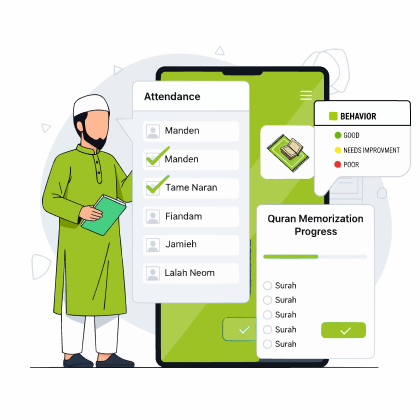
Attendance verification. Did the student actually attend the Zoom class, or were they signed in but not present? How are absences tracked and followed up? Physical attendance is self-evident; online attendance requires active tracking.
Hifdh progression in an online setting. Hifdh requires the teacher to hear the student recite — which online audio transmission can support, but requires structured scheduling (the 15-minute individual slot model used by Ulul Albab is one solution). Tracking which pages have been heard, verified, and approved for each student across multiple simultaneous Hifdh students is the same administrative challenge as physical Hifdh management — but without the natural physical monitoring that comes from students sitting in the same room.
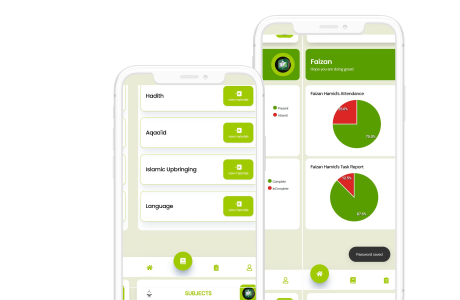
Parent visibility. In a physical maktab, parents who pick up their children can speak to the teacher. In an online setting, the parent may have no visibility into what their child experienced that day. A parent portal — showing what was covered, what the student recited, what homework was set — becomes essential rather than merely convenient.
Multi-device, multi-platform chaos. Online Islamic education programmes often communicate via WhatsApp, conduct classes via Zoom, track progress via Google Sheets, and handle payments via direct bank transfer. For a 150+ student programme, this fragmentation creates genuine administrative burden and information loss.
The solution — a single platform integrating attendance, Hifdh tracking, parent communication, and fee management — is the same whether the programme is physical or online. The difference is that online programmes, lacking the natural social infrastructure of a physical institution, feel the absence of such a platform more acutely.

 at
at