

Introduction
Every mosque madrasah in New Zealand operates within a legal and governance framework — whether its trustees and imams are aware of that framework or not. Understanding the legal structure that governs charitable religious education in New Zealand is not a bureaucratic luxury for small community institutions; it is a practical necessity for protecting students, teachers, and the communities they serve.
The Legal Framework for New Zealand Madrasahs
Charitable Trust Registration
Most serious madrasahs in New Zealand are constituted as charitable trusts or incorporated societies. Two relevant examples from current research:
Madrasahtul Islamiyah NZ Trust (MINT) — Wellington’s Kilbirnie madrasah is registered as a charitable trust with the Charities Services (CC number not publicly published but registration confirmed). Donations to MINT qualify for an IRD tax credit, as explicitly stated on the madrasah’s website. This tax credit — allowing donors to claim back a portion of their donation from Inland Revenue — is a significant financial benefit that is only available to registered charities.
Ulul Albab Islamic Institute — registered as CC59261, a formal charitable trust registration number. Its FIANZ-connected status and formal registration give it credibility and accountability in the eyes of the Muslim community and broader New Zealand public.
Al-Madinah School — as a state-integrated area school, it operates under the Education and Training Act 2020 and the specific requirements of state integration. Its Proprietor is a separately constituted body (the Islamic Trust Board of New Zealand or equivalent), and the School Board operates under the Education and Training Act.
For madrasahs not yet formally registered: New Zealand’s Charities Act 2005 allows organisations with charitable purposes (including advancing religion and education) to register with Charities Services. Registration provides:
- Legal recognition as a charitable entity
- Tax exemption on income
- IRD tax credit eligibility for donations
- Public accountability through annual reporting on the Charities Register
- Director/trustee liability protection relative to unincorporated arrangements
The Charities Register is publicly searchable — any parent, community member, or potential donor can look up a registered madrasah’s trustees, annual reports, and financial statements. This transparency is both a governance discipline and a trust-building mechanism.
Privacy Act 2020
New Zealand’s Privacy Act 2020 (which replaced the 1993 Act) governs how organisations collect, store, use, and disclose personal information. For a madrasah, the personal information it collects includes:
- Student names, dates of birth, and contact details
- Parent/guardian contact information
- Quran recitation levels and progress records
- Attendance records
- Fee payment records
- Medical information (for allergy management, etc.)
- CCTV footage if cameras are installed
The Privacy Act’s 13 Information Privacy Principles govern each stage of this data lifecycle. Key principles for madrasahs:
Collection: Only collect personal information that is necessary for the madrasah’s purposes. Don’t ask for information you don’t need.
Security: Take reasonable steps to protect personal information from loss, unauthorised access, use, modification, or disclosure. Storing student records in an unlocked filing cabinet, on a shared WhatsApp group, or in an unprotected Google Sheet may not meet this standard.
Access and correction: Students (and parents of young students) have the right to access the personal information held about them and to request corrections.
Retention: Don’t keep personal information for longer than necessary. A student who left three years ago — does the madrasah need to retain their complete record indefinitely?
Breach notification: From December 2020, organisations must notify the Privacy Commissioner and affected individuals if a privacy breach occurs that causes (or is likely to cause) serious harm.
The Privacy Commissioner has published specific guidance for small organisations. A 50-student madrasah is a small organisation — but the Privacy Act still applies to it.
Working with Children — Vulnerable Children Act 2014
New Zealand’s Vulnerable Children Act 2014 requires safety checks for people working with children in regulated services. For many madrasahs, the specific requirements depend on whether they meet the definition of a “regulated service” — generally, services where children are in the care of others for defined periods.
A weekend madrasah where parents remain on-site may have lighter obligations than a full-time girls’ Darul Uloom where students are in the institution’s care for extended periods. But all institutions should conduct Police Vetting (through NZ Police) for staff and volunteers who work with children, and should maintain records of those checks.
Darul Hidayah lil Banat, as a residential institution, has the most extensive child safety obligations — taking in-loco-parentis responsibility for boarding students 24 hours a day during term. Police Vetting, clear child protection policies, and formal complaints procedures are not optional for a residential Islamic school.
Governance Structures: What Best Practice Looks Like
The Charitable Trust Model
A well-governed madrasah charitable trust typically has:
A Board of Trustees (3–7 people):
- A chairperson (Amir or President)
- A secretary managing correspondence and minutes
- A treasurer managing finances
- Additional trustees providing community representation
Trustees have legal duties: to act in the best interests of the trust, to avoid conflicts of interest, and to act with reasonable care and diligence. A trustee who is also a family member of the imam, or who has a financial interest in the madrasah’s premises, needs to manage potential conflicts of interest formally.
An Annual General Meeting (AGM):
Where the charitable trust constitution requires it, an AGM provides community accountability — presenting financial statements, reporting on educational activities, and renewing trustee positions.
Separate roles for governance and operations:
The Board governs; the Imam or Principal manages day-to-day educational operations. Conflating these roles — the same person who is the imam, the trustee, the treasurer, and the lead teacher — creates governance risk and is a common source of community disputes in mosque institutions.
Financial Management
For a madrasah receiving donations and collecting fees, appropriate financial management includes:
- A separate bank account in the trust’s name (not the imam’s personal account)
- Dual signatory requirements for expenditure above a threshold (e.g., any payment over $500 requires two trustee signatures)
- Monthly financial statements reviewed by the Board
- Annual accounts prepared by an accountant and filed with Charities Services
- A clear policy on what donations can and cannot be used for
Naar (interest) avoidance: Charitable trusts should keep funds in non-interest-bearing accounts or Islamic finance accounts if possible, consistent with Shari’ah principles.
Cash fee collection: Many madrasahs collect fees in cash. If this is necessary, a formal cash receipting system — sequentially numbered receipts, reconciled to a cash register or spreadsheet — is the minimum standard. Unexplained cash handling in a charitable trust creates legal and reputational risk.
Common Governance Failures and How to Avoid Them
New Zealand’s Islamic education sector has experienced a range of governance challenges. Al-Madinah School’s ERO reports (2020 most recently) documented governance and management concerns — representing the most publicly visible governance challenges in NZ Islamic education. But smaller institutions have their own characteristic governance failure modes:
Single-person control: When the imam or founding director controls all decisions, holds all records, manages all finances, and is the sole contact for parents — the institution’s continuity is entirely dependent on one person. Succession planning is an institutional obligation, not a personal choice.
Board captured by founding family: Boards where all trustees are family members or close allies of the imam cannot provide independent oversight. The best governance involves people willing to ask hard questions on behalf of the community.
No formal admissions policy: Without a written admissions policy, decisions about who to admit or refuse are made informally and are vulnerable to claims of favouritism or discrimination. A formal policy — published, applied consistently, reviewable — protects the institution.
No complaints procedure: When a parent has a grievance about how their child was treated, they need a clear process to raise it. Institutions without a formal complaints procedure often see grievances escalate into community disputes or public accusations.
WWCC/Police Vetting records not maintained: Checks done when a volunteer first starts are only the beginning. Clearances expire (NZ Police Vetting results are typically considered current for three years in regulated services, though institutions should check specific requirements). Someone needs to track when clearances need renewing.
Digital Administration as Governance Tool
Many governance failures are administration failures in disguise. When student records are lost, fees are unaccounted for, or parents cannot get a clear answer about their child’s progress — these are often not failures of intent but failures of system.
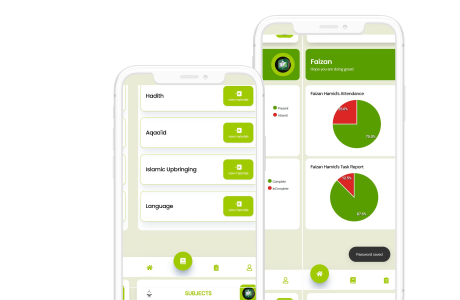
A purpose-built Islamic education management platform provides governance infrastructure:
- Student enrolment records with complete history
- Attendance tracking with auditable records
- Fee ledgers with receipt history
- Teacher records including Police Vetting dates and expiry
- Parent communication logs
- Progression records (Quran, Islamic Studies, Hifdh)
This infrastructure is not merely convenient. It is the evidence base that demonstrates compliance with Privacy Act obligations, demonstrates charitable trust accountability, and demonstrates to the community that the madrasah takes its responsibilities seriously.
For New Zealand’s growing madrasah sector — from Auckland’s state-integrated schools to Wellington’s Tasheel Series maktab to Northland’s online Fardu’l-‘Ayn programme — administrative professionalism is not an aspiration but a requirement of trust.


 at
at