

Introduction
New Zealand’s Islamic educational landscape sits at an unusual intersection: a small but young and growing Muslim community, a high-quality national education system with robust oversight, and an almost complete absence of the national Islamic education infrastructure that larger Muslim-minority communities in Singapore or the UK have built over decades. The result is a patchwork — three full-time Islamic schools in Auckland serving a portion of the community, and a network of mosque madrasahs of highly variable quality and structure serving the rest.
This article maps that landscape fully — the full-time schools, the mosque madrasah network, the maktab tradition, and the administrative reality of running Islamic education in Aotearoa New Zealand.
The Three Full-Time Islamic Schools
New Zealand has three full-time Islamic schools, all located in Auckland. This concentration reflects the geographic reality that approximately 65% of New Zealand’s Muslim population lives in the Auckland region.
Al-Madinah School — Mangere, Auckland (Year 1–13)
Al-Madinah School at 8 Westney Road, Mangere, is New Zealand’s largest and most established full-time Islamic school. It is a state-integrated school with special character — meaning it is funded by the Crown (like all New Zealand state schools) but maintains a distinct Islamic character that defines its curriculum, values, and daily operation.
Al-Madinah School caters for students from Year 1 through Year 13, making it one of only a handful of all-through schools (Year 1 to Year 15 composite school classification) in New Zealand. It serves approximately 550 students currently enrolled, drawn from all parts of Auckland. The majority of enrolled students are of Fijian-Indian heritage, with significant groups from Afghan, Middle Eastern, and African family backgrounds.
The school’s charter vision is for students to achieve all-round development within a dual commitment: to the mission of Islam, and to citizenship of Aotearoa New Zealand. This dual framing — Islamic formation and New Zealand citizenship — is the same fundamental integration challenge that full-time Islamic schools face worldwide, and Al-Madinah has been navigating it for decades.
Curriculum: Students follow the New Zealand Curriculum (NZC) in academic subjects, studied alongside Islamic Studies, Quran, and Arabic Language. From Year 7 onwards, the school maintains separate learning spaces for boys and girls under its Islamic special character provisions. The school has integrated NZC requirements with Islamic special character across all year levels, developing its own local curriculum over time.
Governance challenges: Al-Madinah School has experienced long-standing governance difficulties. The Education Review Office (ERO) has documented that ineffective board governance has been a recurring issue, with Ministry of Education statutory interventions and professional support for trustees not resulting in sustainable, effective governance. The school has been working with MoE to establish an effective and durable board of trustees structure. This governance challenge — common to community-founded Islamic schools worldwide — reflects the difficulty of transitioning from an institution founded by passionate community volunteers to a professionally governed school managing millions of dollars in government funding and serving hundreds of students.
Security: In September 2024, Al-Madinah School went into lockdown alongside Zayed College after receiving an email threat featuring a gun-wielding man randomly shooting. FIANZ described the threat as having brought back memories of the 2019 Christchurch mosque shootings.
Zayed College for Girls — Mangere, Auckland (Year 7–13)
Zayed College for Girls at 44 Westney Road, Mangere (adjacent to Al-Madinah School and the Auckland Airport Mosque complex), is a state-integrated special character Islamic secondary school for girls, catering for Year 7 to Year 13 students. The school’s single-sex provision reflects the Islamic principle of separate male and female education at secondary level, and it serves families who specifically want their daughters educated in an Islamic environment through secondary school.
Zayed College is named after the late Sheikh Zayed bin Sultan Al Nahyan, former ruler of Abu Dhabi and founding president of the UAE, whose patronage of Islamic educational projects globally extended to New Zealand.
Iqra School — New Lynn, Auckland (Year 1–8)
Iqra School at 5-9 Hugh Brown Drive, New Lynn (west Auckland), is a Year 1 to Year 8 school serving the western Auckland Muslim community. A new principal began in July 2024.
Iqra School describes its mission as providing high-quality learning in an Islamic environment, through its own IQRA special character curriculum — an integrated framework comprising Islamic Studies, Quran, and Arabic Language woven through the New Zealand Curriculum. The school explicitly offers formal Quran and Arabic language lessons alongside this integrated approach.
The Education Review Office (ERO) report from November 2024 notes that a large majority of students achieve at expected curriculum levels in mathematics; a small majority achieve expectations in reading and writing. Students demonstrate a strong sense of belonging and describe a positive learning environment that acknowledges their culture, language, and identity.
The Mosque Madrasah Network
For the majority of New Zealand’s Muslim children — those attending state, Catholic, or independent secular schools — Islamic education comes through mosque-based madrasah classes. These classes are the backbone of part-time Islamic education across New Zealand, and they operate in a remarkably diverse array of formats.
The FIANZ Islamic Centres directory lists madrasah facilities at virtually every Islamic centre in New Zealand. A survey of Auckland centre listings shows the range:
Daily madrasahs: Multiple Auckland centres list “Daily Madrasah” — morning or after-school classes held on weekdays, typically lasting 1–2 hours. The Auckland Airport Mosque adjacent to Zayed College lists “All Salat & Madrasah Classes Every Day.” The Avondale Islamic Centre on Blockhouse Bay Road runs a daily madrasah. The Otahuhu Mosque at 34 Portage Road lists daily madrasah. At-Taqwa Mosque in Manukau lists “Madrasah Classes Every Day.”
Sunday schools and weekend classes: Several centres run weekend-only programmes — for children whose school and family schedules make weekday attendance impossible. The Avondale Islamic Centre runs children’s classes on Sunday afternoons. The Al-Huda Sunday School in Dunedin serves the Otago Muslim Association community.
Specialist madrasahs: A number of more formally structured madrasahs operate as distinct institutions attached to mosques:
- Madrasah Uthmaaniyah (Auckland Islamic Trust) — running for over a decade, with approximately 200 students studying various Islamic subjects. The madrasah has four faculties: Hifdh (Quran memorisation) classes, weekday classes, weekend classes (run in two locations), and Stepping Stones for 4–5 year olds. The madrasah follows the Tasheel Series — the South African-developed comprehensive Islamic studies curriculum covering Fiqh from wudhu and salaah through to business and inheritance law. Principal: Moulana Muhammad Ashfaaq Motara. The madrasah achieved Hifdh completions in 2020 and operates a full Hifdh programme alongside the Diniyyat stream.
- Madrasah Miftaahul Uloom Lil Banaat (541 Massey Road, Mangere) — a girls-specific madrasah.
- Umar bin Khattab Learning Academy (UKLA) — attached to Masjid-e-Umar, Mount Roskill Islamic Trust, 185-187 Stoddard Road.
- Nabaoi Institute — a madrasah and Islamic learning provider.
- Saleheen Academy — Lower Hutt Islamic Centre, Taita, serving the Wellington region.
- Al Noor Educational Trust — providing madrasah classes in Papatoetoe.
- Waikato Islamic School of Education (WISE) — 917 Heaphy Terrace, Claudelands, Hamilton, serving the Waikato Muslim community.
Outside Auckland, Islamic education provision is thinner. Wellington has the Saleheen Academy and mosque-attached classes. Christchurch is rebuilding its community infrastructure post-2019. Dunedin, Hamilton, and Palmerston North each have their own small community madrasah provisions.
The Maktab Tradition in New Zealand
A significant portion of New Zealand’s madrasah network — particularly those connected to the South Asian Deobandi tradition — operates on the maktab model brought from South Africa, where the maktab system has been the dominant form of part-time Islamic education for the South African Indian Muslim community for generations.
Madrasah Uthmaaniyah is the clearest example in New Zealand: its use of the Tasheel Series, its structured daily morning sessions, its Hifdh programme alongside Diniyyat education, and its articulation of the maktab’s role in saving Muslim children from growing up without Islamic foundations — all of these elements are recognisably South African Deobandi maktab culture transplanted to Auckland.
The Tasheel Series itself, developed by South African ulama and now implemented in various countries including New Zealand, provides a structured Grade 1–12 equivalent Islamic studies curriculum covering Fiqh, Hadith, Aqeedah, Sirah, and Quran. It is “tried, tested and systematic,” as Madrasah Uthmaaniyah’s own description notes, and it has been one of the most important tools for systematising the teaching of Islam in diasporic Sunni communities worldwide.
For a maktab in New Zealand using the Tasheel Series, students sacrifice morning time before school and evening time after school — the Madrasah Uthmaaniyah description notes students committing approximately 5 hours daily for Hifdh programmes. This is not supplementary. For families committed to this programme, it is the central educational project of childhood.
Administrative Realities: Managing Islamic Education in New Zealand
New Zealand’s Islamic schools and mosque madrasahs face administrative challenges that are simultaneously familiar from the global Islamic education context and sharpened by the New Zealand regulatory environment.
For full-time Islamic schools: State-integrated schools like Al-Madinah and Zayed College are governed by boards of trustees and subject to full Ministry of Education oversight, ERO reviews, NZQA requirements, and all the administrative demands of any New Zealand school. The added complexity of Islamic special character — maintaining Islamic studies records alongside NZC academic records, managing prayer times and Islamic observances within a school day, parent communication across multiple ethnic communities and languages — makes governance and administration significantly more demanding.
The ERO report on Al-Madinah’s governance difficulties makes explicit what Islamic school leaders globally have described: community-founded Islamic institutions often start with passionate volunteers rather than professionally qualified governors, and the transition to institutional maturity requires deliberate effort. The board capacity challenge — needing accountants, lawyers, and education professionals alongside community representatives — is universal across Islamic schools.
For mosque madrasahs: The administrative challenge is the reverse — these institutions often have no formal governance structure at all, running entirely on the personal effort and informal record-keeping of the imam and a small group of volunteer teachers.
Student records (if they exist) are in handwritten notebooks. Quran progression — which Juz a student is memorising, which Iqra level they have reached, how well they are retaining older memorisation — is in the teacher’s head, not in any system accessible to parents or the madrasah’s management. Fee collection is cash in an envelope. Parent communication is a WhatsApp group. When the teacher leaves, the institutional memory goes with them.
For a madrasah serving 200 students like Madrasah Uthmaaniyah, this is genuinely unmanageable without a digital system. For a smaller community madrasah serving 40 or 50 children, it is fragile — a family crisis, a teacher departure, or a natural disaster can destroy years of educational records irreplaceably.
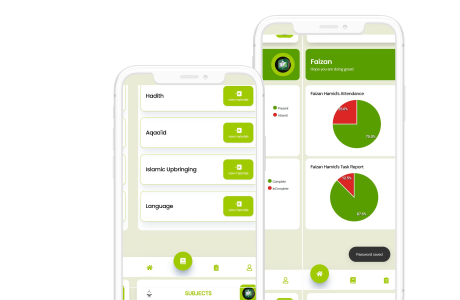
A management platform that maintains digital student records, tracks Quranic progression per student per session, manages fee collection with receipts, and enables individual parent communication — accessible from a smartphone in Auckland or Hamilton — is the infrastructure that New Zealand’s mosque madrasah network needs to match the community’s educational ambitions.


 at
at