
Introduction
New Zealand’s Islamic schools and mosque madrasahs are, in 2026, at a pivotal point in their administrative development. The three full-time Islamic schools (Al-Madinah School, Zayed College for Girls, and Iqra School) operate within New Zealand’s formal school registration and accountability framework — managing NZQA requirements, ERO reviews, Ministry of Education reporting, and the full complexity of a multi-hundred-student school. The mosque madrasah network, serving the majority of Muslim children whose primary schooling is in the state system, ranges from professionally run programmes with 200 students to informal after-school classes of 20 children run by a single teacher with a notebook.
Both ends of this spectrum have technology needs. This article examines what the management software market looks like for New Zealand Islamic educational institutions, what the specific requirements of the New Zealand context demand, and what platform choices are available.
The New Zealand Context: What Makes It Different
New Zealand’s Islamic education technology requirements share common ground with other English-speaking Muslim-minority countries — the UK, Australia, Canada — but have several distinctive features.
Privacy Act 2020 compliance: New Zealand’s Privacy Act 2020, which came into force on 1 December 2020, applies to all organisations that collect personal information, including mosque madrasahs and Islamic schools. The Act’s core requirements include: collecting only information that is necessary; storing it securely; allowing individuals to access and correct their information; and not sharing it without appropriate consent. A madrasah storing student data on WhatsApp or in an unsecured Google Sheet is not compliant with the Act. A purpose-built management system with proper access controls, data encryption, and audit trails meets the Act’s requirements.
New Zealand Curriculum integration (for full-time schools): Al-Madinah School and Iqra School both integrate Islamic education with the New Zealand Curriculum. Their management systems need to handle both streams — academic progress aligned with NZC levels and Islamic education progress (Quran stage, Islamic Studies grade) — in a single view per student. Generic New Zealand school management systems (Kamar, Edge, Hero) handle the NZC academic side well but have no Islamic education functionality. An Islamic-specific platform handles the Islamic side well but may need to be used alongside a generic NZ school system for NZC reporting.
English-first interface: New Zealand’s Islamic community operates in English. Unlike Malaysia (Bahasa Malaysia-first) or Indonesia (Bahasa Indonesia-first), New Zealand madrasahs teach in English, communicate with families in English, and need software with a fully functional English interface. Arabic names, Arabic subject names (Quran, Hifdh, Iqra), and Arabic progression terminology (Sabak, Dhor) need to be handleable within an English-language system.
Small institution scale: The majority of New Zealand mosque madrasahs are small — 30 to 150 students. They cannot afford enterprise-scale school management systems. They need affordable, simple, mobile-first tools that work on the smartphones their volunteer teachers actually carry.
Ethnic diversity of families: Parent communication in a multi-ethnic New Zealand madrasah may need to reach families whose primary languages include Urdu, Arabic, Somali, Hindi, Gujarati, and English. At minimum, the platform’s parent-facing interface needs to be in clear, simple English that is accessible to families for whom English is a second language.
What the Software Must Do: The Non-Negotiables
Based on the specific requirements of New Zealand Islamic education, a management platform must provide:
1. Student Registration and Records
A complete digital student register — name, date of birth, wali details, contact information, current Quran level at enrolment, special needs notes — stored institutionally (not on the teacher’s personal device) and accessible only to authorised users.
2. Quran Progression Tracking
Per-student, per-session Quran progression records. For Iqra students: which volume and lesson. For Nazirah students: which Surah or Juz, with Tajweed quality notes. For Hifdh students: three-stream tracking (Sabak, recent revision, old revision) with quality assessment for each stream per session. This is the educational core of the madrasah and the most important thing the system must do well.
3. Attendance
Session-by-session attendance records, with automated individual parent notification when a student is absent. Not a group message. An individual, automated message to the right parent, in the same session the absence occurred.
4. Fee Management with Receipts
Individual student fee accounts, tracking what is owed and what has been paid. Digital receipt generation for every payment (cash or electronic). Monthly summary report for the treasurer. Arrears flagging for regular follow-up. No public disclosure of individual family fee status.
5. Individual Parent Portal
Each family has private, individual digital access to their child’s Quran progression, attendance, and fee status. They can see their child’s current Iqra level or Hifdh status without seeing any other family’s records. This is the standard New Zealand parents expect.
6. Mobile-First Design
The system must work on a smartphone — because that is what the teacher has, that is what the parent has, and that is what the madrasah administrator uses. A platform that requires a desktop computer is not usable in the New Zealand mosque madrasah context.
7. Privacy Act Compliance
Proper access controls, secure data storage, and audit trails that demonstrate the organisation is handling personal data in accordance with the Privacy Act 2020.
Platform Comparison: What Is Available
Generic New Zealand school management systems (Kamar, Edge, Hero):
These platforms serve New Zealand state and independent schools well for NZC academic management, attendance, and parent communication. They have no Islamic education functionality — no Quran progression tracking, no Hifdh management, no understanding of the maktab model. For full-time Islamic schools like Al-Madinah that need robust NZC tracking, these may be part of a two-system approach. For mosque madrasahs, they are entirely unsuitable and significantly over-engineered for the scale and budget of most New Zealand Islamic centres.
Generic church/Sunday school management software:
Some Australian and New Zealand churches use purpose-built Sunday school management tools. These handle basic student registration and attendance well but are built for a Christian educational context — they have no concept of Quran progression, Arabic subjects, or the specific Islamic educational model.
WhatsApp + Google Sheets combination:
The default approach at most New Zealand mosque madrasahs. Free, familiar, immediately available. Inadequate for institutional record-keeping — Privacy Act concerns with personal data on WhatsApp; Google Sheets provides no Islamic progression model, no parent portals, no automated notifications, no receipts.
UK Islamic education platforms (IBEams):
IBEams is a UK-developed Islamic school management platform designed specifically for the British maktab/madrasah context. It handles student management, attendance, and fee management with the Islamic education model in mind, with testimonials from UK madrasahs managing 400+ students. For New Zealand madrasahs with close ties to the UK Islamic education community, IBEams is a genuinely Islamic-context tool — though its fee management is calibrated to British banking rather than NZ payment methods, and its interface language is British English.
Ilmify:
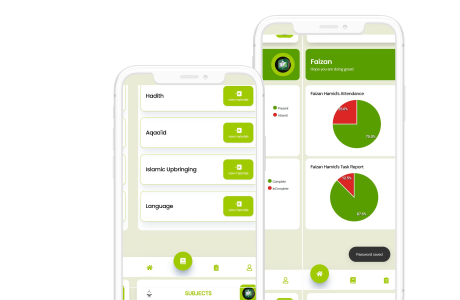
Ilmify provides the full set of capabilities required for the New Zealand mosque madrasah context: student registration, three-stream Hifdh progression tracking (Sabak/recent revision/old revision per student per session), Iqra level tracking, individual parent portal with private digital access, automated absence notification, fee management with digital receipts (compatible with NZ payment methods), and a mobile-first interface that works on a smartphone. Its English-first interface suits the New Zealand context, while its Arabic terminology support handles the Islamic education dimension. For Hifdh programmes like the one at Madrasah Uthmaaniyah, the three-stream tracking model is specifically valuable — providing the systematic record that allows a Hifdh teacher to manage 15-20 students’ memorisation across all three streams simultaneously.
Implementation: Getting Started
For a New Zealand mosque madrasah transitioning to digital management, the practical implementation path is:
Week 1–2: Student data entry. Enter all currently enrolled students into the system, recording their current Quran level, family contact details, and any relevant notes. This is the foundational step — the institutional record that replaces the notebooks.
Week 3: Teacher and administrator setup. Set up teacher accounts with appropriate access. Brief teachers on how to record attendance and update Quran progression after each session — this should take no more than 30 minutes per session.
Week 4: Parent portal activation. Send each family their individual login credentials. A brief WhatsApp message explaining the portal and its purpose is all that is needed. Most parents will explore independently once they know it exists.
Ongoing: Fee management integration. As the new term begins, manage all fee collection through the system. Issue digital receipts for all payments. Review the fee summary monthly with the treasurer.
The transition from notebooks to digital should be treated as a two to three week project with a dedicated person driving it. It will feel uncomfortable at first. Within a term, it will feel indispensable.

 at
at