
Introduction
The Australian and New Zealand Islamic education sector is one of the most institutionally diverse in the English-speaking world. Full-time state-integrated Islamic schools (Al-Madinah Auckland, Al-Hidayah Perth), mosque maktabs serving 200+ students (Madrasah Uthmaaniyah Auckland, Iqra Academy Slacks Creek), residential girls’ Darul Uloom institutions (Darul Hidayah Epsom), six-year Alimah programmes (Madrasa Fatima Azzahra Fawkner), rural online madrasahs (Ulul Albab Northland), and single-imam Saturday schools (Darul Uloom Brisbane, ISOD Darwin) all have genuine management needs.
The question is not whether Islamic education institutions in Australia and New Zealand need management software. They do — the administrative burdens documented throughout this series make that clear. The question is what software actually meets their needs, given the specific regulatory context, curriculum traditions, and operational realities of this region.
What Australian and New Zealand Islamic Institutions Currently Use
Research across documented institutions reveals a spectrum of current practice:
Professional school management platforms: Al-Madinah School (Auckland) uses Edge (Helix SMS) — a school management system designed for New Zealand schools, with student and caregiver portals. Al-Hidayah Islamic School (Bentley, Perth) uses Compass — one of Australia’s major school management platforms.
These systems are well-suited to full-time Islamic schools operating within the NZ/Australian school regulatory environment. They handle timetabling, reporting, parent communication, fee management, and NCEA/NAPLAN preparation. They do not, however, handle Islamic-specific functions: Quran progression, Tasheel grade tracking, Hifdh stream management, or prayer attendance records.
Generic digital tools: Umar bin Khattab Learning Academy (UKLA, Auckland) uses Airtable for its enrolment form — a general-purpose database tool rather than a purpose-built management system. Ulul Albab uses Google Classroom for its online madrasah delivery.
WhatsApp and notebooks: The majority of smaller maktabs — Darul Uloom Brisbane, ISOD Darwin, Ar-Rukun Rockingham, Madrasahtul Islamiyah Wellington, NPICC Noble Park — communicate primarily through WhatsApp and manage student records in paper-based or informal systems.
The Two-Platform Reality for Full-Time Islamic Schools
Full-time Islamic schools in Australia and New Zealand face a fundamental two-platform challenge:
Platform 1 — State school management system (Compass, Edge, TASS, Synergetic, KAMAR): Required for compliance with NZ/Australian school regulatory requirements. Handles timetabling, attendance (NAPLAN/NCEA-relevant), parent communication, and financial reporting. Built for secular school contexts.
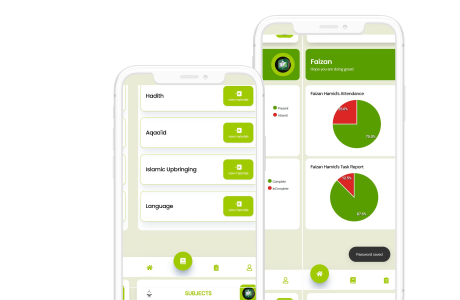
Platform 2 — Islamic education management system: Required for the school’s Islamic character. Handles Quran progression (Nazirah stages, Hifdh), Islamic Studies curriculum tracking (whether the school uses its own curriculum or a structured framework), prayer attendance monitoring, Tarbiyah records, and parent reporting on Islamic dimensions of student development.
Al-Madinah School maintains both the Edge school management system and (presumably) some form of internal Islamic education tracking. Al-Hidayah Perth uses Compass for parent portal and school management alongside whatever internal systems its Islamic Studies and Quran departments use.
The gap is real and it is not being met by any current mainstream provider. The Islamic education management system that integrates with (or complements) Compass or Edge for Islamic studies tracking does not exist as a commercial product in Australia or New Zealand — it needs to be built or adapted from Islamic education platforms developed for other markets.
What Mosque Maktabs Need (That Mainstream School Software Does Not Provide)
For the majority of Australian and New Zealand Islamic education institutions — the mosque maktabs, weekend schools, and community madrasahs — mainstream school management platforms are simply not appropriate. They are too complex, too expensive, and built for full-time school environments with stable class sizes, state curriculum frameworks, and trained administrative staff.
What a mosque maktab actually needs:
Student enrolment and records:
- Basic demographic data (name, date of birth, parent contact)
- Enrolment date and class assignment
- Medical/allergy information relevant to the teaching environment
- WWCC/Police Vetting check dates for teachers associated with the student
Quran progression tracking:
- Current stage (Qaidah, Tajweed, Nazirah, Hifdh)
- Specific position within each stage (which page, which surah)
- Session-by-session progress notes
- Strength assessment per portion memorised
Hifdh management (the three streams):
- Sabak (new memorisation): daily position, quality rating
- Sabaq Para (recent revision): pages covered, flags for weak portions
- Dhor (long-term revision): scheduled Juz rotation, coverage confirmation
- Parent-facing summary report
Islamic Studies tracking:
- Current Tasheel (or An-Nasihah, Safar, or other curriculum) grade per subject
- Annual assessment results
- Progression decisions
Attendance:
- Per-student, per-session attendance record
- Absence follow-up workflow
- Term attendance summary for parents
Fee management:
- Term fees, one-off payments, donation tracking
- Receipts (critical for charitable trust ACNC/Charities Services reporting)
- Student sponsorship tracking (where community members sponsor a student’s fees)
Teacher and volunteer management:
- Teacher profiles with WWCC/Police Vetting details and expiry dates
- Teaching assignments per class
- Automated WWCC expiry alerts
Parent communication:
- Individual student progress reports
- Term announcements and calendar updates
- Bulk messaging (replacing ad hoc WhatsApp groups)
Compliance support:
- Privacy policy acknowledgement at enrolment
- Data retention configuration (how long to keep records after a student leaves)
- Export functionality for Charities Services/ACNC annual reporting
Australian and New Zealand-Specific Requirements
Generic Islamic education management platforms built for UK, South African, or North American markets need adaptation for Australian and New Zealand use:
WWCC state variation: Each Australian state has a different WWCC system (Blue Card, WWCC card, Ochre Card, etc.). A management platform for Australian use needs to handle the different state systems — at minimum allowing the administrator to record which state’s check a teacher holds and when it expires.
Privacy Act 1988 (Australia) and Privacy Act 2020 (NZ): Both require reasonable security measures for personal information. A cloud-based management platform storing student data needs to use Australian or New Zealand data hosting (or at minimum, provide a data processing agreement that covers trans-national data transfers compliantly). The Privacy Act review in Australia may increase compliance requirements for small organisations including maktabs.
ACNC charity reporting (Australia) and Charities Services reporting (NZ): The financial records in a management platform need to produce the data required for annual reporting to the relevant regulator. Fee income, donation records, and expenditure summaries should be exportable in a format that supports the annual information statement.
Child Safe Standards (Victoria): Victorian maktabs must comply with the Commission for Children and Young People’s Child Safe Standards. A management platform that helps institutions maintain the required records (Police Vetting dates, child safety policy acknowledgements, incident records) directly supports this compliance obligation.
AUD and NZD fee management: Fee amounts and payment processing need to handle Australian and New Zealand dollar amounts, GST considerations (most charitable educational services are GST-exempt), and local payment methods. Australian users commonly use BPay, direct debit, and Stripe-based payment links; New Zealand users use internet banking and POLi. An international platform defaulting to GBP or USD is not usable.
School term calendar integration: Australian school terms vary by state. New Zealand has four terms. The management platform needs to support the correct term calendar for the institution’s jurisdiction, including Ramadan period handling.
Timezone management: Australia has eight time zones (including daylight saving variations in some states). New Zealand operates in NZST/NZDT. A platform managing student sessions and parent communications needs to handle timezone correctly.
What to Look For When Evaluating Islamic Education Management Software
For an Australian or New Zealand maktab or Islamic school evaluating management software in 2026, the evaluation criteria should include:
Islamic education-specific functionality:
- Quran progression tracking (Qaidah → Tajweed → Nazirah → Hifdh)
- Three-stream Hifdh management (Sabak, Sabaq Para, Dhor)
- Islamic Studies curriculum tracking (flexible enough to support Tasheel, An-Nasihah, or own curriculum)
- Prayer attendance monitoring (optional but valuable for full-time schools)
- Tarbiyah and character development tracking
Operational functionality:
- Student enrolment and records management
- Teacher and volunteer management including WWCC tracking
- Session attendance recording
- Fee collection and receipt generation
- Parent communication portal (individual progress reports, bulk announcements)
- Mobile-accessible (for parents checking from phones)
Regional compliance:
- Australian/New Zealand data hosting or GDPR/Privacy Act-compliant data processing agreement
- Support for multiple WWCC state systems
- Charitable trust financial reporting output
- AUD/NZD fee handling with local payment methods
Operational fit:
- Can be managed by a non-technical volunteer administrator
- Pricing appropriate for a charity with 50–200 students
- Onboarding and support available in Australian/New Zealand time zones
- Trial period or demo available before commitment
Integration:
- Can complement (not replace) Compass or Edge for full-time schools using both systems
- Import/export compatibility with common formats (CSV, Excel) for data migration
The Opportunity for an Islamic Education Management Platform in This Region
Australia’s Muslim community of 813,000 and New Zealand’s 75,000 Muslims are served by:
- Approximately 40+ ISAA member schools in Australia
- 2 state-integrated Islamic schools in New Zealand
- Hundreds of mosque maktabs and weekend Islamic schools across both countries
The full-time school sector has functional (if imperfect) solutions in Compass, Edge, and equivalent systems. The maktab sector — the hundreds of community Islamic education programmes serving tens of thousands of children — has almost nothing appropriate to its needs.
A platform that handles the specific requirements of the maktab sector, built with Australian and New Zealand compliance requirements in mind, priced appropriately for charitable community institutions, and supported in local time zones, would serve a significant unmet need in the Australasian Islamic education sector.
That platform does not yet dominate the market. The institutions that move early — supporting the build of such a platform, adopting it in its early stages, and contributing to its development — will be at the frontier of Islamic education management in this region.

 at
at