

Introduction
Running a mosque madrasah in New Zealand in 2026 means navigating a unique combination of responsibilities: maintaining the Islamic educational tradition faithfully, managing a volunteer-dependent community institution, communicating effectively with families who speak many different languages and have many different expectations, and doing all of this without the national framework support that Islamic educational administrators in Singapore, Malaysia, or South Africa can draw on.
This guide is written for the imam, the madrasah principal, the mosque committee member, and the volunteer administrator who is actually doing this work — for the person who stays after Taraweeh to update the attendance register, who sends out fee reminders from their personal phone, who keeps the Quran progression records in a folder in the office. It acknowledges the reality of how most New Zealand madrasahs operate, and it offers a pathway toward the institutional maturity that serves students, families, and the broader Muslim community better.
Understanding Your Administrative Obligations
Unlike Singapore’s mosque madrasahs, which operate within a MUIS-mandated framework with defined curriculum requirements, teacher recognition standards, and financial reporting obligations, New Zealand mosque madrasahs have relatively light formal regulatory requirements. You are not reporting to a government Islamic authority. There is no SIMPENI equivalent requiring your student data. There is no ARS equivalent requiring your teachers to be certified.
What this means in practice is that New Zealand mosque madrasahs have significant freedom — and significant vulnerability. Freedom to structure your programme according to your community’s needs and your tradition. Freedom to develop your own curriculum, hire teachers you trust, and set fees at whatever level your community can sustain. Vulnerability because that same freedom means there is nothing external requiring you to maintain proper records, ensure teacher quality, or communicate effectively with families.
The obligations you do have are the obligations you choose to hold yourself accountable to: the Islamic obligation of amanah (trustworthiness) in managing what the community has entrusted to you; the ethical obligation to the children in your care to provide them with quality Islamic education delivered safely and consistently; and the practical obligations that come with managing money, personal data, and the expectations of Muslim families who are counting on you.
New Zealand Privacy Act 2020: Even without sector-specific Islamic education regulation, New Zealand’s Privacy Act 2020 applies to any organisation that collects personal information — including mosque madrasahs. Student names, contact details, and learning records are personal information. Storing them on WhatsApp or in unsecured notebooks creates Privacy Act compliance exposure. Storing them in a properly secured digital system with access controls meets the Act’s requirements.
Student Registration: Building Your Institutional Foundation
Every madrasah should maintain a formal student register — a document that exists as an institutional record, not in the teacher’s personal notebook or phone.
For each enrolled student, your register should contain:
- Full name and date of birth
- Wali (parent/guardian) name(s) and relationship
- Primary contact phone number and email address
- Current Quran/Iqra level at time of enrolment
- Any relevant special needs or medical information
- Emergency contact details separate from primary contact
This register should be stored institutionally — on a school computer, in a digital management system, or at minimum in a secure folder in the mosque office — not exclusively on the teacher’s personal device.
Why this matters: When a teacher leaves — for any reason, planned or unplanned — the institutional record must survive intact. In a small madrasah, the departure of the main teacher without proper records handover can set students back by months as the incoming teacher reconstructs what every child knows from scratch.
Quran Progression Tracking: The Core Educational Record
The single most important educational record in any New Zealand mosque madrasah is the Quran progression record — a per-student account of where each child is in their journey with the Quran.
For children in the Iqra/Qaida phase (learning to read Arabic):
- Which volume (Iqra 1–6 or Noorani Qaida equivalent) they are currently on
- Which specific lesson within that volume
- When they started and when they are expected to complete each volume
- Quality notes — are they progressing at an appropriate pace, or struggling with particular sounds?
For children in the Nazirah phase (reading from the Quran):
- Which Surah or Juz they are currently reading
- The quality of their Tajweed — specific errors they are working to correct
- Their reading pace relative to expected progress
For children in a Hifdh (memorisation) programme like the one at Madrasah Uthmaaniyah:
- Current Sabak (the new passage being memorised today)
- Recent revision (Sabaq Para) — how well are the recently memorised passages holding up?
- Old revision (Dhor) — which Juz from earlier in the Hifdh is currently under review, and is it being retained?
The three-stream Hifdh tracking model is not a bureaucratic nicety. It is the functional necessity that allows a Hifdh teacher with 15–20 students to know, at the start of each session, the exact state of each student’s memorisation across all three streams simultaneously. Without this record, the teacher is essentially starting blind each day, relying entirely on memory — a system that works for excellent teachers but fails catastrophically when a teacher is absent or departs.
This Quran progression record should be updated after every session. It should be available to parents on request. And it should be stored institutionally, not in the teacher’s personal register.
Attendance Management: The Safety and Learning Record
Attendance records serve two purposes in a mosque madrasah: they are the safety record (confirming that the children who arrived were accounted for) and the learning record (identifying students who are falling behind through chronic absence before the problem becomes irreversible).
A student who misses two sessions of Hifdh per week will fall significantly behind their peers over a term. A student who misses classes regularly at the Iqra stage will not progress through the volumes on schedule. Attendance records, reviewed weekly, allow the madrasah principal to identify these students early and contact their families before the situation deteriorates.
Practical approach for most New Zealand madrasahs:
Every session should have a written attendance record. If the class is small enough for the teacher to call the register verbally and mark it on a sheet, this is adequate. The critical step is that the record is then stored, and that a designated person (the madrasah principal or mosque secretary) reviews it regularly.
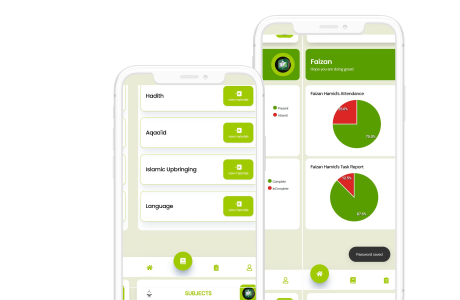
For madrasahs with digital management capability: attendance taken on a smartphone or tablet at the start of each session, with automatic notification sent to parents whose child was absent. This is the standard that New Zealand parents — who are used to the digital communication standards of state schools — increasingly expect from any educational institution their child attends.
Fee Management: Building Trust Through Transparency
Most New Zealand mosque madrasahs charge fees — typically modest, to cover teacher costs and materials — and the way these fees are collected and managed has a direct impact on community trust.
Common problems in poorly managed fee administration:
- Fees collected in cash without receipts, creating disputes when payment is denied
- No system for tracking who has paid and who is in arrears, leading to inconsistent follow-up
- End-of-year financial position is unclear because no proper records were maintained
- Teacher remuneration is delayed because cash flow is poorly tracked
Minimum standards for fee management:
- Issue a receipt for every payment, even cash. A handwritten receipt book is better than nothing; a digital receipt is better still.
- Maintain a simple ledger showing what each family owes, what they have paid, and what remains outstanding.
- Review the ledger monthly. Families in arrears should be contacted individually and privately — not called out in a WhatsApp group or in front of other families.
- The mosque treasurer (or whoever holds the madrasah finance responsibility) should receive a monthly summary and approve any fee waivers or financial assistance.
Parent Communication: Beyond the WhatsApp Group
WhatsApp groups are the default communication channel for New Zealand mosque madrasahs, and they serve genuine purposes: sharing general announcements, notifying about class cancellations, distributing event information. They are not, however, a substitute for proper individual parent communication.
What families actually need from their child’s madrasah:
- Individual progress reports — not just “they are doing well” in a group message, but a specific update on their child’s Quran level, their attendance, and any areas of concern
- Private communication about sensitive matters — a child struggling with behaviour, a family behind on fees, a concern about a student’s welfare — none of which belongs in a group chat
- Prompt individual notification when their child is absent unexpectedly
The standard for parent communication in 2026 should be: each family receives individual, digital communication about their child’s progress at least once per term, and receives individual notification for absences. This is what New Zealand state school parents expect, and there is no reason a mosque madrasah should hold itself to a lower standard.
Digital Management for New Zealand Madrasahs
All of the administrative functions described above — student registration, Quran progression tracking, attendance records, fee management, and individual parent communication — can be managed in a single purpose-built Islamic education management platform.
Ilmify is designed specifically for the Islamic educational context. It provides Quranic progression tracking built for the maktab/madrasah model (not adapted from a generic grade tracking system), including three-stream Hifdh tracking for Hifdh programmes. It handles attendance with automatic parent notification. It manages fee collection with digital receipts. It provides each family with an individual parent portal — private access to their child’s records, progress, and fees, without seeing any other family’s information. And it works on a smartphone, which is the device most New Zealand madrasah teachers and administrators actually have available.
For a New Zealand mosque madrasah, the transition to digital management does not require a technology specialist or a large budget. It requires a principal who decides that the community’s children deserve properly maintained educational records — and who takes the two to three weeks required to set up the system and transition from notebooks to digital.


 at
at