

Introduction
Understanding Islamic education in New Zealand requires understanding the bodies that give it direction, the scholars who staff it, and the governance framework — or absence of one — within which it operates. Unlike Singapore’s MUIS-directed system or Malaysia’s JAKIM-regulated framework, New Zealand’s Islamic educational provision emerges from a decentralised, community-driven environment where the quality and consistency of Islamic education varies enormously from centre to centre, city to city, and tradition to tradition.
This article examines the key institutions shaping that environment: FIANZ as the apex national body, the role of imams and ulama in the New Zealand context, the traditions that have shaped the maktab and madrasah landscape, and what effective Islamic educational governance might look like in Aotearoa New Zealand in 2026.
FIANZ: The Apex Body and Its Education Role
The Federation of Islamic Associations of New Zealand (FIANZ) was established in April 1979, bringing together Auckland, Wellington, and Canterbury Muslim associations under a national umbrella. Today FIANZ is affiliated with seven regional associations and functions as New Zealand’s primary representative body for the Muslim community in its relations with government, other faith communities, and international Islamic organisations including the World Muslim League and the Islamic Development Bank.
FIANZ’s formal educational role is limited compared to more directive bodies like Singapore’s MUIS. There is no FIANZ-mandated national Islamic education curriculum equivalent to the aLIVE programme, no FIANZ teacher recognition scheme equivalent to Singapore’s ARS, and no FIANZ data system equivalent to Malaysia’s SIMPENI. Instead, FIANZ’s role in education is more foundational: maintaining and publishing the directory of Islamic centres (which includes information about madrasah services at each centre), facilitating community connections, and representing Muslim educational interests in government consultation processes.
This lighter-touch approach reflects both the small scale of the New Zealand Muslim community and its extraordinary ethnic diversity. A national curriculum mandate that worked for Auckland’s South Asian Fijian Muslim families might be poorly suited to Wellington’s Somali and Bosnian families. FIANZ holds the community together without mandating uniformity — which preserves community diversity but creates the educational variability that is the most significant structural challenge in New Zealand Islamic education.
FIANZ’s education-relevant activities:
The FIANZ Islamic Centres directory — accessible through the FIANZ website — is the primary tool most New Zealand Muslim families use to find Islamic education for their children. Every affiliated mosque and Islamic centre can list its services, including madrasah class times, contact details, and programme descriptions. The directory effectively maps the entire mosque madrasah network across New Zealand.
FIANZ also engages directly with government on matters affecting Muslim educational institutions. Following the September 2024 threat against Al-Madinah School and Zayed College, FIANZ spokesperson Abdur Razzak directly addressed the government’s security policies, arguing that reduced national security funding had created conditions in which the Muslim community was more vulnerable. This advocacy role — ensuring that the security, welfare, and educational interests of Muslim children are represented in government policy — is a core FIANZ function.
The Imams and Ulama of New Zealand
New Zealand’s imams serve a community that is simultaneously ethnically diverse, geographically dispersed, and served by a relatively small number of qualified Islamic scholars. The imams leading New Zealand mosques come from a broad range of backgrounds — South Asia, the Middle East, Southeast Asia, East Africa — and typically received their Islamic education in their countries of origin before migrating to New Zealand.
The challenge this creates for Islamic education is significant: there is no New Zealand-based institution training imams for the New Zealand context. Unlike the UK, which has Darul Ulooms and Islamic universities producing graduates versed in both classical Islamic scholarship and the British Muslim experience, New Zealand has no equivalent. The Christchurch mosque shooting has made the need for contextually trained, New Zealand-rooted Islamic leadership — scholars who can speak to the New Zealand experience, engage with Maori and Pacific Islander dimensions of New Zealand identity, and navigate the specific challenges of being Muslim in Aotearoa — more urgent than ever.
The July 2025 controversy illustrated the complexity of this landscape. When FIANZ signed its Peace and Harmony Accord with Jewish organisations, eighteen imams and ulama in New Zealand signed a statement criticising the accord as having been negotiated without adequate consultation with the ulama community. This was not a dispute about interfaith relations per se — it was a governance dispute about who has the authority to make significant public commitments on behalf of the Muslim community. The ulama’s position was that scholarly consultation was required before such an accord could be signed. The debate reflects a real tension in how Islamic leadership authority operates in diaspora Muslim communities: between representative associations like FIANZ and the scholarly tradition represented by imams and ulama.
Islamic Educational Traditions in New Zealand
New Zealand’s mosque madrasah landscape is shaped by three dominant Islamic educational traditions, each with its own curriculum approach and institutional culture:
The South African Deobandi Maktab Tradition
The most structured and systematic tradition present in New Zealand’s madrasah network comes not from South Asia directly but from South Africa, where the Indian Muslim community developed a comprehensive maktab system over more than a century. The Tasheel Series — a structured Grade 1–12 Islamic studies curriculum developed by South African ulama — is used explicitly at Madrasah Uthmaaniyah in Auckland and likely at a number of other South African-origin community centres.
This tradition emphasises: daily morning and evening class attendance; structured progression through Quran reading and Hifdh; systematic Diniyyat education covering Fiqh, Hadith, Aqeedah, and Sirah; the role of the maktab as a community institution in its own right; and the production of Huffaz as a community aspiration. The Madrasah Uthmaaniyah website explicitly articulates the maktab’s civilisational importance — arguing that it is the maktab system that has preserved Muslim identity even among communities far from Islamic heartlands.
Moulana Muhammad Ashfaaq Motara, principal of Madrasah Uthmaaniyah, represents this tradition in Auckland. His community’s description of the maktab uses language that is recognisably continuous with the South African Jamiatul Ulama tradition.
The South Asian Tradition
Many of New Zealand’s mosques are primarily attended by families of South Asian origin — from Pakistan, Bangladesh, India, and the Fijian-Indian diaspora — and the Islamic education provided at these centres often reflects South Asian traditions of Quranic learning: the Qaida/Noorani Qaida method for Arabic literacy, Nazirah (Quran reading), and Hifz for the gifted and committed student. This tradition is less formally structured in its Diniyyat education than the South African Deobandi curriculum but shares the same emphasis on Quran mastery as the foundation of Islamic formation.
The New Approach: IQRA Special Character Curriculum
Iqra School’s development of its own “IQRA special character curriculum” — weaving Islamic Studies, Quran, and Arabic Language through the New Zealand Curriculum framework — represents a genuinely New Zealand approach to full-time Islamic education. This approach takes the national curriculum as its starting point and integrates Islamic content rather than treating them as parallel streams. The result, when well executed, produces students who are simultaneously grounded in the New Zealand Curriculum and in Islamic knowledge — but it requires substantial curriculum development expertise and ongoing renewal.
What Better Islamic Educational Governance Would Look Like in New Zealand
The New Zealand Islamic education community does not need to reinvent the wheel. Singapore’s experience with MUIS, the UK’s experience with Darul Uloom networks and Wifaq ul Ulama, and South Africa’s Jamiatul Ulama framework all offer models from which lessons can be drawn.
The most pressing priorities for New Zealand Islamic education in 2026 are:
A shared Quran progression framework: Every mosque madrasah should be tracking student Quranic progression systematically — recording which Iqra level or Quran page each student has reached, updating this after each session, and making it visible to parents. A shared framework would allow families to move between centres without losing their educational record.
Teacher minimum standards: New Zealand has no equivalent of Singapore’s ARS or the UK’s implicit expectation that madrasah teachers hold recognisable Islamic qualifications. Establishing minimum teaching standards — not as bureaucratic gatekeeping but as community quality assurance — would lift the floor across the network.
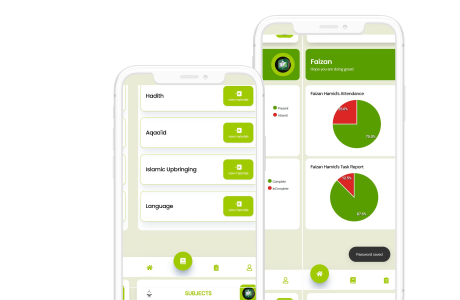
Digital administration: The mosque madrasahs that run on handwritten notebooks and WhatsApp groups are not just inefficient — they are fragile. When the imam or lead teacher leaves, the community’s educational records can disappear. Digital management that maintains institutional records, tracks Quranic progression, handles fee administration, and enables individual parent communication is not a luxury in 2026. It is the minimum infrastructure for a functioning educational institution.
FIANZ education coordination: FIANZ is well placed to develop a lightweight national coordination function — not a bureaucratic mandate, but a shared resource library, best practice guidance, and annual gathering of madrasah principals to share experience and build community of practice.


 at
at